
The SUAR team explored the thoughts of decision-makers or leaders in companies and economic observers regarding the implementation of the MBG program through the Business World Universe Survey.
Highlight:
- The majority of respondents (74.3%) agreed that the MBG program has not worked as expected.
- The main reasons are poor food quality (46.2%) and many children not receiving benefits (23.1%), especially those in remote areas.
- A small number of respondents stated that the MBG program has been running well because of the increasing number of beneficiaries (50%).
- Respondents understood that the objectives of the MBG program were to improve the nutritional condition of Indonesian children (37.1%) and to ease the burden on families in serving nutritious food (25.7%).
- However, the implementation, which costs a lot of money, has not been considered successful in four ways. Namely, developing UMKM, empowering local food, mobilizing cooperatives, and easing the burden on families.
- To be sustainable, the MBG program must be closely monitored in terms of food supply, food processing, and distribution. Evaluation of activities also needs to be carried out periodically and thoroughly to fix gaps that are still lacking. 60% of respondents emphasized this supervision and evaluation.
- The private sector can play a role in assisting the implementation of the MBG program by partnering with the government in serving food (SPPG) or supplying food ingredients. Only a few respondents (8.6%) suggested that the private sector take part in financing.
The Free Nutritious Meal Program (MBG) is one of the priority agendas of President Prabowo Subianto's administration. The government wants to improve the nutritional status of students, pregnant women, nursing mothers, and children under five through the provision of nutritious food according to the daily nutritional adequacy rate (AKG). The price per serving of MBG with adequate nutrition is set at IDR 10,000.
A budget of Rp 71 trillion was prepared for the implementation of the MBG program in 2025. Because the target beneficiaries and implementation staff will continue to be added, the budget for 2026 jumps to IDR 335 trillion. Until the end of September, Head of the National Nutrition Agency (BGN) Dadan Hindayana said the number of MBG beneficiaries had reached 31 million children.
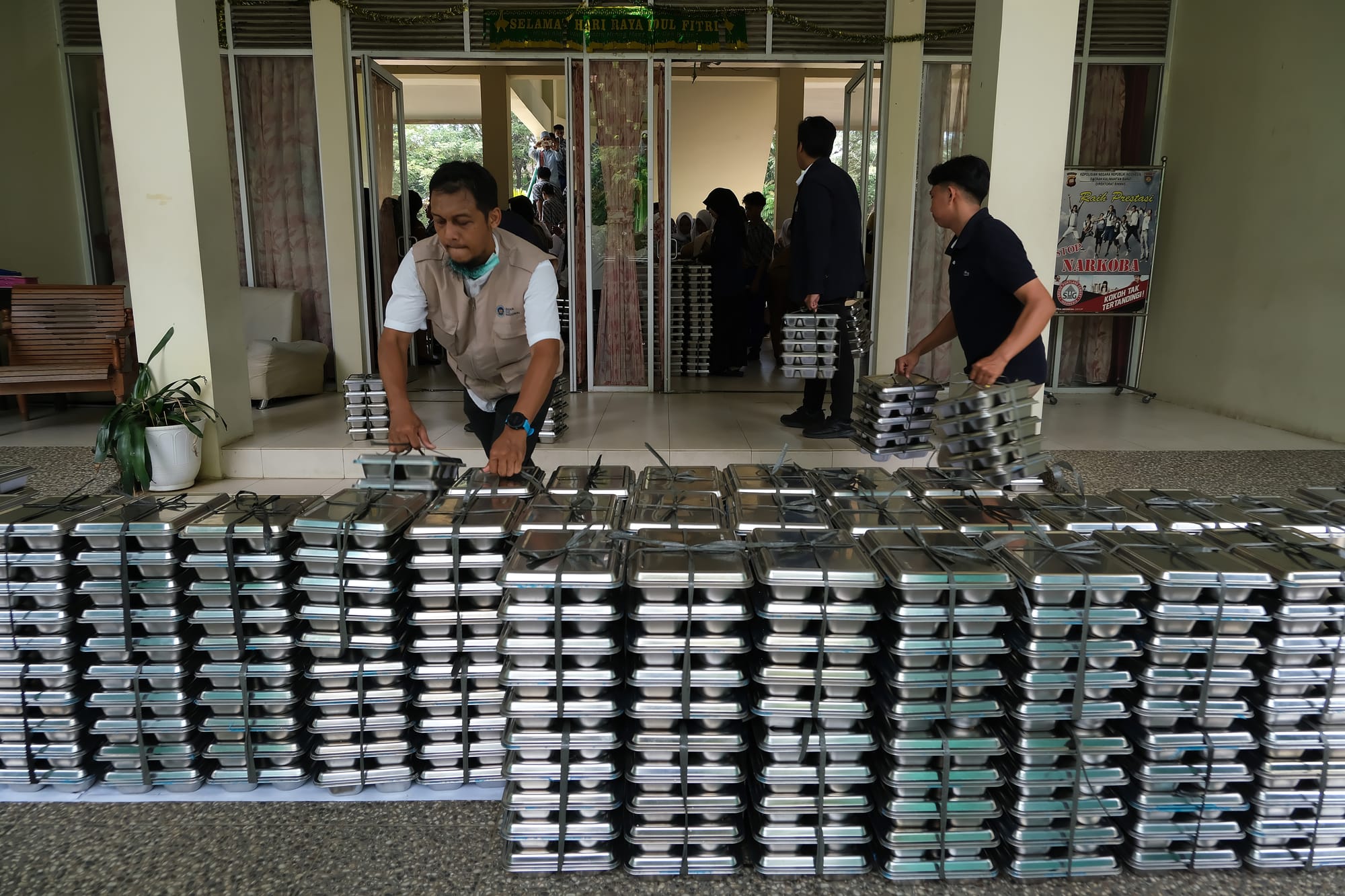
In serving food directly to students' tables at school, the government formed partners of the Nutrition Fulfillment Service Unit (SPPG). As of September, there are 9,615 SPPG units throughout Indonesia. Business actors who become government partners need to provide land to build a kitchen measuring 20 meters x 20 meters.
Still far from expectations
The MBG program, which has been running since January 6, 2025, opens up space for the public to judge. However, during these 9 months, the impression received by the public is still far from being satisfied. This is mainly due to the many news reports about cases of children being poisoned at school after eating MBG dishes.
The government seems unprepared to implement the MBG program in terms of infrastructure and human resources. This condition was captured in the Business World Universe Survey, which captured the opinions of decision-makers in companies and a number of economic observers in the period September 9 to September 25.
The majority of respondents (74.3%) stated that the MBG program has not worked as expected. Only 17.1% stated otherwise.
Reasons why the MBG has not worked as expected include the poor quality of the food, as reported by 46.2% of respondents. Instead of improving nutrition, students have to be treated and their learning time at school is disrupted.
Another reason is the uneven distribution of beneficiary students (23.1%), meaning that there are still many who have not received benefits, especially children in remote areas. The MBG program is actually projected to reach beneficiaries in all regions, including remote, frontier, outermost or 3T areas.
The MBG program reaches various target groups, ranging from PAUD/TK/RA, SD/MI, SMP/MTs, SMA/SMK, pesantren students, PKBM and SLB participants, seminaries, to pregnant women, nursing mothers, and toddlers.
In addition, respondents also believed that the MBG program was not well-targeted to children who really needed it (15.4%). This is because every child in the school gets an MBG ration regardless of their nutritional status.
According to the National Nutrition Agency, the MBG program reaches various target groups, ranging from PAUD/TK/RA, SD/MI, SMP/MTs, SMA/SMK, pesantren students, PKBM and SLB participants, seminaries, to pregnant women, nursing mothers, and toddlers.
The respondents who assessed the MBG program as having worked as expected was due to the increasing number of beneficiaries (50%). This shows that the government is really working to achieve the target.
In addition, the program was supported by many parties (33.3%). In addition to support from schools, there is also support from micro, small and medium enterprises, farmers, fishermen, and so on.
Respondents understood that the goal of the MBG program was noble. Namely, improving the nutritional condition of Indonesian children (37.1%), which also means preparing for a better future for Indonesian children. By feeding children at school, the program is also expected to ease the burden on families in serving nutritious food (25.7%).
Many reports state that children who are well-nourished during the learning process have better concentration levels, can be more energized, excited, and better behaved. This can improve academic performance and in the long run increase national productivity and competitiveness as a nation.
Economically, the provision of MBG will increase demand for foodstuffs, which will lead to a growth in supply. This food supply will drive the economy.
In addition, 22.9% of respondents stated that the MBG program could drive the economy. Economically, the provision of MBG will increase demand for foodstuffs, which will encourage the growth of supply. This food supply will drive the economy.
This increased demand and supply will ultimately create jobs. This is an opportunity to boost economic growth. The government estimates that an additional IDR 71 trillion for the MBG program by 2025 will contribute 0.86 percent to gross domestic product.
Therefore, the MBG program is important and must be implemented properly and sustainably. Unfortunately, respondents also saw a number of weaknesses in the implementation of the MBG program.
These weaknesses include the poor food distribution mechanism (28.6%) that led to nearly 6,000 students being poisoned after eating the MBG menu. The problem was allegedly caused by the long time between the cooking time of the menu, the distribution time and the time the students ate it. Therefore, it is necessary to shorten the distribution chain.
Food safety and hygiene are also not guaranteed (25.7%). The government is considered unprepared to implement the MBG program (20%), especially in preparing skilled implementers who understand food safety and nutrition standards.
There are also concerns that the program could burden state finances due to its large budget allocation (8.6%). This large amount of funding also leaves room for misappropriation or corruption.
In its relatively short implementation, the MBG program, which was expected to have a large multiplier effect, has not been fully realized. Respondents assessed that the provision of food for the MBG program has not empowered UMKM actors (48.6%) and has not utilized local food (42.9%).
In addition, the MBG program has not fully mobilized cooperatives (57.1%) in relation to the provision of foodstuffs. In fact, the program is also not considered to ease the burden on families (48.6%). This is because the value of free school meals is Rp 10,000 per meal. Meanwhile, the cost of health recovery in the event of a health problem is even greater.
Factors to consider
The MBG program will run well if the government, based on the 9-month implementation experience, conducts a comprehensive monitoring and evaluation (60%). The goal, of course, is to minimize the problems that have occurred so far and to achieve the target of multiple economic impacts of this program.
Standard operating procedures (SOPs) related to food procurement and distribution must be established to standardize implementation throughout Indonesia. Also, vendors or SPPG partners must have a certificate of eligibility to operate.
In addition, the availability of a budget for the sustainability of this program also needs to be considered (8.6%). This includes maintaining the quality and nutrition of food for students (8.6%).
In this situation where the MBG program is not working as expected, the private sector could play a bigger role. The private sector can be involved in the supply chain of food ingredients and shorten the span of food distribution to schools. In this way, the economic multiplier effect of MBG could be greater, creating more jobs.
A total of 45.7% of respondents said that the private sector could partner with the government as an SPPG or as a supplier of food raw materials (20%). Respondents did not fully agree with the involvement of the private sector in financing. Only a small number (8.6%) suggested that the private sector participate in financing the MBG program or by making this program a goal or a form of corporate social responsibility or CSR (5.7%).
Much needs to be done if the MBG program is to run well and sustainably to create a healthy and smart generation of Indonesians. The government cannot only focus on quantity, but also quality. It should also not only focus on the beneficiary students, but also on the executives who serve the food.
Evaluations should be conducted on all aspects and all stakeholders. Child safety must be a priority.

Methodology and Interviewee Profile
The Business World Universe Survey was conducted from September 9 to September 25, 2025. A total of 35 resource persons (respondents) were selected by purposive sampling from the business world and economic observers.
From the business world, the positions of the resource persons varied, ranging from director, managing director, to owner. The age of the informants ranged from 25-75 years old. The education level of the informants was dominated by S1 (48.6%) and S2 / S3 (45.7%).
Author: Gianie