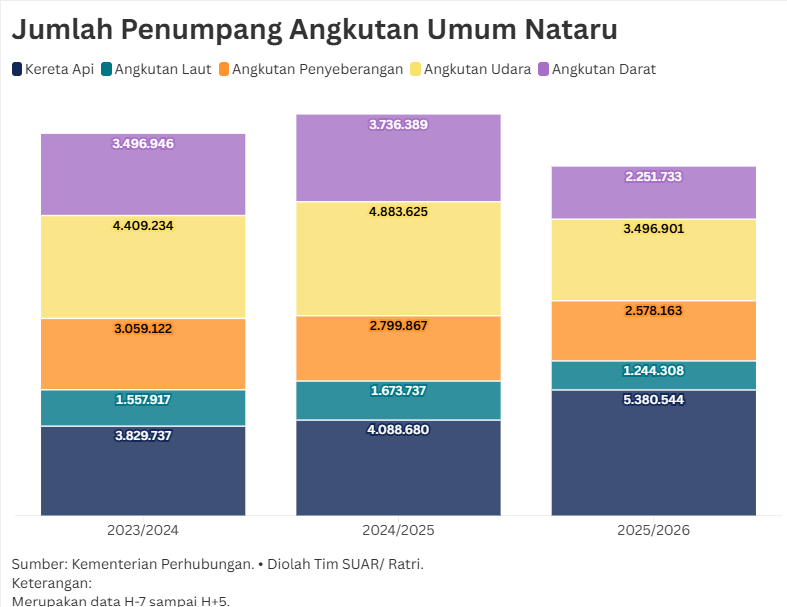
Based on accumulated data from H-7 (December 18) to H+5 (December 30) during the Christmas and New Year (Nataru) holiday period, the total number of passengers across various modes of transportation fluctuated.
During the 2023/2024 Christmas and New Year period, the number of air passengers was recorded at 4,409,234, which then increased to 4,883,625 passengers in the 2024/2025 period. However, in the 2025/2026 period, there was a sharp decline in the number of air passengers to 3,496,901 people.
This condition is different from rail transportation, which continues to climb until it reaches its peak of 5,380,544 passengers in the 2025/2026 period.
Overall, land transportation and ferry services also experienced adjustments in passenger volume. Road transportation (buses), which reached 3,736,389 passengers in 2024/2025, fell to 2,251,733 in the most recent period. On the other hand, ferry transportation has remained relatively stable, despite a slight decrease to 2,578,163 passengers this year.
The decline in various modes of mass transportation indicates a change in people's preferences in choosing transportation. This may also be influenced by changes in purchasing power and holiday distribution patterns that are different from previous years.
In the aviation sector, data for the 2025/2026 Christmas and New Year period shows that total national aircraft movements were dominated by domestic flights, with 51,482 flights, while international flights numbered 8,793.
Although domestic flight volumes appear high, total air passenger numbers have actually fallen from 4.8 million to 3.4 million. This decline in domestic passenger numbers is a cause for concern, as this sector is usually the backbone of citizen mobility during the long year-end holidays.
The Ministry of Transportation has identified a change in the vacation patterns of Indonesians. Currently, there is a trend of shifting interest from domestic destinations to international destinations. Director General of Air Transportation at the Ministry of Transportation Lukman Laisa said that there has been an increase in international flights, namely 7.2% (y-o-y) in terms of the number of aircraft and 5% (y-o-y) in terms of passengers.
The Ministry of Transportation also noted that cumulatively, domestic flights have declined this year. The number of domestic passengers decreased by 2.2%, even though the number of flights increased by 2.01%.
The sluggish domestic flight industry during this holiday season is believed to be due to the high price of domestic airline tickets compared to more competitive international routes to neighboring countries. This has encouraged the upper-middle class to choose to vacation abroad.
Ease of access and promotion of foreign tourism has also begun to erode the local tourism market. The Ministry of Transportation's findings confirm that the growth in international passengers has become a lifeline or mainstay for the air transportation industry amid declining interest in domestic travel.
This situation poses a unique challenge for domestic tourism industry stakeholders to evaluate ticket pricing structures and the appeal of local destinations in order to remain competitive in attracting domestic tourists in the future.
Travel patterns during the 2025/2026 Christmas and New Year period show that dependence on domestic air travel is beginning to decline due to a shift in interest toward overseas vacations and the transition of medium-distance passengers to rail travel. The success of rail transport in reaching over 5 million passengers shows that people are looking for more affordable and punctual alternatives.
This change in pattern has become a challenge for the government to improve transportation policies that are more oriented towards domestic economic development. With transportation policies that are more favorable to the community, the national tourism sector will continue to grow.