The potential value of the global coconut sugar market is estimated at USD 744.2 million in 2025 and is projected to grow to USD 1,271.3 million by 2035.
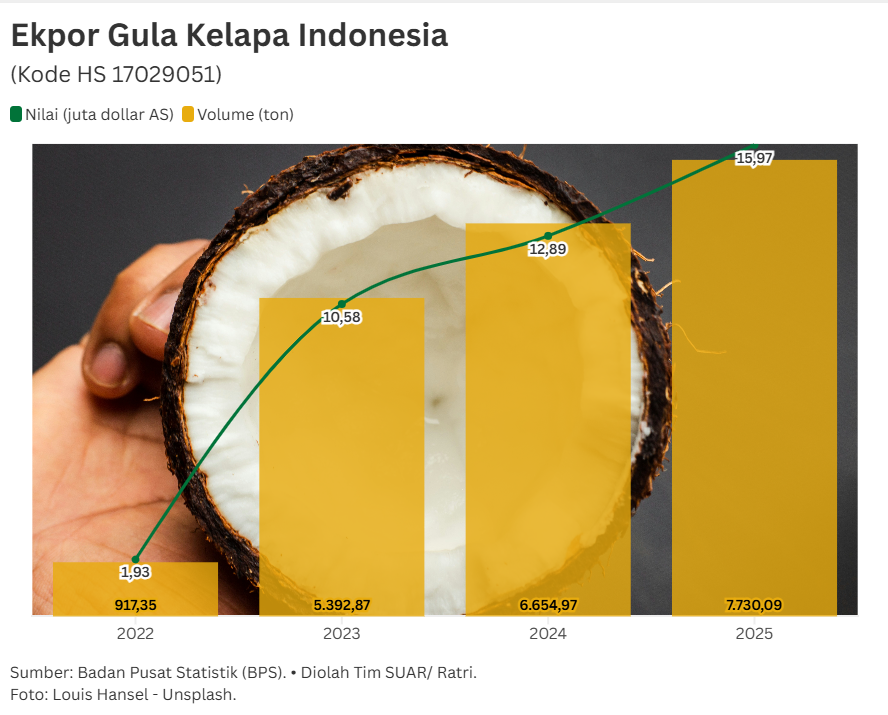
Indonesia's coconut sugar export trend also reflects a positive trend, with volumes rising from 917.35 tons (2022) to 7,730.09 tons (2025), an increase of 700% in three years. Not only a jump in volume, but also in nominal value from US$1.93 million (2022) to US$15.97 million (2025).
While the export potential of processed coconut sugar promises to add a lot of value, the industry needs to anticipate challenges in the upstream sector, related to the availability of raw coconut raw materials. Data from the Central Bureau of Statistics shows that of the total coconut production (which stands at around 2.8 million tons per year), a significant amount is exported.
Coconut export volume reached 2,174,712 tons in 2023, which is close to the total production (2,836,200 tons). In 2024, exports reached 1,097,349 tons out of total production of 2,822,118 tons. The large volume of raw coconut exports risks reducing the supply of raw materials needed by the downstream industry, affecting the processing of coconut sugar and other derivative products.
The dilemma is related to upstream regulation and downstream acceleration. Regulatively, the government needs to regulate raw coconut export policies, either by imposing high export taxes or quota restrictions, to ensure the availability of supplies for the domestic processing industry. This step is not to stop exports, but to shift the orientation from raw material exports to finished product exports.
Simultaneously, the expansion and rejuvenation of smallholder coconut plantations (PR) is vital, given that smallholder plantations dominate Indonesia's coconut production. Incentive programs for replanting old plantations and training in sustainable agricultural practices can significantly increase coconut yields, ensuring future availability of raw materials without compromising export markets.
Coconut sugar offers a clear pathway for Indonesia to increase its export value and strengthen the coconut industry to be more organized upstream to downstream. The large market potential and global demand trends provide opportunities for Indonesia.
By implementing a bold and structured policy to prioritize raw material supply for the processing industry, while actively promoting quality standards and organic certification, Indonesia will not only become the largest exporter of coconuts, but also a key player in the global processed coconut sugar value chain.