
Business and environmental sustainability appear to have an interdependent relationship. Business activities can have a significant impact on the environment. Vice versa, environmental conditions also affect a company's operations and long-term prospects.
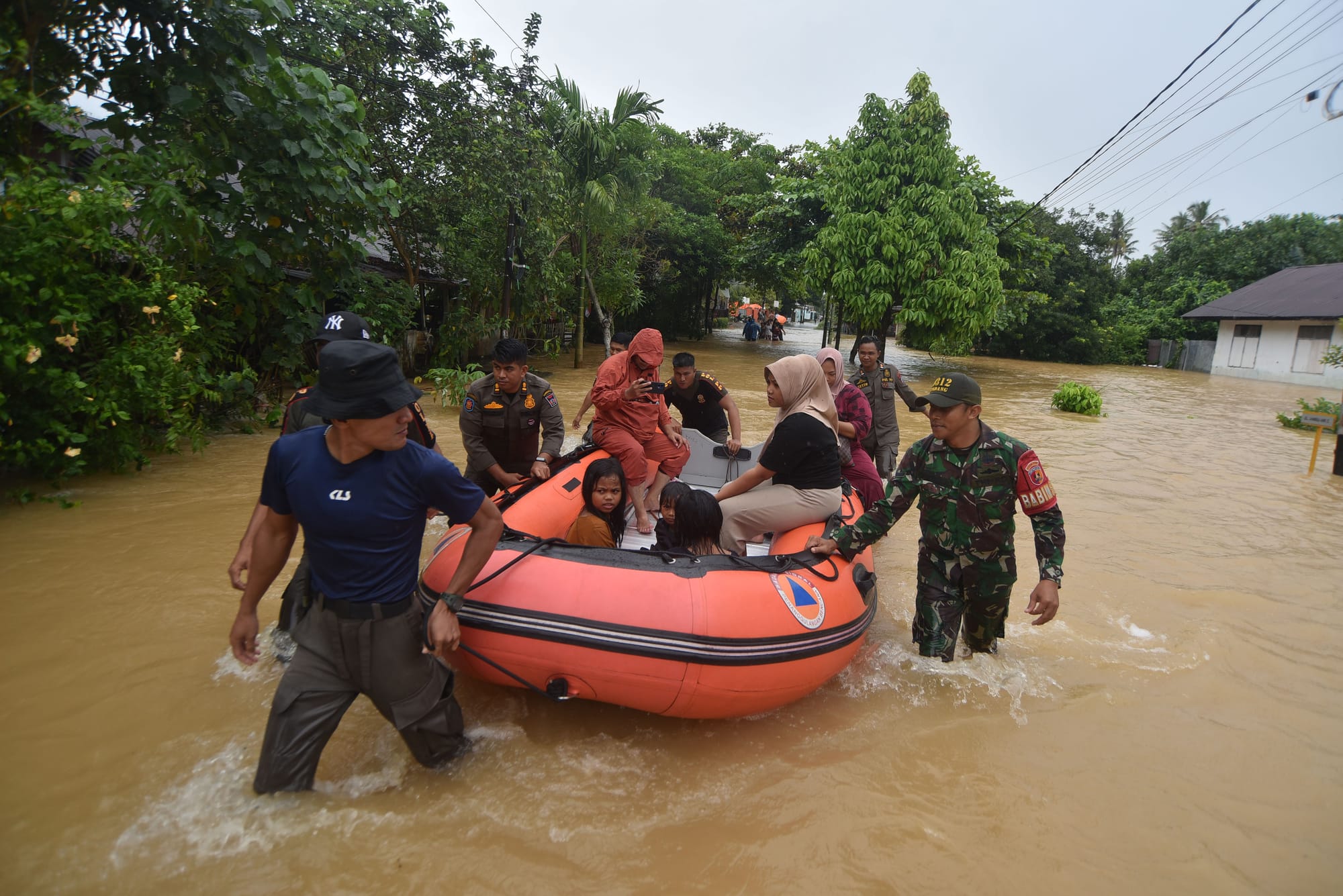
Both sides have been in the spotlight recently as flash floods and landslides in the provinces of Aceh, North Sumatra and West Sumatra have claimed hundreds of lives since December 25, 2025.
The National Disaster Management Agency (BNPB) at a press conference held on Sunday (30/11/2025), revealed that from the three regions, so far the total number of casualties is 316, while 289 people are still missing and are being searched.
On that occasion, Coordinating Minister for Human Development and Culture Pratikno said that a number of ministers have also been assigned by President Prabowo to actively monitor and intervene to resolve the issue.
"He (President Prabowo) immediately ordered to mobilize all national forces, focus on handling this emergency response as quickly as possible, evacuate, mobilize logistics, mobilize health workers, restore infrastructure, and to also oversee in the field," Pratikno said.
Not only focusing on handling during the emergency response period, the government is also designing scenarios for rehabilitation and reconstruction of the damage caused by the disaster.
"We are preparing scenarios for recovery, of course we focus on emergency response, but we are also preparing scenarios for rehabilitation and reconstruction. I have discussed with Mr. Coordinating Minister for Infrastructure about how this recovery can be done quickly," he explained.
The causes of the disasters that occurred in a number of regions vary. From the fact that the disaster areas are located on steep hills to extreme weather, there are many reasons for the disasters.
Such natural disasters are not the first to occur in Indonesia in 2025. Based on data from BNPB, from January 1 to November 4, a total of 2,726 disasters hit Indonesia. These natural disasters were dominated by floods with 1,340 incidents, and extreme weather with 582 incidents. From this incident, as many as 258 access roads, namely bridges, were damaged.
Natural disasters and economic losses
Quoted from the Inarisk website managed by BNPB, the total potential physical losses reached IDR 4,491 trillion and losses of around IDR 4,497 trillion. This comes from a total calculation of 13 disaster categories such as earthquakes, tsunamis, floods, landslides, extreme weather, forest fires, and also volcanic eruptions.
This figure is greater than the total state expenditure in the 2025 State Budget (APBN) of IDR 3,621 trillion.
According to the World Bank, Indonesia is ranked 12th out of 35 countries that have a high risk of various disasters that have an impact on casualties and economic losses. Almost all areas of Indonesia are exposed to the risk of more than 10 types of natural disasters including earthquakes, tsunamis, floods, landslides, volcanic eruptions, fires, extreme weather, extreme waves, drought, and liquefaction.
Furthermore, projections made by the World Bank estimate that economic losses due to natural disasters could reach 0.66 percent to 3.45 percent of a country's GDP by 2030 if not taken seriously.
The Ministry of National Development Planning/National Development Planning Agency (Bappenas) in 2024 stated that the impact of natural disaster losses in Indonesia reached an average of IDR 1.06 trillion per year. The total cost of climate change mitigation reaches Rp 4 trillion per year. Indonesia's Gross Domestic Product (GDP) also has the potential to decline by 19 percent when the earth's temperature rises to 4 degrees Celsius.
As much as 25 percent of Indonesia's economy has a high carbon footprint intensity: mining 14.07 percent, agriculture 9.22 percent, fisheries 2.58 percent, and forestry 0.6 percent. More than 50 percent of Indonesia's major exports are natural resource-based.
This is despite the fact that these sectors provide a large number of jobs for the community and are the engine of economic growth. This means that there is a need for policies that encourage the transformation of these economic activities to be more environmentally sound.
The role of the business world
Chairperson of the Indonesian Employers Association (Apindo) Shinta Widjaja Kamdani, said businesses have a very decisive role in reducing environmental damage, because most production activities, energy use, and resource management are in the business sector.
"This is what makes the implementation of ESG(environmental, social, and governance) imperative. When companies incorporate environmental, social, and governance aspects into their operations, the impact can directly reduce emissions, waste, and pressure on ecosystems," Shinta explained when interviewed on Sunday (30/11/2025).
By practicing sustainability, the business world will benefit from improving a good image, business resilience, reducing operational costs, competitiveness, and attracting investors.
Therefore, the country's businesses are very likely and can participate in reducing environmental damage due to natural disasters by implementing ESG principles in their business, which in turn is also beneficial for business.
"Therefore, for Apindo, the implementation of ESG is not just a response to environmental issues, but a business strategy to improve competitiveness, business resilience, and national economic sustainability," he continued.
Read also:
 Chris Wibisana
The implementation of business with ESG principles is very important because it helps companies to mitigate the risks arising from climate change and environmental damage. Global market pressure is also getting stronger as many of Indonesia's export destination countries require sustainability standards in the supply chain.
Indonesia's export products also run the risk of not being able to compete in the global market without ESG implementation. Today's business practices are no longer measured solely by profit, but also by their contribution to maintaining the balance between people, planet and profit.
"In terms of financing, investors and financial institutions now prioritize companies with good governance and clear sustainability strategies. This means that ESG not only reduces risk, but also opens access to cheaper and more competitive funding," he said.
Apindo also encourages businesses to set measurable ESG targets, and continue to collaborate with various parties including the government in environmental mitigation and recovery programs. Commitment from the business world is very important to maintain environmental sustainability while ensuring business resilience in the long term.
"Concrete contributions can start from energy efficiency, the use of more sustainable raw materials, the application of clean technology, to a better waste management system," said Shinta.
In line with her, President Director of the Institute for Sustainability and Agility (ISA) Maria R. Nindita Radyati, said that by integrating ESG in supply chain management, it also provides great opportunities for company operations. Sustainable use of resources and operations not only reduce risks, but also increase the company's competitiveness in the global market.
Today's business supply chains are said to be exposed to various ESG-related risks. In terms of environmental risks, these include deforestation, excessive carbon emissions, excessive water use, and waste from production and logistics.
"For example in Indonesia, palm oil companies are under pressure to eliminate deforestation and forced labor from their supply chains. Many large companies are now following NDPE(No Deforestation, No Peat, No Exploitation) policies to meet the standards of international buyers," Maria was quoted as saying by ISA's official website.
Integrating ESG in robust supply chain management also requires continuous monitoring and capacity building. This capacity building can be done by providing training to suppliers, especially micro, small and medium enterprisesUMKM) and farmers, to improve their compliance with ESG standards, as done by one bank in Indonesia.
"Bank Rakyat Indonesia (BRI) works with UMKM and smallholders through sustainable financing schemes, helping them improve ESG compliance in the agricultural supply chain," he said.
Resources and environmental sustainability are also key to the long-term sustainability of a company's business.
"Integrating ESG into supply chain management is no longer optional. Companies must evaluate environmental and social risks, adopt sustainable sourcing strategies, and consistently monitor supplier performance," he concluded.
In a research titled "Natural Disaster Risk Mapping: Urging Improvement of Early Warning System and Insurance for Mitigation" released by IFG Progress, it was found that the disaster early detection system was proven to have a positive and significant relationship with Gross Regional Domestic Product (GRDP) in Indonesia.
The results of the research stated that when an area has an early detection system, the GRDP in the area/village has the potential to increase. Every 1 percent increase in the number of villages that have an early warning system will increase GRDP by IDR 226 billion to IDR 315.68 billion.