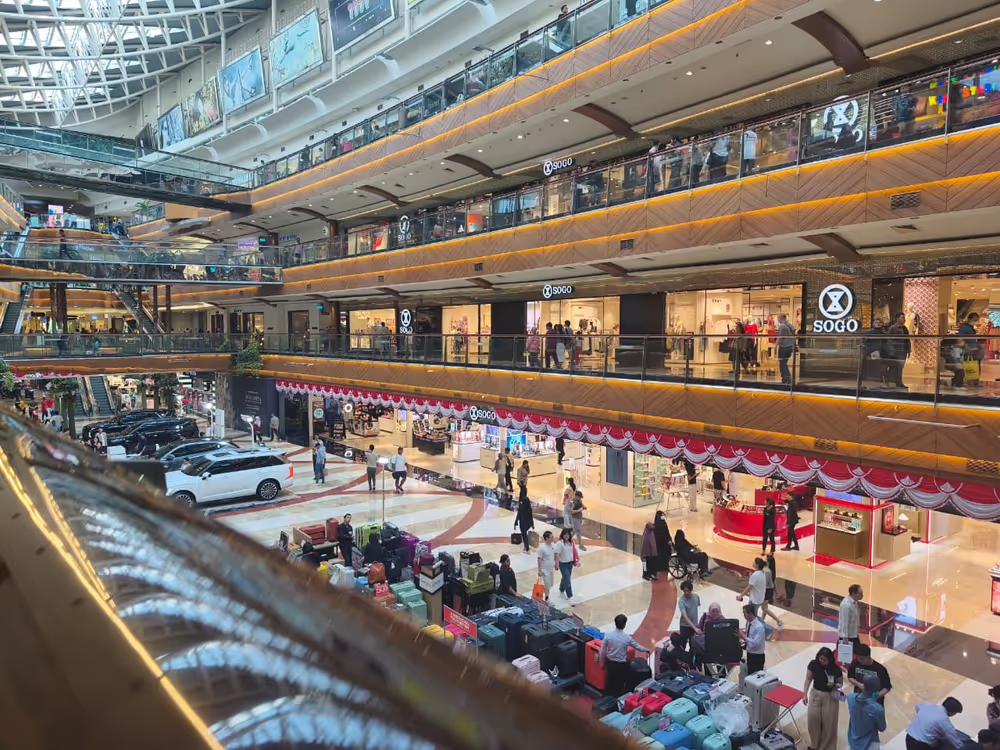
Amid sluggish purchasing power and the rise of the Rohana (only-asking) and Rojali (rarely-buying) consumer trends, Indonesia’s retailers and shopping centers used the Independence Day long weekend to boost sales. The results were mixed - effective in sparking traffic and short-term gains, but still constrained by middle-class caution.
The government’s decision to declare collective leave on Monday, August 18, created a three-day holiday following the 80th Independence Day celebrations on Sunday, August 17. Retailers seized the momentum with discounts and promotions.
At Pondok Indah Mall 2, Jakarta, Timberland launched its Independence Day sale on August 14, offering 17% off selected items. The effect was immediate.
“Today we’ve already sold six pieces, and it’s likely to increase this evening,” said Dimas, a sales advisor at Timberland, on the first day of the holiday. Sales climbed steadily in the days leading up to the long weekend, from just six items on August 13 to 16 pieces on August 16.
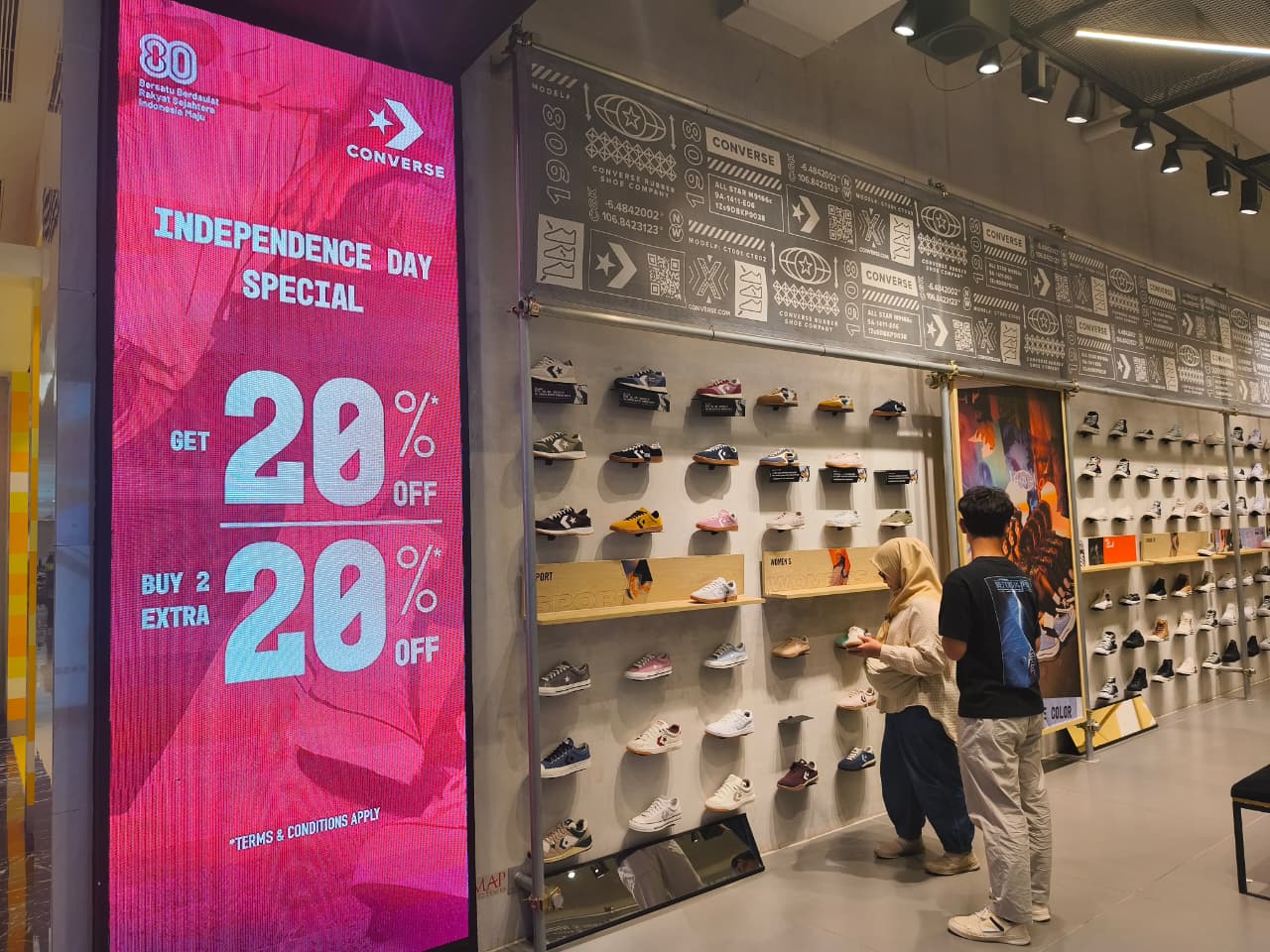
Converse at Bintaro Jaya Xchange Mall, Tangerang, rolled out a similar campaign: 20% off storewide, plus an extra 20% for buying two products.
“But compared to regular weekdays, this Independence Day promo boosted sales up to four times,” said Agus, the store leader. However, he noted the increase from the long weekend itself was modest, just 10% above the previous weekend, since Converse runs regular discount programs..
The Chairman of the Indonesian Shopping Center Tenants Association (Hippindo), Budiharjo Iduansyah, believes that the August 17 momentum successfully boosted visitor traffic. He noted that almost all types of businesses in shopping centers felt the impact, ranging from restaurants and clothing stores to toy outlets. Simultaneous promotions made the shopping atmosphere more lively throughout the long weekend.
However, the Chairman of the Indonesian Shopping Center Management Association (APPBI), Alphonzus Widjaja, emphasized that there are still factors to be considered. A long weekend does not always bring maximum impact for shopping centers. Many middle-class consumers prefer traveling out of town or abroad, making shopping centers less crowded compared to “sandwiched holidays.” The main drivers of visitor numbers remain food, beverage, and entertainment outlets.
To anticipate this, APPBI organized the 2025 Indonesia Shopping Festival (ISF), running from August 14 to August 24 across 400 shopping centers. The event is expected to increase mall visits by 10% to 20%, with potential transactions reaching around Rp 23.32 trillion. ISF is designed not only to enliven the Independence Day celebration but also to sustain consumer purchasing power amid the long-holiday trend.
In line with this, Budiharjo highlighted that promotional events such as ISF and Belanja di Indonesia Aja–Hari Belanja Diskon Indonesia (BINA HBD Indonesia) 2025 are important to maintain visitor enthusiasm. The opening of new stores, renovation of outlets, and the addition of both imported and local products are seen as effective in sustaining shopping interest.
Banking Promotions
Not only shopping centers and retailers are offering special Independence Day promotions—banks are also joining in.
PT Bank Central Asia Tbk (BCA) is rolling out various promotions to celebrate the 80th Anniversary of Indonesia’s Independence. BCA customers can enjoy attractive offers starting from Rp 17,000 for transactions at various stores providing household needs, F&B, retail, entertainment, and fashion. These promotions serve as BCA’s token of appreciation for loyal customers, as well as a form of participation in enlivening the nation’s historic moment.
“As a national banking institution, BCA is proud to celebrate the 80th Independence Day of the Republic of Indonesia by presenting a variety of exciting promotions. Through these Independence Day promos, we hope to add value and deliver a memorable shopping experience for our customers,” said Norisa Saifuddin, EVP of Transaction Banking Business Development, in a statement on Thursday (August 16, 2025).

BCA’s Independence Day promotions can be enjoyed by customers through transactions using QRIS on myBCA, BCA mobile, Flazz, Sakuku, BCA Debit, or BCA Credit Cards at selected merchants. Full details of BCA’s Independence Day offers are available at bca.id/hutri80.
The program runs from August 14–31, 2025, offering a variety of attractive deals, ranging from discounts and cashback to rewards designed to meet the financial and lifestyle needs of the public.
Bank Mandiri is also rolling out a similar program. Senior Vice President of Digital Marketing at Bank Mandiri, Diah Eka Purwanti, explained that this initiative is designed to accelerate customer transactions in the retail sector while simultaneously driving sustainable national economic growth.
To achieve this, Bank Mandiri is collaborating with dozens of well-known merchants and brands, both offline and online, including Erafone, iBox, Samsung by Erafone, Blibli, Lazada, Shopee, and Tokopedia.
“Bank Mandiri is committed to being the people’s top choice in celebrating Independence Day while also accelerating the nation’s digital economic transformation. Through a comprehensive digital ecosystem, we aim to deliver promotions that not only benefit customers but also support MSMEs, in line with Bank Mandiri’s spirit of advancing Indonesia,” said Diah in an official statement on Saturday (August 16).
Throughout the promotional period, a range of special offers will be available. Customers can enjoy discounts of up to Rp 80,000 for transactions using QRIS Livin’ by Mandiri at Pantai Indah Kapuk, as well as discounts of up to Rp 35,000 at selected tenants of Inacraft Vol. IV 2025 across ten regions in Indonesia, including Greater Jakarta, Cirebon, Bandung, Semarang, Pekalongan, Yogyakarta, Madura, Malang, Bali, and Mataram.

In the investment sector, rewards of up to Rp 250,000 are available for the purchase of SBR014 through the Livin’ Investasi feature. For financing, Bank Mandiri is offering an administrative fee discount of up to Rp 800,000 for Mandiri Auto applications, a welcoming bonus of up to Rp 1 million for Mandiri Credit Card applications, a special fixed interest rate of 8.80% for 10 years for Mandiri Mortgage (KPR), and interest rates starting from 9.25% for Mandiri Multipurpose Loan (KSM).
For those looking to open savings accounts, there is a fee discount of up to Rp 200,000 for opening an All in One Package Savings account, special rewards for Business Savings accounts, and an e-voucher worth Rp 100,000 for opening a Tabungan Rencana (Installment Savings).
Meanwhile, in the lifestyle segment, Livin’ Sukha users can enjoy a Rp 50,000 discount when shopping at Alfamart, Rp 45,000 off for transactions at Klik Indomaret, and up to Rp 180,000 off for Ultra Voucher purchases. For more detailed information on Bank Mandiri’s 80th Independence Day promotions, visit bmri.id/fomoHUTRI.
Boosting Sales
Bank Mandiri’s 2024 research showed that long weekend holidays increased public spending by up to 14.4% compared to regular weekends. In 2025, long weekends boosted public spending by up to 13.8% compared to regular weekends.
The retail sub-sector that enjoyed the highest increase in revenue during the long weekend was restaurants, with an index value of 427.7. This was higher than the supermarket and fashion store sub-sectors, which recorded 291.5 and 133.9, respectively.
Despite the many long weekends, these did not significantly encourage people to travel long distances. One indicator is that household spending on hotel accommodations did not experience a notable increase.
The Mandiri Spending Index (MSI) in June 2025 was recorded at 269.5 points, up from 255.4 points in May thanks to the momentum of collective leave and religious holidays. The Bank Mandiri Institute estimated that without the holidays, the spending index would have been 5% to 8% lower.
However, researcher at the Center of Reform on Economics (CORE), Yusuf Rendy Manilet, assessed that this kind of consumption surge is not evenly distributed across all social groups.
“The impact is more felt by the upper-middle class whose consumption is relatively less dependent on government stimulus,” said Yusuf. According to him, promotions and long holidays rarely have a major effect on the lower-middle class, who are price-sensitive and heavily reliant on direct government assistance.
He considered the increase in consumption during the August 17 long weekend to be limited. “There was indeed an impact on the middle and upper class, but for other groups, the effect was small,” he said. Moreover, there was no additional stimulus from the government as had been provided in the previous quarter.
Yusuf emphasized that the middle class is in a vulnerable position. They no longer receive regular aid like the poor, but they are also not as flexible as the upper class. “This ‘middle-ground’ group tends to hold back on spending even when there are plenty of promotions,” he noted.
Yusuf emphasized that the middle class is in a vulnerable position. They no longer receive regular assistance like the poor, but they are also not as flexible as the upper class.
The phenomena observed in shopping centers also reflect middle-class behavior. Many visitors merely browse or compare prices with online platforms before deciding to buy. According to Yusuf, this is evident in the Rojali-Rohana phenomenon. “Some come, ask about prices, then leave because they feel it’s cheaper to buy online,” Yusuf explained.
Yusuf also stressed the importance of distinguishing between seasonal trends and sustainable increases. “We need to see whether this consumption pattern continues into September or October. Our assumption is that this is a seasonal phenomenon driven by holidays and promotions,” he said.
To encourage sustainable consumption, he believes the government needs to provide more targeted stimulus. Cash assistance can be a quick step to boost spending, but what is more fundamental is the creation of formal jobs with decent wages and social security.
“Short-term stimulus is important, but it must be balanced with medium- and long-term policies. The government needs to push for social mobility so that the poor can move up to the middle class, and the middle class can move up to the upper class,” Yusuf said. He emphasized that formal employment with guaranteed wages and social protection is the key to maintaining purchasing power.
The main focus, he added, should be directed toward the middle class, which makes up a large portion of the population but is now under pressure. “If this group is neglected, it will be difficult to expect consumption to continue growing. The government must ensure that policies truly target them,” Yusuf stated. This way, long holiday momentum would not merely become a seasonal discount fest but rather a gateway to sustaining people’s purchasing power.
In addition, government policies also influence visitor enthusiasm. Budiharjo expressed hope that the government would maintain political and security stability so that consumers remain eager to shop. Excessive regulations, he warned, would only discourage consumers and harm businesses.
“If the rules are too burdensome, consumers may choose to shop abroad, leaving domestic businesses at a loss,” he said.
Writers: Benediktus Krisna Yogatama, Harits Arrazie, and Chris Wibisana