
President Prabowo Subianto has revived the plan to build a national car project as an effort to realize the independence of an independent industrial ecosystem.
Not only are we proud to see domestic car brands on the streets of the capital city, but the car manufacturing industry is also expected to produce thousands of skilled workers, creating a large number of jobs that can ultimately increase economic growth.
A number of national brands have emerged, from Esemka, i2C to Maleo. Most recently, Prabowo Subianto began to echo that the Maung car variant from PT Pindad (Persero) would become the national car from Indonesia.
Automotive Observer from the Bandung Institute of Technology (ITB) Yannes Martinus said the nation's ideals since the Soekarno era need to be supported, but also balanced with the right steps to realize the national car project.
"Building a national car is not easy, it needs efforts and intentions that are really mature," he told SUAR in Jakarta (28/10/2025).
According to him, apart from funding or capital issues, there are six strategic steps that must be realized to realize the national car project:
- The first step is to prepare human resources of engineers and technicians along with tools in conducting design, texting, production, assembly until after-sales.
- The second step is to build a domestic component supply chain to create a national automotive industry ecosystem that can increase national GDP.
- The third step is to build an independent stamping capability so that increasing the high TKDN value automatically opens up job vacancies for Indonesians starting from tier 1, 2 and 3.
- The fourth step is to build a marketing and after-sales network throughout Indonesia step by step.
- The fifth step, after the domestic market is considered strong, is to build a network of foreign markets, and
- The sixth step, building a national automotive industry must have the mindset of building its own independent principal with a supply chain from Indonesia itself.
Polytron Electric Car
One of the prominent national brands is Polytron. Approaching its 50th year, Polytron continues to expand its contribution through business diversification from home electronics to electric vehicles.
After achieving the highest sales in the national electric bike category, Polytron is now ready to go further.
By launching its first electric car Polytron G3 and G3+ for the needs of families in Indonesia.
Polytron G3+ comes with 2 color variants, Midnight Black and Galaxy Grey, while Polytron G3 also comes with 2 color variants, Aurora White and Twilight Blue.
"Polytron G3 and G3+ are our steps to bring electric vehicles closer to the wider community," said Polytron Chief Executive Officer, Hariono in a press release received by SUAR in Jakarta (28/10).
Based on consumer research, when deciding to buy an electric vehicle, the majority of consumers consider three main things: cost, environment, and convenience.
From the data, 73% of consumers ranked cost as the most important factor, proving that price remains a key consideration in investing in new technologies such as electric cars. Environmental awareness came in second (47%), followed by convenience (44%).
Responding to this need, Polytron also introduced Battery-as-a-Service (BaaS) - a new ownership solution that allows consumers to own an electric vehicle without having to purchase batteries upfront, resulting in lower acquisition costs.
The scheme also includes a lifetime battery warranty during the Subscribe period, making electric vehicle ownership more flexible, affordable, and worry-free.
Design Innovation
With a portfolio of manufacturers of various defense special function vehicles ranging from the 6x6 Апоз ranpur, 6x6 Badak ranpur, 4x4 Komodo rantis, to the chain-wheeled vehicle Medium Tank Harimau, PT Pindad has also produced the MV3 Maung operational vehicle (ranops) which has been used by the TNI and Polri.
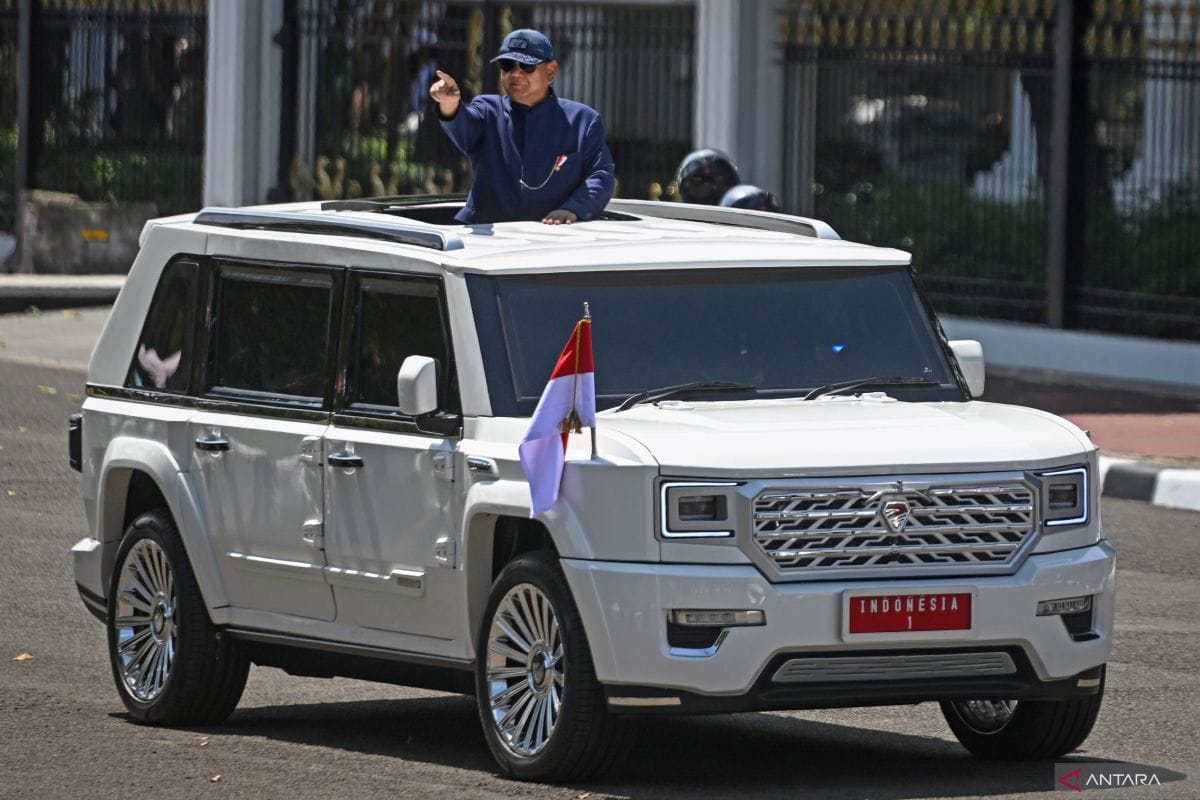
The MV3 platform continues to be developed with the special design of the Maung tactical vehicle to the Garuda Limousine which has currently been used by President Prabowo as well as the next series of MV3 Garuda to support the operations of Ministers, state officials, to the needs of civilian vehicles for the Indonesian people.
President Director of PT Pindad, Abraham Mose appreciates the strong commitment of the 8th President of the Republic of Indonesia who has consistently supported the development of the domestic defense industry, especially the national automotive industry since he was Minister of Defense.
"Pindad is the first step to realizing a national automotive ecosystem that is the pride of Indonesia," he told SUAR in Jakarta (28/10).
PT Pindad has been producing the Maung MV1 which continues to be developed until the third generation. This has been so successful that it has even been used as a presidential vehicle, the MV3 Garuda Limousine.