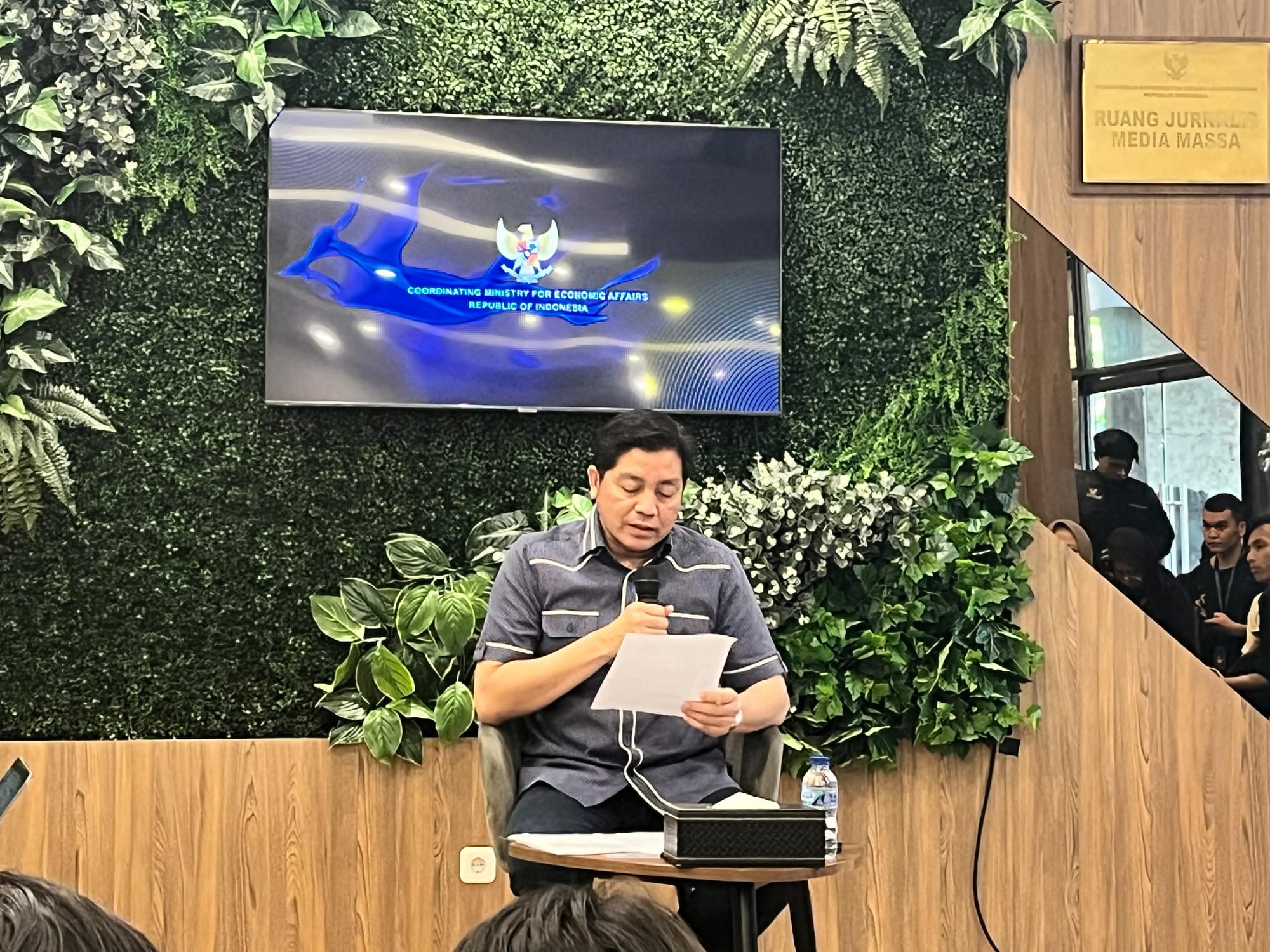
"Trade negotiations are actually lifelong, you could say, ongoing," said the spokesperson for the Coordinating Ministry for Economic Affairs, Haryo Limanseto, starting a press briefing in the mass media room of the Office of the Coordinating Ministry for Economic Affairs, Lapangan Banteng, Jakarta, Wednesday, July 9, 2025.
Haryo stated that the Indonesian government is currently trying to continue negotiations related to the decision of President Donald Trump's administration regarding the imposition of tariffs on Indonesia.
On Tuesday, July 8, United States (US) President Donald Trump finally set the imposition of tariffs on imported goods from Indonesia at 32 percent. This figure for import tariffs for Indonesia has not changed compared to what Trump announced in early April 2025.
In addition to Indonesia, President Trump also sent letters imposing tariffs on imported goods to the US to 13 other country leaders. Among them are South Korea, Japan, Malaysia, Kazakhstan, South Africa, Myanmar, Laos, Tunisia, Bangladesh, Serbia, Bosnia and Herzegovina (BiH), Cambodia, and Thailand. The amount of tariffs varies, ranging from 25 percent to 40 percent and will be imposed starting August 1, 2025.
The government is also trying to refute the decision by renegotiating, because it is only through diplomacy that Indonesia is expected to make a mutually beneficial agreement. Coordinating Minister for the Economy Airlangga Hartarto is spearheading the renegotiation efforts to the United States.
"Pak Menko Airlangga is currently in the United States and is scheduled to meet directly with the Secretary of Commerce, Treasury, and USDA," Haryo said.
Airlangga's presence, continued Haryo, is a form of response to the US Government's official letter yesterday, which we think still leaves room to respond before the policy takes effect in August.
B2B Deal as an Alternative
In addition to intergovernmental diplomacy, Indonesia also relies on a business-to-business (B2B) approach. Haryo revealed that the government encouraged the private sector to immediately agree on trade or investment transactions with their counterparts in the US before the tariff announcement came out. One of the results was the signing of a memorandum of understanding (MoU) for the purchase of wheat worth US$1.25 billion between Indonesian and US businesses.
"Several MoUs have been completed and this can be a sweetener for the government's negotiation efforts," he explained.
In fact, according to Haryo, the total value of B2B agreements reached has exceeded the value of the trade deficit complained about by the US side.
Based on INDEF data, US trade with Indonesia experienced throughout the 2020-2024 period. In 2022, the US posted a deficit of US$27.3 billion.
Then, in 2020 the US trade balance with Indonesia was a deficit of US $ 13.9 billion, and 2021 a deficit of US $ 19.6 billion.
Furthermore, in 2023 the US trade balance with Indonesia was a deficit of US$ 18.2 billion.
Finally, throughout 2024 the US trade balance with Indonesia was a deficit of US$ 19.3 billion.
According to him, the negotiation steps taken by Indonesia received a positive note from the US negotiating team. Indonesia's proposal is even said to be a reference for other countries in dealing with new trade tariffs.
However, Haryo has not been able to detail the parties that will be involved in this cooperation, as well as its impact on the national economy. "We apologize, because this is business to business, we also have limitations to convey," Haryo explained, emphasizing that some transactions are still in process and not yet finalized.
Indonesia since the beginning of the week has sent the Coordinating Minister for the Economy, Airlangga Hartarto to Uncle Sam's country for further negotiations regarding the 32% reciprocal tariff.
There, he detailed that Indonesia through various state-owned companies had entered into agreements to import oil, corn and LPG from the US.
Among others, PT Pertamina (Persero) has signed a memorandum of understanding related to the import of crude oil from the United States (US). In the cooperation document or Memorandum of Understanding (MoU), Pertamina is ready to buy LPG, gasoline and crude oil from the US.
In addition, said Airlangga, FKS Group and PT Sorini Agro Asia Corporindo Tbk have signed an agreement to purchase corn from Cargill, including Sorbitol Syrup and Sorbitol Powder, Maltitol, Dextrose Monohydrate, Maltose Syrup, and Maltodextrine.
Not only through business transactions, the government is also preparing a long-term foundation through regulatory reform. "So far, we also have a deregulation team, PP28, OSS, and so on," Haryo explained, when answering the question of non-tariff barriers which is said to be the reason why Vietnam can get tariff relief faster.
These steps, while not specifically aimed at responding to US policies, are evidence that Indonesia is improving itself. "We have been making investment easier, not just for the US, but for all countries," he added.
Indonesia in a Difficult Position
Although the government claims the negotiations are going positively, a number of economists see Indonesia's position in these negotiations as quite weak. Yusuf Rendy Manilet, an economist from CORE Indonesia, believes that Trump's plan to give lower tariffs to Vietnam puts Indonesia at a disadvantage.
"This has the potential to reduce the competitiveness of Indonesian products, especially those that have similarities with Vietnam such as electronics and textiles. In fact, we know the US is the main export market for these products," Yusuf said.
He added that this condition is increasingly worrying because the national textile industry is experiencing a decline in performance and a wave of layoffs. Therefore, according to Yusuf, the government needs to prepare alternative strategies such as diversifying export markets, especially through membership in FTAs or initiatives such as BRICS.
But he also cautioned, "Market diversification must be done carefully, so as not to conflict with ongoing negotiation efforts."
Economic observer Yanuar Rizky believes that the tariff disparity between Indonesia (32%) and allied countries such as Malaysia (25%) could be detrimental to our manufacturing export sector.
"Our goods will be more expensive than Malaysia's. This will make it difficult for our production sector to compete in the US market and lead to the risk of layoffs, deindustrialization, and a decrease in state tax revenue," said Yanuar.
He also highlighted the weak position of Indonesia's diplomacy because it is considered by the US as China's carry trade route. "Unlike Vietnam, which is ready to become an alternative to China, we are seen only as a trade intermediary, not a direct partner," he said.
Yanuar emphasized the importance of careful calculations going forward. "If we want to join dedollarization and enter BRICS, is China ready to cover our US dollar-based government and private sector debts? This must be considered before diplomatic steps are taken," he said.
Negotiations Not Yet Completed
Haryo continued, although the announcement of the 32% tariff has come from the US side, Indonesia has not considered the negotiations complete. According to him, the notification letter from the US is not the end of the negotiation process.
"This negotiation is still ongoing. The US also said that Indonesia should not be disappointed, and we also said the same thing. This is still fluid diplomacy," Haryo said.
The government considers that Indonesia still has the opportunity to change the final outcome of the tariff policy, by prioritizing Indonesia's strategic position in global trade.
"We will emphasize to the Americans that Indonesia is a strategic country in personal trade. So, we hope to get a better deal than the current one," Haryo continued.