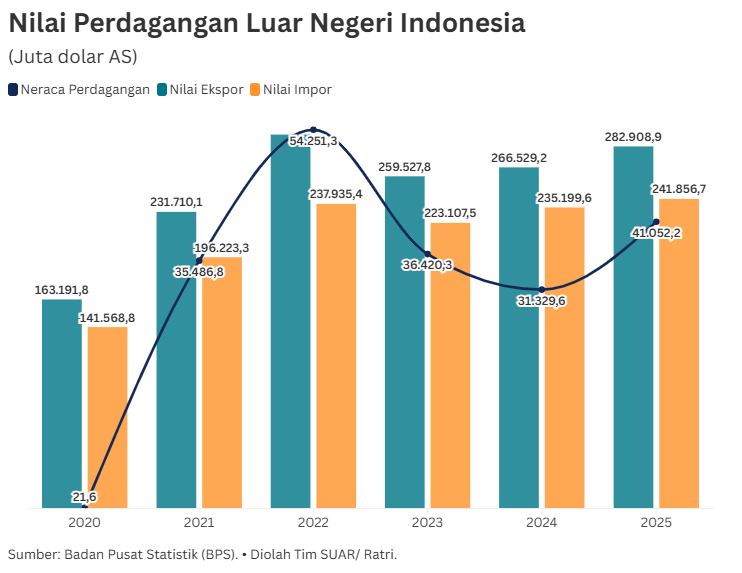


Amid global uncertainty, Indonesia has continued to record a trade surplus for 67 consecutive months since May 2020. Indonesia's total exports in November 2025 amounted to USD 22.52 billion, while Indonesia's total imports in November 2025 amounted to USD 19.85 billion. Thus, a trade surplus of USD 2.66 billion was recorded.
Deputy Head of Distribution and Services Statistics at the Central Statistics Agency (BPS) Pudji Ismartini explained that exports were supported by non-oil and gas exports in November 2025, which reached USD 21.63 billion. Despite a decline of 5.09%, non-oil and gas exports continued to play a significant role in overall export growth, contributing to 95.40% of total exports.
Indonesia's total export value from January to November 2025 reached USD 256.6 billion, an increase of 5.61% compared to the same period last year.
Meanwhile, Indonesia's import value from January to November 2025 reached USD 218.02 billion, an increase of 2.03 percent compared to the same period the previous year.
Pudji explained that the value of oil and gas exports was USD 11.81 billion, down 17.64%. The value of non-oil and gas exports rose by 7.07% to USD 224.75 billion.
When viewed by sector, the cumulative increase in non-oil and gas value occurred in the manufacturing and agriculture sectors. The manufacturing industry was the main driver of non-oil and gas export performance in January-November 2025, contributing 10.41%.
"Exports from the manufacturing sector that have increased significantly include palm oil, agricultural-based organic chemicals, non-ferrous base metals, and other electronic semiconductors," said Pudji at the BPS office in Jakarta on Monday (5/1).
China remains Indonesia's main export destination with a non-oil and gas export value of USD 58.24 billion, up 6.24% compared to January-November 2024, followed by the United States with USD 28.14 billion and India with USD 16.44 billion, with the three countries contributing 42.02 percent.
"Compared to last year's cumulative figures, January-November 2025 non-oil and gas exports to America and Europe have increased, while exports to India have decreased," he said.
Indef Executive Director Esther Sri Astuti said Indonesia recorded a trade surplus of US$ 2.4 billion in November 2025, continuing its trade surplus for 67 consecutive months since May 2020.
The positive impact of months of trade surplus is an increase in foreign exchange reserves, as foreign exchange inflows from exports add to the supply of foreign currency, strengthening the country's foreign exchange reserves.
Read also:
 Benedictus Krisna Yogatama
Surpluses can also stabilize the rupiah exchange rate, drive economic growth, and high export demand encourages increased domestic production, which contributes directly to an increase in real Gross Domestic Product (GDP).
"The trade surplus helps cover deficits in other areas such as services and primary income, maintaining the overall balance of payments," he told SUAR Jakarta (5/1).
Strong export performance improves investor perception of the country's economic fundamentals and attracts further investment.
How to Maintain a Trade Surplus
Apindo Expert Council member Danang Girindrawardana said that in order to maintain a trade surplus, Indonesia needs to diversify its export markets, strengthen the promotion of its products overseas, and accelerate the downstreaming of natural resources to increase added value.
Expand export targets to non-traditional markets such as Africa, Latin America, and the Middle East to reduce dependence on the main markets of the US, China, and India.
Promotion and economic diplomacy by optimizing the role of ambassadors and trade attachés as "salesmen" for Indonesian products abroad, as well as utilizing international trade exhibitions.
"Being active in free trade agreements (FTAs) and comprehensive economic partnerships to reduce tariff barriers can also have a positive impact on the trade balance," he told SUAR Jakarta (5/1).