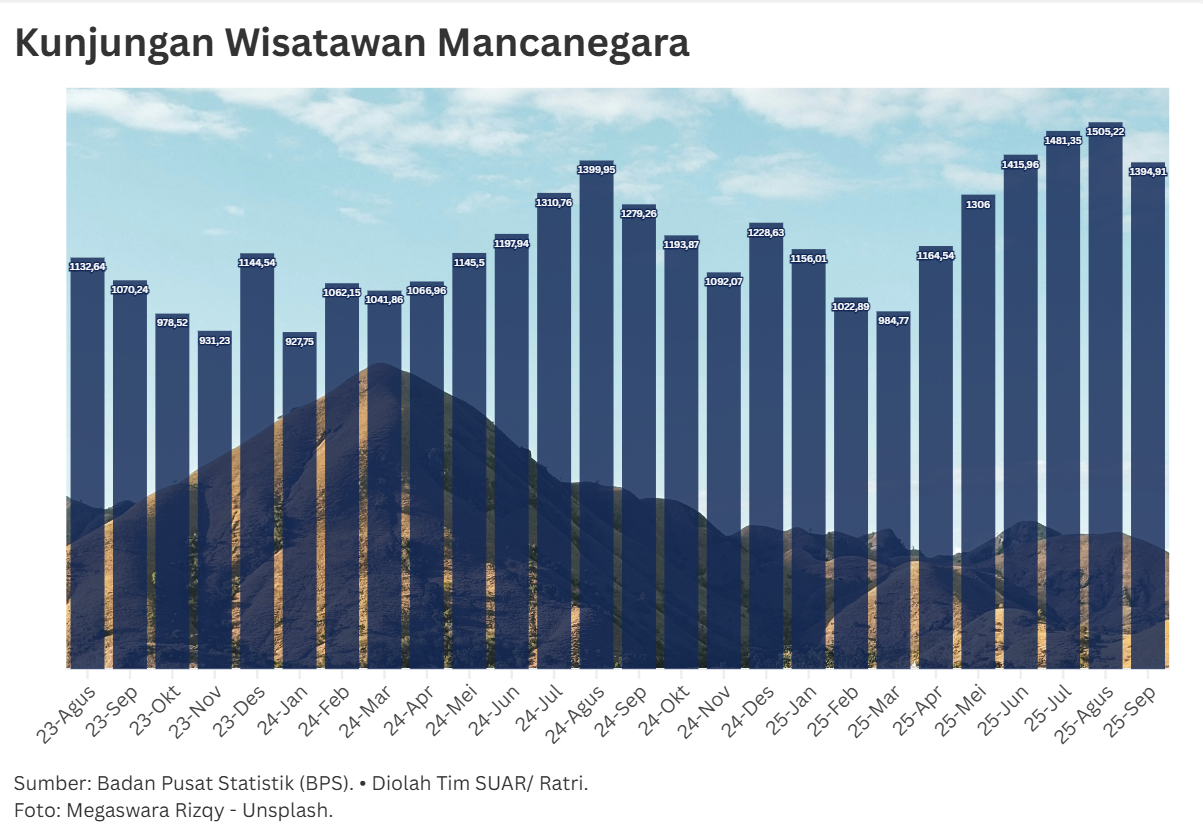
A report from the Central Statistics Agency (BPS) noted that the number of foreign tourist visits (foreign tourists) was 11.43 million visits, up 10.22% compared to the same period in 2024. However, the increase in the number of visits was not evenly distributed at all main doors of arrival. At a number of main doors, the number of foreign tourist arrivals even decreased.
The decline occurred at the main gate of Yogyakarta International Airport (-4.86%), Halim Perdanakusuma (-9.95%), Juanda (-0.01%), and the highest at Kertajati (-69.31%).
On a monthly basis, the number of foreign tourist arrivals in September 2025 was recorded at 1.39 million. This number decreased by 7.33% compared to the previous month. This decline is a natural and recurring seasonal pattern, along with the end of summer vacations in many major tourist source countries.
Based on the country of origin of foreign tourists, the largest number of visits in September 2025 came from neighboring countries. Malaysian tourists recorded 272,421 visits (19.53%), Australia 163,526 visits (11.72%), and Singapore 119,237 visits (8.55%). The dominance of tourists from Malaysia and Singapore cannot be separated from the proximity factor with the character of short, repeated or business trips.
The BPS report also noted that the average expenditure of foreign tourists in the third quarter of 2025 reached around 1,297.31 US dollars per visit, with the average length of stay increasing to 10.09 nights. Countries such as Australia and China as well as other countries outside Asia mostly have a length of stay of more than 10 days. Chinese tourists, for example, the average length of stay in Indonesia is 20.54 days. While Russian tourists reached 22.70 days.
Although the volume of visits continues to increase, the challenge of tourism development has now shifted to issues of quality and equity. The increase in the number of foreign tourists and the average length of stay demands improved supporting facilities in infrastructure as well as hygiene, safety, and service quality in tourist destinations. The government and industry players must ensure that this quantity growth is matched by a better quality of tourist experience, especially to increase thespending of tourists.
Equitable distribution of tourism outside Bali and Jakarta should also be encouraged to reduce congestion. This is in line with the global trend towards cultural immersion and health & wellness tourism that requires unique and authentic destinations. This global trend is an opportunity for Indonesia to promote various cultures and the uniqueness of authentic indigenous communities to attract foreign tourists.
With 11.43 million arrivals as of September, Indonesia is on track to meet or even exceed the 2025 annual foreign tourist target. Until the end of the year, the number of foreign tourists is predicted to increase in line with the year-end holidays.
With the current condition that the average number of foreign tourist visits is 1.27 million per month, until the end of the year the number of foreign tourists can reach 15 million visits. This number will match the number of foreign tourist visits as before the pandemic. In 2019, the number of foreign tourist visits was 16.1 million visits with an average of 1.34 million visits per month.