

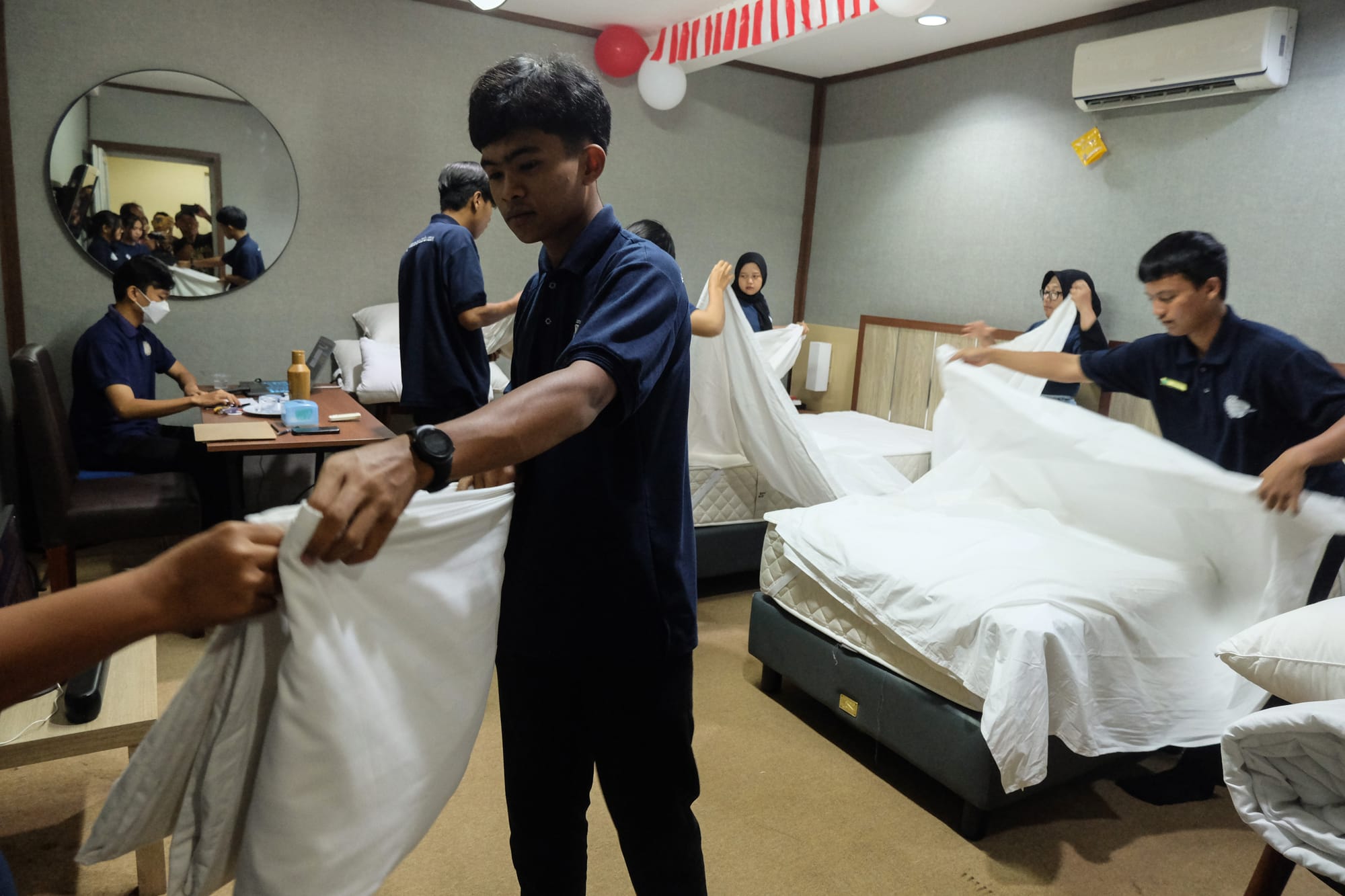
The hospitality industry is now cleaning up. The clamp holidays or often called long weekends left in September and December make them have to rack their brains to attract both domestic and foreign tourists to stay.
The government set a public holiday for September 5, 2025 to commemorate the Prophet Muhammad's birthday. Meanwhile, the next national holiday falls on December 25 to commemorate Christmas and a joint leave set for December 26, 2025, until the 2026 New Year's holiday.
Various strategies are being implemented to maximize occupancy potential during the remaining two long holiday opportunities. One of them is by collaborating with airlines and holding events.
"Not only maximizing services for guests who stay with the aim of vacationing, we also have to work together with other tourism industry players to increase visits while maintaining healthy competitiveness," Chairman of the Indonesian Hotel and Restaurant Association (PHRI), Hariyadi Sukamdani, told SUAR in Jakarta.
According to him, the implementation of Presidential Instruction Number 1 Year 2025 on Shopping Efficiency in the Implementation of the State Budget and Regional Budget has hit the hospitality industry quite hard.
The reason is, visits and activities of government officials occupy a segment of 40% to 70% of hotel revenue after domestic and foreign tourists, especially outside Java. "When the government cuts the travel budget, everything will be affected," said Hariyadi, who also leads PT Hotel Sahid Jaya International Tbk.
Not only affected by budget efficiency, the hospitality industry is also facing a tightening of travel budgets for various corporations and a ban on student study tours that has been implemented by a number of regional heads.
In addition, foreign tourists vacationing in Indonesia are increasingly renting places to stay with online room or villa rental applications that offer cheaper rates, although not all rooms or villas for rent are registered as inns in the regional tourism office database.
Encourage family tourism
The decline in hotel occupancy rates due to these external factors does not necessarily make hoteliers discouraged. With tips that focus on attracting tourists, Hariyadi encouraged hoteliers to consolidate with other sectors of the tourism industry.
"As Chairman of the Indonesian Tourism Industry Association consisting of 36 associations, we will organize a B2B Travel Mart on 9-12 October 2025 which will invite more than 300 buyers from abroad. This travel mart will also be held on October 30 to November 2, 2025 in Utrecht, the Netherlands, to bring inbound," he explained.
In addition to promotion through exhibitions, Hariyadi continued, collaboration between the hospitality industry and airlines is also being pursued. So far, AirAsia has opened the Bangkok-Kuala Lumpur-Yogyakarta route to attract foreign tourists.
The main attraction that draws travelers to the city of Gudeg is none other than Borobudur Temple.
So that tourists do not just use the hotel as a place to stay, the hotel also organizes interesting activities that can be a means of family gathering.
Activities such as soccer matches for children aged 8 years-12 years and cooking classes from the harvest of the hydroponic garden, are two examples of initiatives by Hariyadi's hotels to attract guests.
"If the children go to a soccer match or cooking class, they will definitely invite their mothers. Well, for educational activities to support children like that, middle-class parents will be interested and willing to spend money. We pack this event not only as a vacation, but also an effort to bring children to excel," he added.
In addition to organizing interesting activities in the hotel, maximizing the potential of local cultural activities is also a way to attract tourists.
This concept is worth developing by noting that with changing preferences, tourists do not just want to take a vacation, but get a memorable tourism experience or experiential tourism.
In East Java, he gave an example, there is a promo that combines a vacation package with the opportunity to witness the Kasada Ceremony on Mount Bromo. Promotions like this, in addition to introducing the richness of regional culture, also encourage vacation moments as an opportunity for family gatherings.
"The middle class increasingly has a preference forfamily-friendly events, so that is what we are encouraging. We are now playing between the many options for the middle class to travel to more attractive places abroad that are heavily promoted and have strong support from their respective governments," he said.
A survey conducted by Lokadata at the end of last year showed that the types of activities most often done when traveling include nature tourism (84 percent), culinary (63 percent), cultural visits (44 percent), adventure (27 percent), shopping (28 percent) and recreation (24 percent).
From hotel to villa
Based on data from the Central Statistics Agency (BPS), in June 2025 foreign tourist arrivals in Indonesia reached 1.42 million visits. This number increased by 8.42 percent compared to May 2025 month-to-month (m-to-m) and increased by 18.20 percent compared to the same month last year (y-on-y).
Visitors to Indonesia in June 2025 were dominated by travelers from Malaysia (16.70 percent), Singapore (12.98 percent), and Australia (10.89 percent).
Meanwhile, the room occupancy rate (TPK) of hotels in Indonesia in June 2025 reached 38.45 percent. This value increased 1.39 points compared to the previous month (m-to-m), but decreased 4.45 points compared to June 2024 (y-on-y).
However, on an annual basis (y-on-y), the TPK of star hotels in June 2025 decreased by 4.71 percent compared to June 2024. The provinces of Papua Mountains, East Kalimantan, and Riau Islands recorded the deepest decline in star hotel TPK.
According to Tourism Minister Widianti Putri Wardhana, this decline is not caused by a weakening interest in traveling, but rather due to changes in tourist preferences to stay in villas rather than star hotels.
"We are still highlighting this and we have identified that there is a shift in the preference of tourists staying in alternative accommodation such as villas, compared to star hotels," said Minister Widianti, in a Tourism report aired last July.
Furthermore, according to Widianti, her party appreciates the shift in preferences for where tourists stay. "This helps the availability of accommodation facilities for tourists and even offers a unique stay experience in the destination," she added.
Therefore, he reminded the importance of alternative availability balanced with fair business competition between alternative lodging managers and star-rated hotel managers. In addition, unregistered alternative lodging is also feared to be unable to provide protection and safety guarantees for consumers.
"For alternative accommodation issues, the Ministry of Tourism together with local governments are working on guidance so that these tourism businesses have the right permits, have the right business standards, and offer standardized services according to lodging business standards for tourists," explained Widianti.
Bank Mandiri Economist, Dendi Ramdani, assessed that the strategy of hoteliers to attract domestic tourists is a form of adjustment to the growth trend of post-Covid-19 tourist visits which is dominated by domestic tourists, both for vacation and business purposes or attending events.
"Stakeholders [tourism] must work together to empower regional tourism opportunities: what hotels are there, what tours, what culinary, places worth visiting on weekdays and those worth visiting Saturday-Sunday. Effective coordination like that does not yet exist," said Dendi when contacted by SUAR, Friday (22/08).
In addition to domestic tourists, Dendi considers the potential of allied tourists from neighboring countries in the Southeast Asia region to be a niche that has not been paid attention to so far. In fact, driving intra-regional tourist visits is more prospective and potential than inviting European and American tourists.
The reason is that the visit of allied tourists does not depend on major holiday moments, can be done in moments such as weekends, and is more adaptable to the similarities in climate, weather, food, and culture.
Dendi underlined that efforts to attract allied tourists require two prerequisites. First, attractive incentives for investors to develop tourism special economic zones for the foreign tourist segment, such as Bintan in the Riau Islands to attract Malaysian and Singaporean tourists; and Manado in North Sulawesi to attract Chinese and Taiwanese tourists.
Second,direct flight paths that make tourists do not have to repeatedly make transit to reach destinations.
"However, building direct flights is not easy. There is something called the principle of reciprocity. If we ask foreign airlines to open a route, we must also open it, while the number of our airlines is not too large and the airlines think the demand from here is not too high," he explained.
Apart from Bintan and Manado, Lombok is also a tourist destination that can experience a doubling of visits from allied tourists, if it has better access.
"Because it's useless to have a tourism special economic zone, but the flights are difficult because they have to transit through Jakarta or Bali first," concluded Dendi.
Premium class
In the midst of these conditions, tourist destinations for the premium class are still showing solid performance. Citing Lokadata research, the average annual family expenditure on entertainment for the upper 1 and upper 2 classes is increasing. In 2024, the average annual family expenditure on entertainment for the upper 1 class reached IDR 1.5 million, an increase compared to 2019 which amounted to IDR 1.2 million.
Similarly, the average annual family expenditure on upper 2 class entertainment reached IDR 600,000 in 2024, up from IDR 500,000 in 2019.
Meanwhile, the average annual family expenditure on entertainment for economic classes below the upper, namely middle and lower, did not change.
According to Lokadata, they took the definition of the upper economic class as Nielsen's criteria. The characteristics of the upper class are characterized by higher education levels, significant income, access to various resources, and influence over trends.
Lokadata Chief Data Officer Ahmad Suwandi explains that this surge in spending is not a reflection of equitable financial health. He explained, "The increase in non-food spending in Indonesia between 2019-2024 is driven by a paradox: on the one hand, the macroeconomy is growing strongly and GDP per capita is rising, but on the other hand, the middle class is shrinking by 9.48 million people."
According to him, this surge in spending is very likely due to three main factors: economic polarization, shifting middle-class priorities, and digital acceleration. Economic polarization, for example, can be seen in the stable and financially strong upper class, which has increased spending on luxury goods and premium experiences.
"The middle and upper classes have similar travel destinations but different classes, along with different spending patterns," he said. He pointed out that the upper class tends to choose premium travel experiences such as diving or sailing, while the middle class chooses more affordable experiences, such as watching concerts or visiting popular tourist destinations.