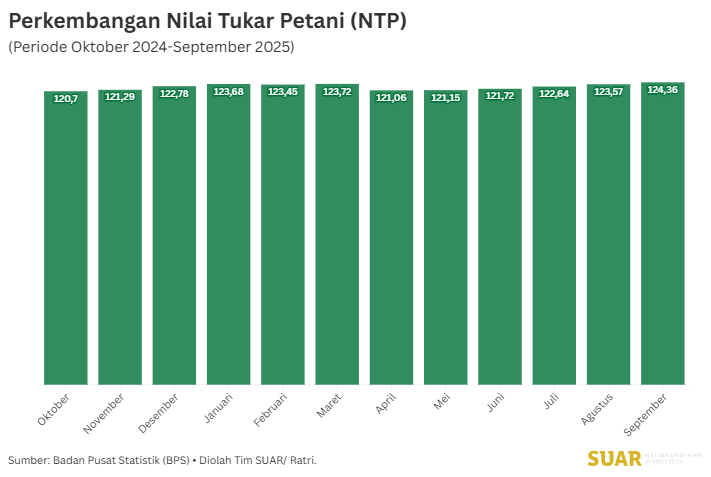
The government is working hard to achieve food self-sufficiency, especially rice. Based on calculations from the Central Bureau of Statistics, until November this year national rice production reached 33.19 million tons, up 12.62% compared to last year. Farmers' welfare as seen from the farmer exchange rate (NTP) indicator has also shown improvement.
The national rice production of 33.19 million tons is believed to cover domestic rice consumption. The National Food Agency (BPN) in a press release last May stated that rice consumption in the first 6 months of 2025 was 15.43 million tons. If it is assumed that the consumption figure in the second 6 months of 2025 is the same, it means that for one year rice consumption is around 31 million tons.
Thus, there is a surplus of more than 2 million tons. Under these conditions, the government's policy of not issuing import licenses for government rice reserves throughout 2025 is appropriate.
The 2025 Rice Balance Projection prepared by BPN shows that the availability of rice stocks nationally is safe and sufficient until the end of the year. Considerable rice production occurred in the January-April period which reached 14 million tons. While in the May-August period rice production was around 11.2 million tons.
The increase in rice production this year is in line with the increase in rice harvest areas in Indonesia. BPS noted that during the January-November period, the rice harvest area was 10.855 million hectares or increased by 12.08% compared to the harvest area during 2024.
In addition to the increase in rice production and harvest area, BPS data also shows an improvement in farmers' welfare as seen from the farmer exchange rate (NTP) indicator since October 2024. The increase in the NTP shows that farmers' purchasing power and profitability strengthened during the first year of the administration.
The upward trend in NTP starts from 120.7 in October 2024 and reaches 124.36 in September 2025. This figure, which is consistently above 100, indicates that the price index received by farmers (income from sales) is growing faster than the price index paid by farmers (production costs and household needs).
The increase of 3.66 points in 12 months is evidence of the success of the policy in keeping agricultural commodity prices favorable to farmers. The continued increase in this figure is a positive note for a vital performance to maintain the motivation and sustainability of farming businesses at the site level.
This synergy between a high NTP and efforts to increase production shows that the management of the agricultural sector is improving. An increase in NTP means that farmers have a greater economic incentive to produce, which can directly support the target of increasing harvest volume in the following year.
By keeping the NTP high, the government is not only improving the welfare of farming households, but also indirectly investing in future food security. The government's efforts to protect the interests of producers or NTP can also ensure the availability of national supply or national production. This will also strengthen Indonesia's position as the largest rice producer in ASEAN and the world.
In an effort to ensure this momentum is sustainable, factors such as weather and climate need to be the focus of the government, especially in mitigating seasonal risks and ensuring efficient availability of production facilities. These sustainable efforts will ensure long-term food self-sufficiency.