

The city government will face complex challenges in 2026 due to a decline in Regional Financial Transfers (TKD) from the Ministry of Finance. Given the city government's high dependence on TKD, this reduction in funds from the central government could potentially lead to delays in employee salary payments and a reduction in development projects. However, like skilled pilots navigating turbulence, mayors must still strive with all their might to overcome these challenges.
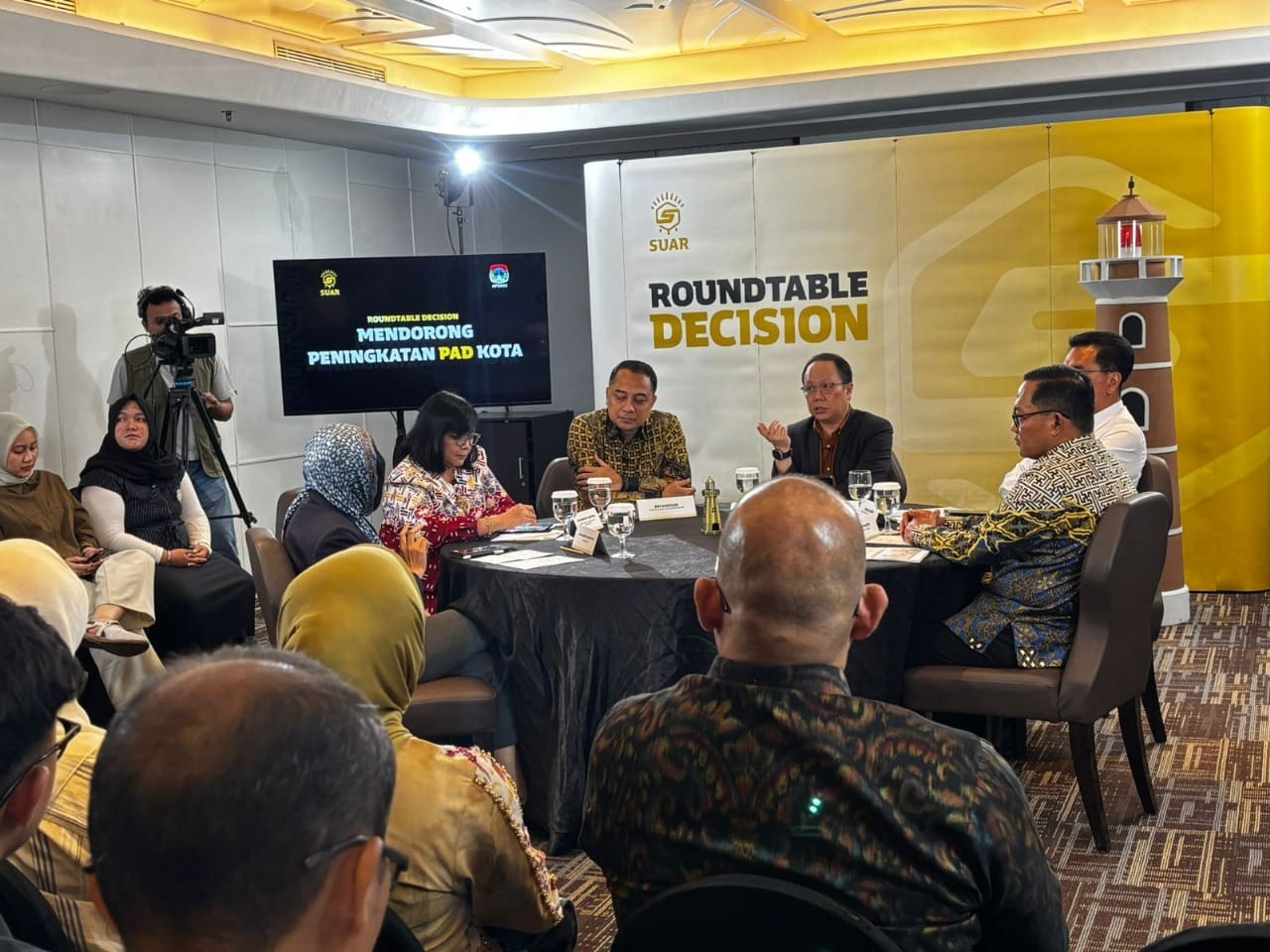
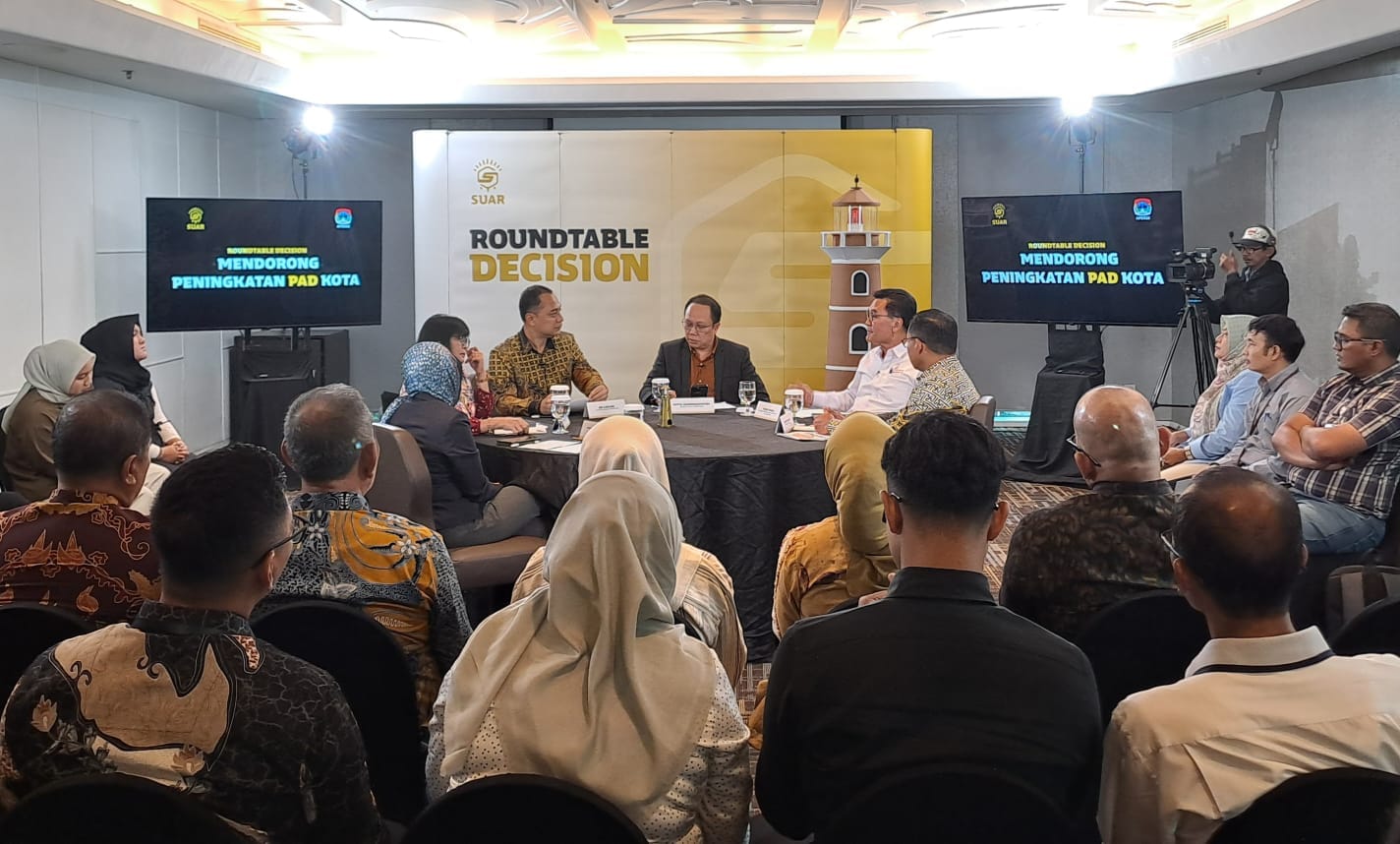
Based on this issue, Suar.id collaborated with the Association of Indonesian City Governments (Apeksi) to hold Roundtable Decision the theme "Encouraging Increased Local Revenue" on Thursday (12/11/2025) in Jakarta.
Deputy Minister of Home Affairs Bima Arya Sugiarto was present to give a speech. Also present at the discussion were the Mayor of Surabaya, who is also the Chair of Apeksi 2025-2030, Eri Cahyadi; Head of the Regional Revenue Agency (Bapenda) of Malang City, Handi Priyanto; Advisor to the Indonesian Hotel and Restaurant Association (PHRI) Yozua Makes, Director of Regional Tax and Retribution at the Ministry of Finance Lydia Kurniawati Christyana, and Researcher at the Institute for Economic and Social Research (LPEM) at the University of Indonesia Riatu Mariatul Qibthiyyah. The event will be moderated by Sutta Dharmasaputra, Founder and Editor-in-Chief of Suar.id.
Citing data from the 2026 Draft State Budget (RAPBN), released last August, TKD allocations fell 29.3% to Rp650 trillion from the previous Rp919.87 trillion (2025 State Budget).
The lowest TKD figures in the last five years have sparked protests from regional heads at the provincial, regency, and city levels. In response, the Ministry of Finance has increased the TKD fund allocation by Rp43 trillion to Rp693 trillion.
The protests from local governments over the reduction in TKD allocations are inseparable from the high fiscal dependence of local governments on funds from the central government to run regional administration and development.
As an illustration, for 2025, based on regional financial data from 93 cities throughout Indonesia (excluding DKI Jakarta), the average regional revenue sourced from TKD is 65.57%. This figure is relatively high. In fact, cities outside Java Island have an even higher dependency rate, which can reach 80%-90%. High dependence is evident in Tual City (Maluku), which reaches 92%.
Optimize all potential
Eri Cahyadi acknowledged that the decline in TKD would certainly have an impact on the running of the city government. He explained that the planning of development programs and the allocation of funds was usually carried out in May. The planning was made on the assumption that the city government would receive a budget from TKD as in previous years.
However, in August, the central government decided to reduce the amount of TKD. The amount of TKD for Surabaya in 2026 will also be reduced by IDR 730 billion.
Nevertheless, Eri encouraged mayors and city officials to view this as a challenge to spur innovation and optimize the region's potential.
"This turbulence can only be overcome with innovation," said Surabaya Mayor Eri Cahyadi, who is also the Chair of Apeksi for 2025-2030.
He said that in order to anticipate the decline in TKD, the city government needs to understand the strengths of the region. Every region, Eri continued, has its own uniqueness, whether it be natural resources, culture, or industrial economic sectors. All of these regional potentials must be optimized creatively.
Eri gave an example: in Surabaya, for example, the creation and maintenance of city parks could be funded by companies' Corporate Social Responsibility ( CSR) budgets. So, he continued, city governments could empower the business world to participate in the development of the cities where they operate.
In line with Eri, Handi from the Malang City Government said that creativity and innovation must be carried out to face the challenge of declining TKD. His party responded to this by developing regional financial digitization.
"That's what we're trying to simplify so that in Malang there is only one office. So, one office for income, one room for taxes, one room for levies. All in one," he said.
He added that, unlike shopping apps, his company simplifies the revenue side. All taxes are combined into one room. All levies are also combined into one room.
"Even though we are not the agency responsible for collecting fees, we prepare the rooms," he continued.
Justice and transparency
As a representative of the business community, Yozua acknowledged that businesses contribute significantly to the city's own-source revenue. He also realized that city spending was increasing while the available funds were shrinking.
He said that digitization in regional finance could be one example and solution amid these pressing issues. This is because digitization can help optimize tax collection and create budget efficiency.
However, this must also be accompanied by fairness. "So, the principle of fairness is important to me in terms of digitization, not only for collecting taxes, but also for the principle of fairness. This way, everyone feels that we are in this together. To be together, the system must be able to be tested for standardization," he said.
As a researcher and academic, Riatu said that each region has different conditions. There are regions where 90% of their fiscal conditions are supported by TKD. However, regional innovation investment costs, which are expected to boost PAD, also require capital.
According to him, investment in development needs to come from the central government, as local governments also have limitations. Meanwhile, the central government is tasked with monitoring so that it can compare which of the local government's innovation initiatives can be scaled up.
So, continued Riatu, there needs to be openness in cooperation between the central and regional governments, which can indeed increase the capacity of both.
"So, transparency means that everyone should not keep their data to themselves. If everyone keeps their data to themselves, it will not be optimal for cross-checking or verification," he said.
Read also:
 Tria Dianti
Lydia from the Ministry of Finance acknowledged that cities are currently experiencing turbulence. However, she believes that they are now more stable in managing their local revenue and is confident that they will be able to get through this difficult period.
This belief, he continued, was based on his calculations.
"The reason I am confident that the region will be able to survive is simple: growth data, potential local revenue, and elasticity indicate that there is still ample fiscal space," he said.
He gave an example that in 2025, the potential figure will reach 80% of the projection. This shows the increasing maturity of fiscal decentralization. According to him, the potential for local taxes is still very large. The data base can also be expanded and the monitoring system strengthened with technology.
"Our cities are becoming more mature in implementing fiscal decentralization. Their ability to manage motor vehicle taxes and various other types of taxes has proven to be growing," he said.
The central role of PAD in the national economy
Although regional in scale, according to Bima Arya, PAD plays a major role in helping to boost the national economy. He said that Indonesia is on its way to becoming the world's largest economy. To achieve this, Indonesia must achieve a minimum economic growth of 8%.
"At this point, PAD becomes the determining factor in whether or not the (economic growth) target can be achieved," he said.
According to him, one possible measure is to simplify existing regulations. The Public-Private Partnership (PPP) scheme needs to be made more flexible.
Local government assets need to be mapped and optimized. "From commercial space and advertising partnerships to the provision of parking spaces. The digitization of public services is also crucial to increasing local revenue," he said.
He added that currently there are more than 1,000 Regional Owned Enterprises (BUMD), most of which are unhealthy. Therefore, he continued, reform is a must.
To that end, the Ministry of Home Affairs is currently planning to establish a Directorate General for Regional Owned Enterprises. In addition, it will also strengthen the institutional framework for regional owned enterprises through a separate law. Currently, the legal basis for regional owned enterprises is still governed by Law No. 23/2014 on Regional Government and regulated in Government Regulation (PP) No. 54/2017 on Regional Owned Enterprises.
"In the future, with the Director General of Regional Owned Enterprises and the Regional Owned Enterprises Law, the Ministry of Home Affairs will be able to provide stronger assistance. We need an effective, transparent, and collaborative government, including exploring investments, philanthropy, bonds, and sukuk, so that regions can grow and Indonesia can progress," he said.