Jakarta and Brussels are moving to finalize the Indonesia–EU Comprehensive Economic Partnership Agreement (IEU-CEPA), but analysts warn that without a long-term industrial strategy, the country risks becoming a distribution hub rather than a manufacturing base.
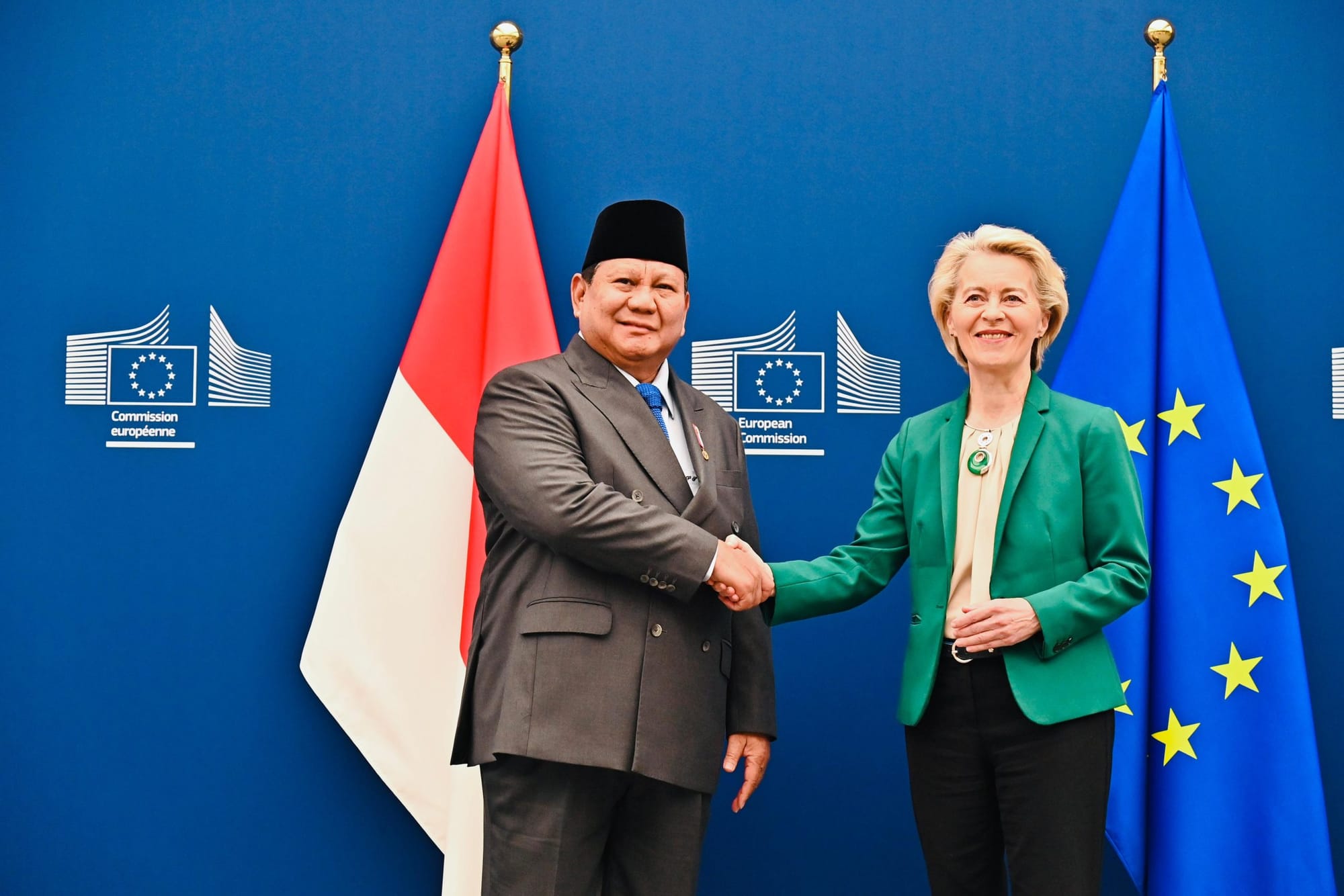
After ten years and 19 rounds of talks, Indonesia and the European Union are preparing to seal the Indonesia–EU Comprehensive Economic Partnership Agreement (IEU-CEPA). President Prabowo Subianto met European Commission President Ursula von der Leyen in Brussels on July 13, 2025, where both sides pledged to conclude the negotiations.
“I have spoken with Commissioner Maros Sefcovic, and he plans to come to Jakarta in September to sign the documents,” According to Coordinating Minister for Economic Affairs Airlangga Hartarto, referring to EU Trade and Economic Security Commissioner Maros Sefcovic Airlangga.
The government targets the IEU-CEPA agreement to take effect in the fourth quarter of 2026 or, at the latest, in the first quarter of 2027. Government estimates suggest the deal could add 0.04% to Indonesia’s GDP.

European Machines to Boost Healthcare Services
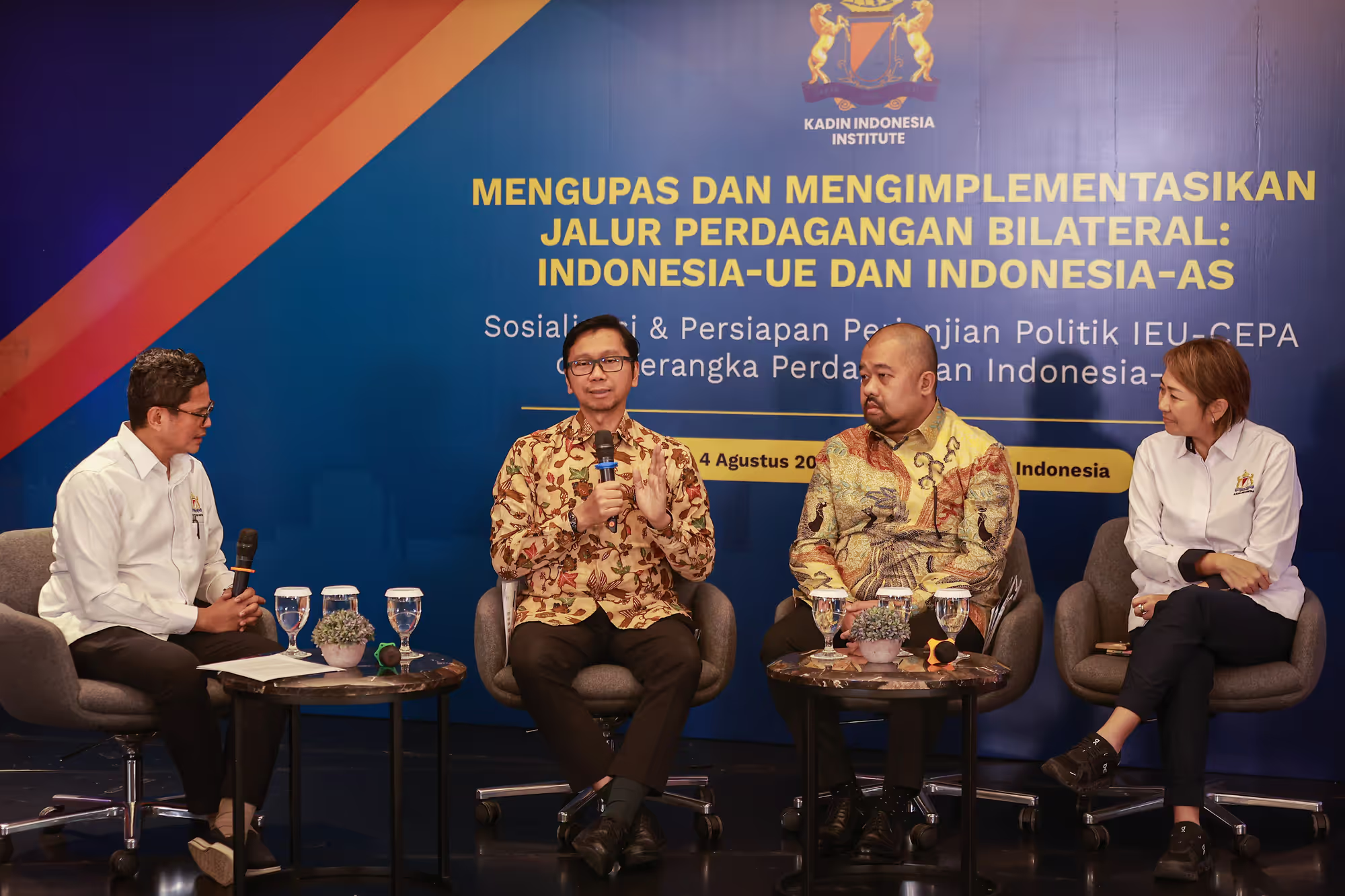
The lengthy trade cooperation negotiations between Indonesia and the European Union will cover sectors such as renewable energy, electric vehicles, information technology, pharmaceuticals, and medical devices. “The European Union is very serious about increasing investment in these sectors,” said Djatmiko B. Witjaksono, Director General of International Trade Negotiations at the Ministry of Trade, at Menara Kadin on August 4, 2025.
Djatmiko stated that the government will open the import channel for products from the European Union through IEU-CEPA. He said this step is expected to boost the performance of the national manufacturing sector. The import channel from the EU will increase the import of high-tech machines from Germany and France, which will indirectly improve the efficiency of domestic factories.
The government also hopes that opening the import channel from the EU, particularly for medical devices, will enhance the quality of healthcare services in the country. With a larger number of high-quality European medical devices in Indonesia, the standard of domestic healthcare services will improve.
“Many high-tech medical devices from Europe are indeed needed domestically. We provide these facilities so that healthcare costs can remain competitive in Indonesia,” he said.
Regarding the increase in medical device capacity in Indonesia, the government is also encouraging European investment to establish medical device factories locally. Minister Airlangga Hartarto mentioned that one of the major local pharmaceutical companies, PT Kalbe Farma, is also exploring cooperation with European manufacturers.
One of the major local pharmaceutical companies, PT Kalbe Farma, is also exploring cooperation with European manufacturers.
“The most concrete investment in the pharmaceutical and medical equipment sector that has already entered into cooperation is Kalbe (Farma), and we will build a factory in West Java,” said Airlangga when met by reporters after attending the Q2 2025 Economic Growth Press Conference in Jakarta on August 5, 2025.
Learning from the Condition of the Pharmaceutical Industry
On paper, this cooperation will benefit the domestic healthcare industry. However, analysts warn that without a long-term strategy, Indonesia could be trapped as merely a distribution hub.
Currently, nearly all domestic pharmaceutical industry activities still rely on imported raw materials, accounting for 90%–95%, mostly from China and India. The 2020 pandemic crisis demonstrated that when supply chains are disrupted, chaos ensues.
“We shouldn’t just prepare the shelves, but also prepare the kitchen,” said Heri Andreas, an economist from the Institute for Development of Economics and Finance (Indef), illustrating the risk. According to him, IEU-CEPA will only be beneficial in the long term if Indonesia negotiates binding conditions for investors to establish research centers and raw material factories locally.

He also suggested that before European investment flows in, local pharmaceutical companies should be encouraged to build research centers before investors take over production functions. “Build the research centers here first. If we can conduct strong R&D locally, they will be more interested in investing in the factories as well,” he said.
The challenge is that research costs are not cheap. The pharmaceutical industry allocates up to 15%–20% of its revenue for research and development (R&D), with a high risk of failure. Additionally, there are challenges due to strict patent protection under the intellectual property rights (IPR) chapter in IEU-CEPA. Certain clauses, such as data exclusivity and patent linkage, could make it difficult for local generic manufacturers to enter the market quickly.
Aspirations for a Regional Pharmaceutical Hub
Meanwhile, the Indonesian Pharmaceutical Companies Association (GPFI) welcomes foreign investment with a strong caveat: without fair regulations, good intentions could undermine the independence of the domestic industry.
“If European industries are interested in entering Indonesia, that’s fine, as long as they receive the same treatment as local industries. Pharmaceutical requirements and regulations are continuously increasing, so they shouldn’t be loosened,” said GPFI Chairman Tirto F. Kusnadi.
Secretary General of the Biopharmaceutical and Drug Raw Materials Association (AB3O), Irfat Hista Saputra, added that the independence of Indonesia’s pharmaceutical industry is still constrained by the high reliance on imported raw materials or Active Pharmaceutical Ingredients (API). “For pharmaceutical raw materials, the situation is still heavily dependent on imports. If these could be produced domestically, that would be excellent,” said Irfat.
Meanwhile, the production capacity for finished drugs is considered adequate. There are more than 200 drug manufacturing factories operating in Indonesia, both foreign-invested (PMA) and local producers. PMA factories are generally grouped under the International Pharmaceutical Manufacturers Group (IPMG), while local producers are organized under the Indonesian Pharmaceutical Companies Association (GP Farmasi).

Irfat explained that AB3O, together with its management team, has prepared a study on incentives to encourage the development of the domestic pharmaceutical raw material industry. The study has been submitted to several ministries and agencies, including the Ministry of Health, Ministry of Trade, Ministry of Industry, the National Agency of Drug and Food Control (BPOM), and the Coordinating Ministry for Maritime and Investment Affairs (Kemenko Marves).
“Overall, the situation is already good; it just needs to be refined,” he added.
If this strategy succeeds, Indonesia will not only be able to reduce imports but also become a regional hub for pharmaceutical production—leveraging agreements such as RCEP and APEC to access the Asia-Pacific market.