
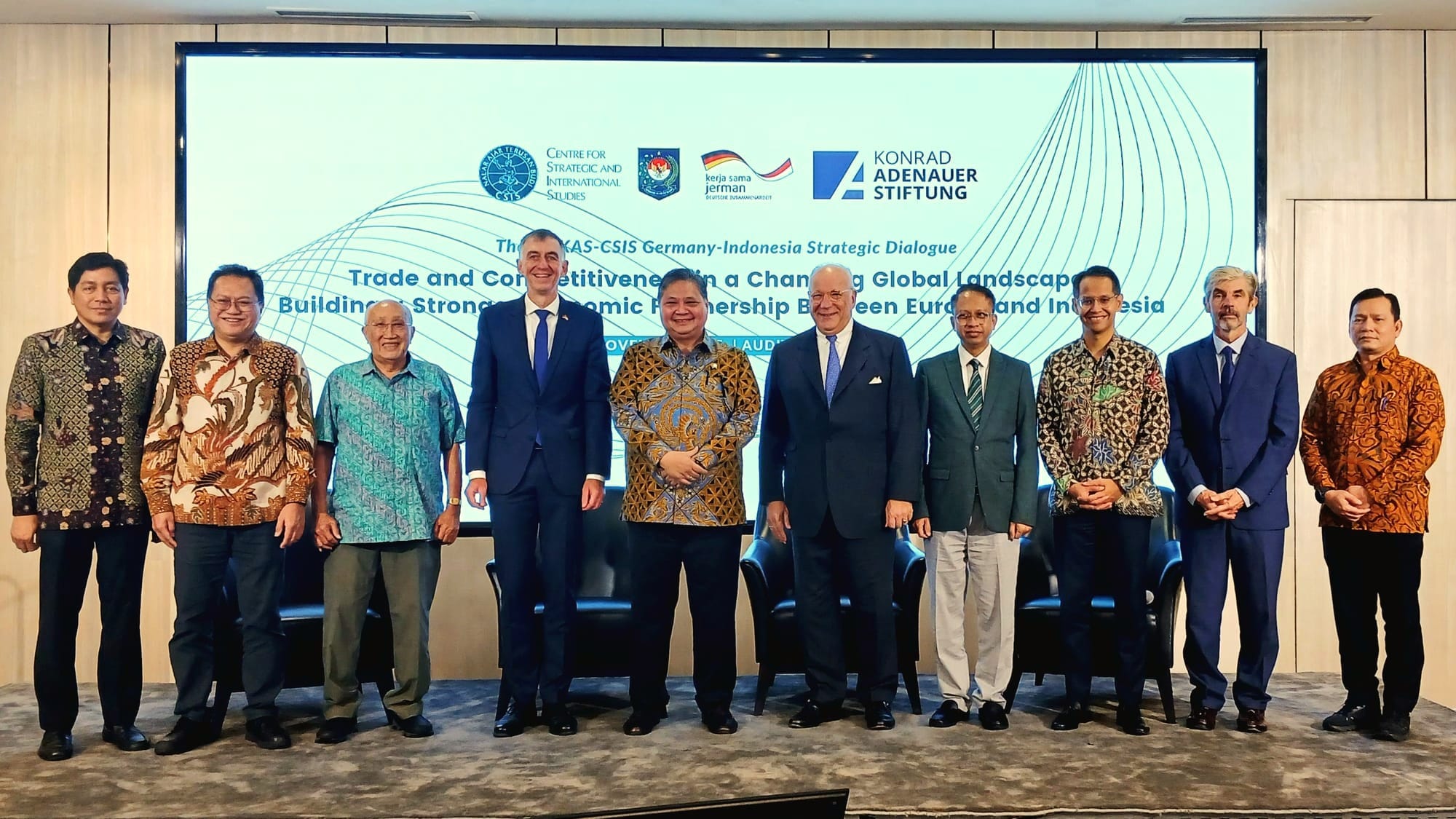
Evaluation and commitment to strengthen bilateral trade cooperation is the first step for Indonesia-Germany to cooperate amid economic uncertainty ahead of the implementation of reciprocal tariffs.
Ralf Beste, Ambassador of the Federal Republic of Germany to Indonesia, said that since he arrived in Jakarta three months ago, he has been struck by Indonesia's enthusiasm and dynamism around the I-EU CEPA agreement.
"This enthusiasm indicates that Indonesia is not only the largest market, but also a very fast growing market and is ready to work together with Germany to achieve the ideal of prosperity based on common economic interests," Beste said in a discussion in Jakarta, Tuesday (04/11/2025).
According to him, the cooperation can also utilize the momentum of the signing of the Indonesia-European Union Comprehensive Economic Partnership Agreement (I-EU CEPA), trade and investment to foreign countries is actually very important for German companies.
However, bureaucratic administrative burdens and time-consuming processes are barriers to German companies reaching foreign markets for trade and investment.
"I am entrusted with improving the investment climate and increasing trade volume, inviting German entrepreneurs to Indonesia as an investment destination, and identifying untapped trade potential. Now is the right time, utilizing the momentum of the recently signed CEPA," he said.
Affirming Ambassador Beste's explanation, Coordinating Minister for Economic Affairs Airlangga Hartarto stated that strengthening cooperation with the European Union in general and Germany in particular is very important for Indonesia's economic acceleration to reach 8% growth by 2029. The newly agreed I-EU CEPA, according to Airlangga, is the CEPA document with the most complete and detailed coverage compared to similar documents with Peru and Canada.
Read also:
 Tria Dianti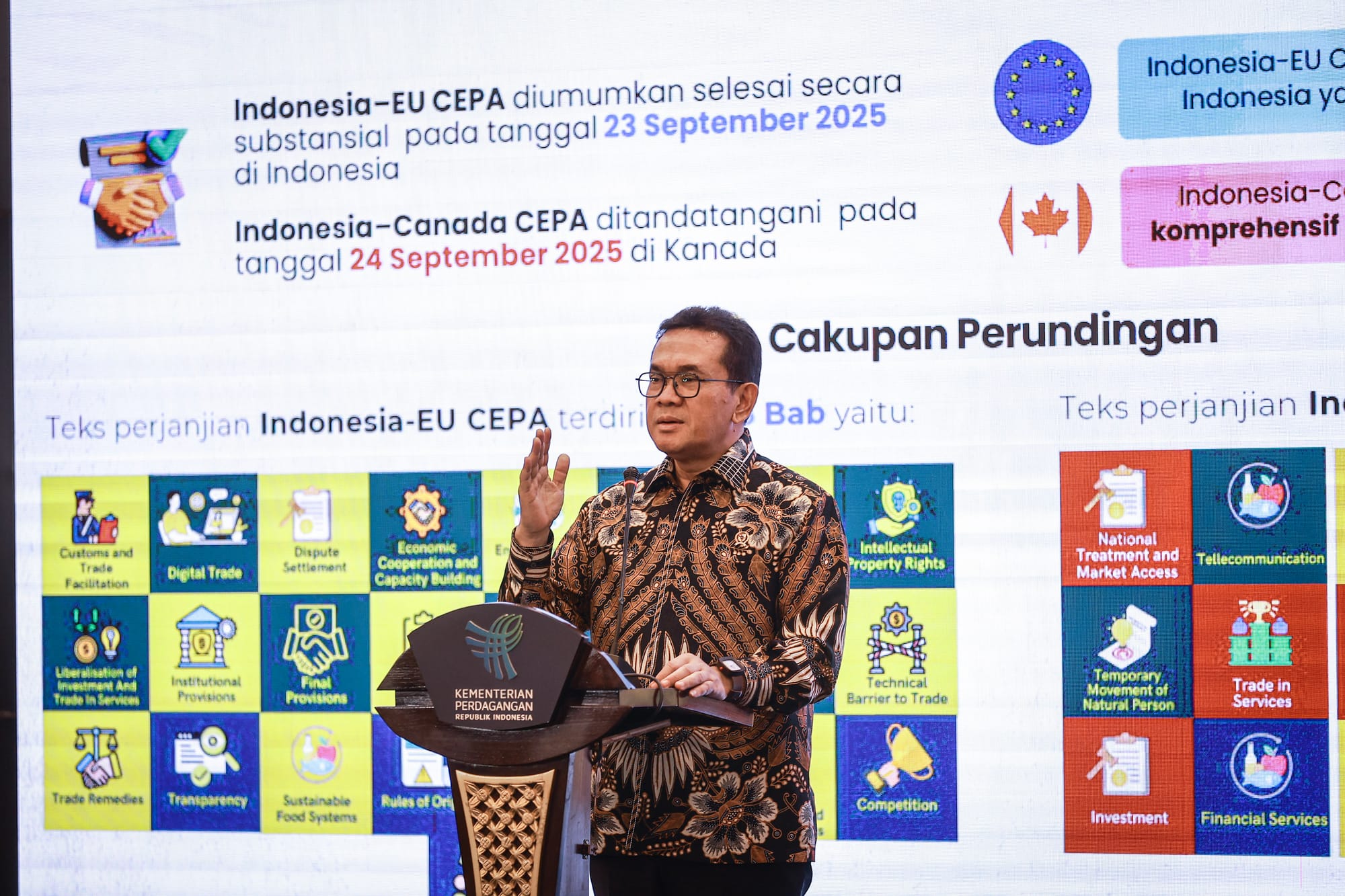
"With a trade balance of USD 15,635.01 million between the European Union and Indonesia, I-EU CEPA enhances the relationship between the two countries from ordinary trading partners to strategic partners. The European market that applies high standards is now open to Indonesian products, including agreed halal products," he said.
From Germany, Indonesia expects imports of industrial machinery and cutting-edge technology that can improve integration capabilities with global supply chains. In addition, the preparation of an online single submission policy and the establishment of a debottlenecking task force are two steps taken by the government to create a foreign investment-friendly environment.
"Indonesia and Germany need to be stronger partners in the future, and with I-EU CEPA and the support of the German government, it is time for us to act, because the environment and ecosystem have been created," Airlangga concluded.
More constructive
By choosing Germany as its main partner, Indonesia has actually found a friend who responds to each other's needs. Indonesia needs market access and technology to improve its capacity and industrial standards to meet the criteria of developed countries, while Germany needs markets and strategic resources for its domestic production.
Former Indonesian Ambassador to the World Trade Organization Iman Pambagyo said that while the United States is spearheading the erosion of global confidence in multilateral institutions such as the WTO, the I-EU CEPA agreement, which is based on WTO norms, is proof of Indonesia's firmness and commitment to multilateralism andrules-based trade.
"I-EU CEPA opens up the widest possible opportunities for diversification, industrial capacity building, and alignment of regulatory arrangements to achieve trade predictability and proportionality. By submitting to I-EU CEPA, Indonesia must learn and achieve product criteria according to the high standards of European consumers," Iman emphasized.
Strengthening the partnership with Germany, according to Iman, is a gateway for Indonesia to reap the great benefits of the I-EU CEPA. This is because, in addition to having technology and industrial quality standards that help increase the country's industrial capacity, Germany is a trusted partner that is able to foster trade relations constructively, even within a strict regulatory corridor.
"In contrast to France, which launched a restriction on palm oil, Germany has never done that against Indonesia, so it is more constructive. Just like other investors, they want regulations that are conducive and do not change suddenly. I-EU CEPA is a reference so that the deregulation we do is directed according to the needs of partners," Iman explained.
The expectation of regulatory certainty cannot be separated from the lessons learned by German entrepreneurs from the two US-China trade wars. Deputy Chief Executive Officer of Unternehmer Baden-Württemberg e.V. Tim Wenniges revealed that since the 1970s, large German companies have been built on efficiency in the sense of timely production, precise to the hour, minute and second.
"Since the trade war broke out in 2018, we have had to change our production methods to no longer interpret efficiency as precision, but rather precaution. The resilience to diversify, bringing market access and sourcing to a wider segment is, in the end, part of that new efficiency," Wenniges says.
For German industry, the most vulnerable commodities affected by the trade war are rare earth minerals and electronic machinery, especially the much-needed lithium batteries. However, the move to expand into Southeast Asia, as a diversification option, cannot be taken lightly.
"In many Southeast Asian countries, China plays a very dominant role, and even diversification is tied to supply chains that are very close to China. As a result, Germany has to be prepared for the consequences of supply chain shifts, which greatly affect our current trade relationship with the US," he said.
The partnership with Indonesia, according to Wenniges, is important as a way for the German industry to understand the importance of resilience for the industry amidst uncertainty. Fully aware that China's global-scale industrial capacity plays a huge role in Southeast Asia, Indonesia serves as a bridge to integrate European supply chains with Southeast Asian supply chains.
"With resilience coming under the scope of industrial efficiency, there is indeed a price that the industry has to pay to make a profit, especially when partnerships with Chinese supply chains become an unavoidable option," concludes Wenniges.
Giant block
Strategic partnerships with Indonesia and Germany, in addition to promising benefits for both countries, also have a systemic impact to reduce the impact of reciprocal tariffs currently faced by Southeast Asian countries. ISEAS-Yusof Ishak Institute Senior Fellow Jayant Menon sees the reconfiguration of bilateral supply chains through the I-EU CEPA framework as a way to "break through" the tariff wall by ensuring maximum benefits for both countries.
"With the US accounting for nearly 20% of world trade, regional and bilateral agreements need to consider the possibility of cooperation. Not mergers, remaining independent entities, but with stronger relationships, such as RCEP and CP-TPP," Menon said.
As a member of RCEP, according to Menon, the Indonesia-Germany partnership can be an inspiration that encourages the approach of RCEP member countries and CP-TPP member countries that have bilateral FTAs with the European Union, creating a giant bloc representing 2/3 of the world's GDP committed to rules-based multilateral trade.
"The voluntary exit of the United States creates a new environment for negotiations to continue. Much work remains to be done, but greater cooperation is needed to revive the WTO in the future, without the United States," Menon concluded.