What is the current state of the economy? What is the future direction of the economy?
It is not wrong that these two questions always echo in the minds of policy makers in the business world.
In the midst of global uncertainty and complex domestic challenges, of course they need a foothold to make the right policies. This is where the Central Bureau of Statistics (BPS) comes in to provide answers with accurate and credible data. Supported by no less than 20,900 employees spread across offices in every province and even district / city in Indonesia, BPS has an abundance of data that can certainly help navigate the economy appropriately.
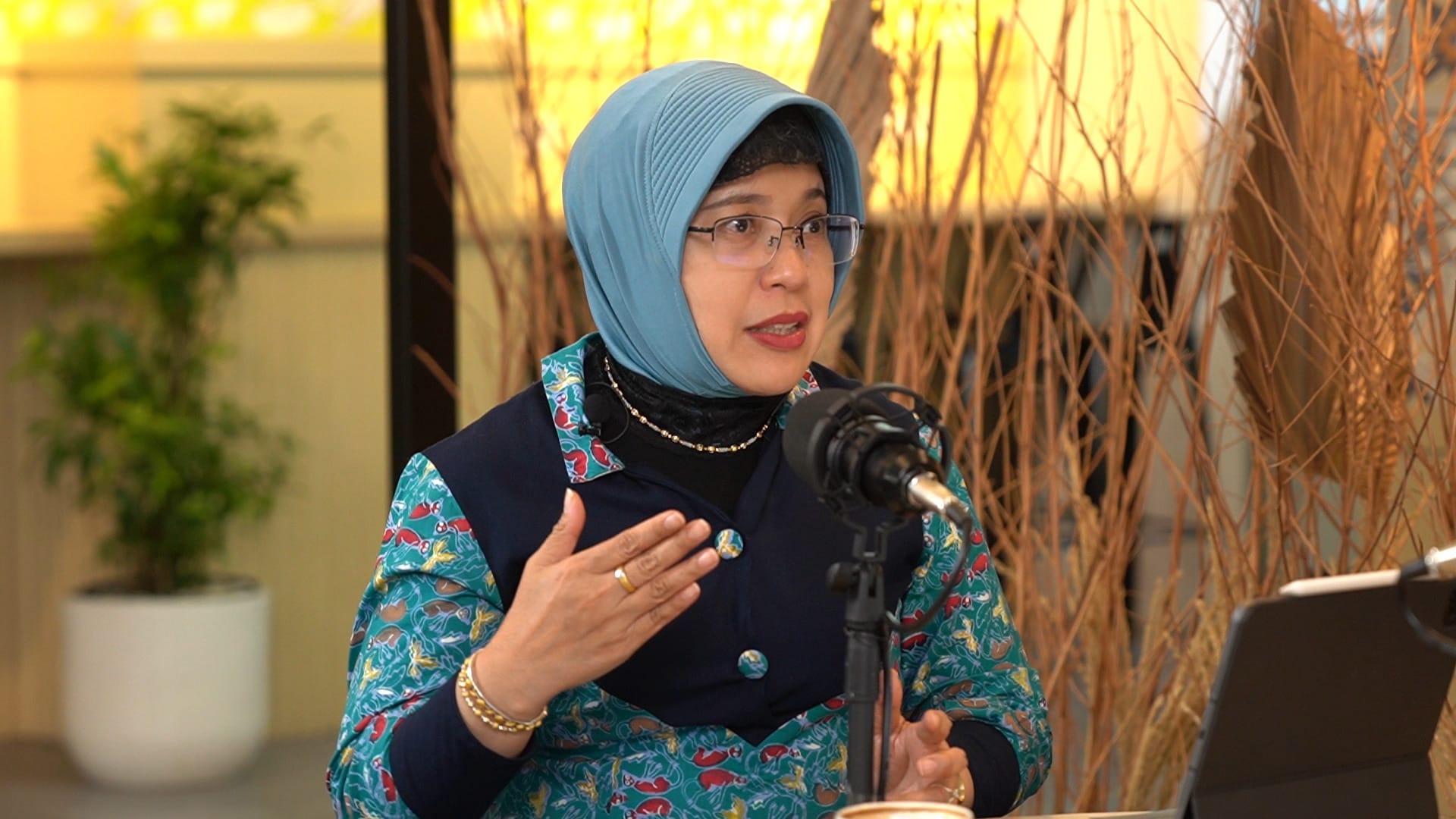
To help disseminate the wealth of BPS data on the economy, Suar.id had the opportunity to conduct an exclusive interview with BPS Head Amalia Adininggar Widyasanti at the BPS Lounge, BPS Headquarters, Jakarta, Monday (10/11/2025). For approximately 75 minutes, Suar.id Editor-in-Chief Sutta Dharmasaputra accompanied by the SUAR team Benedictus Krisna Yogatama, Ahmad Afandi, Agung Mahesa, talked to explore the meaning of economic data and how the data can help read future directions.
On Wednesday (5/11/2025) BPS released the economic growth figure for the third quarter (TW) of 2025, which was 5.04% Year on Year (YoY). Currently, President Prabowo's administration has passed 4 TWs, because this administration began in October 2024 or in TW IV-2024. During these four quarters, economic growth has fluctuated: TW IV-2024 was 5.02%; TW I-2025 was 4.87%; TW II-2025 was 5.12%. What do these data show?
If I look at it, maybe one thing, economic growth from quarter to quarter is a form of business cycle. Sometimes there are seasonal factors there. There is also the influence of external factors that we cannot even avoid. There are even certain events that also affect the economy a little or a lot. For example, in TW I-2024, there was the 2024 election, so the growth could be 5.11%. Meanwhile, in TW I-2025 the economy grew 4.87%, this is because there is a base effect. The calculation base is already high because there is an election event in TW I-2024 so that because of this base effect it becomes a little thinner. Other events such as the Eid al-Fitr and Eid al-Adha moments boosted the performance of TW II-2025.
The President has a very fantastic economic target. The target is 0-8. 0 for 0% percent extreme poverty and 8 for 8% economic growth. But it is not easy to achieve. With the current economic growth trend, what must be observed to pursue the 0-8 target?
First, what I see is that this is a very good start. Because in the first year, it is not easy. But the data here can prove, during the administration of Mr. President Prabowo, we have been able to build a very good foundation and momentum for Indonesia to rebound in the future. Now, for example, every third quarter, yes, historically, economic growth is always lower than the second quarter every year. Because what? There is no event. The third quarter is always the end of the vacation period. For domestic, people have not moved much because there are not many vacations there. School children have gone back to school. Summer vacation is a piece, yes, because usually summer vacation is what influences foreign tourists to come to Indonesia. It ends usually in August. So one of the things that drives the Indonesian economy in the third quarter is because exports were extraordinary. Because it turns out that some of Indonesia's commodities and export products have jumped quite well. In addition to the good price of CPO, there are also industrial products that we export such as chemical products, pharmaceuticals, which have grown tremendously. Then there are also exports of products from kilirization, namely local products and their derivatives, so that is the cushion of Indonesia's exports today. Well, then what we also see is that as far as high exports go, manufacturing industry activity is also growing relatively very well. If we look closely, usually in the past we often heard the term early deindustrialization. So early deindustrialization is a phenomenon where industry should be the driving force of a developing country's economy, but in Indonesia the contribution of the manufacturing industry to Gross Domestic Product (GDP) continues to decline. This is because the growth of the manufacturing industry is lower than economic growth. But it turns out that there is a reversal of the phenomenon. What many people may not realize is that since the second quarter of 2025, the growth of the GDP of the manufacturing industry has been above the growth of the economy.
This is interesting. In TW II-2025, there was a rebound in our manufacturing industry...
Deindustrialization was happening all over the world. In the past, it did. Now it is rebounding. I hope this can continue.
What does this rebound in manufacturingmean for decision-making in central and local governments?
I have observed the phenomenon of regional economic growth. Currently, it appears that regions can grow fast, even double digits. This is because of downstream industrialization in the region. In North Maluku, for example, in TW III-2025 the economy grew 39.10%. Then there was Central Sulawesi, which a few years ago could also grow in double digits. So if we look at the phenomenon of regional economic growth recorded by BPS, it turns out that industrialization is very effective in accelerating the economic growth of a region. If a region is injected with a large economic activity, its economic growth will certainly be very high because its base is small. The economic cake is still small. But this is what we are trying to maintain and replicate to other provincial economies. There is only one homework, namely that future economic growth must be inclusive.
The economic growth that can be double digits is outside Java, right?
Yes, because outside Java, the size of the economy is small, not as big as in Java. After North Maluku, the second highest economic growth was Central Sulawesi due to downstreaming. Then also in the Riau Islands (Kepri). This is interesting because SEZs are the motor of economic growth. For example, in Riau Islands, there is a special area for the electronics industry, there are also special aircraft repairs, and various kinds. In fourth place is Bali, which grew by 5.88%. What is interesting is that Bali grew not because of industrialization but was boosted by domestic tourists and foreign tourists. There is no industrialization there but they capitalize on the potential of natural and cultural wealth. So it is indeed unique if you look at how the economy stretches between one region and another. It is different.
How about employment? The unemployment rate is experiencing a downward trend. This means that more and more of our labor force is working. Any special notes that can be highlighted?
Our special note is that we must first look at the situation of our labor market. I have a diagram that I call the employment statistics tree. Now that is like our gold tree. So we can look at how much the working-age population actually increased. The working-age population in August 2025 increased by 2.8 million people compared to August 2024. And this will continue to rise, because the majority of Indonesia's population is young. Indonesia is also experiencing a demographic bonus period. So that the working-age population will always increase. Now from this working-age population, not all of them become the labor force. Why? Because if he is over 15 years old, but he is still in school, and he is still studying, he is not in the labor force. This amounts to 64 million people. But the working-age population, that is, the population above 15 years old, is now 218 million people. Of the 286 million Indonesians, 218 million are above the age of 15 or the working-age population. Of these 218 million, 154 million of them are working or looking for work. Of the 154 million labor force, there are 7.46 million people who are unemployed. So the unemployment rate is calculated from those who are unemployed divided by the labor force, then we get a figure of 4.85%. If we compare it with August last year, the percentage or open unemployment rate has indeed decreased. From 4.91 percent last year to 4.85 percent this year. Even though the number is increasing. The number of the workforce has increased. But the unemployment rate has decreased. 4,096 people. Now what is also interesting is that the labor force has increased by 1.89 million people.
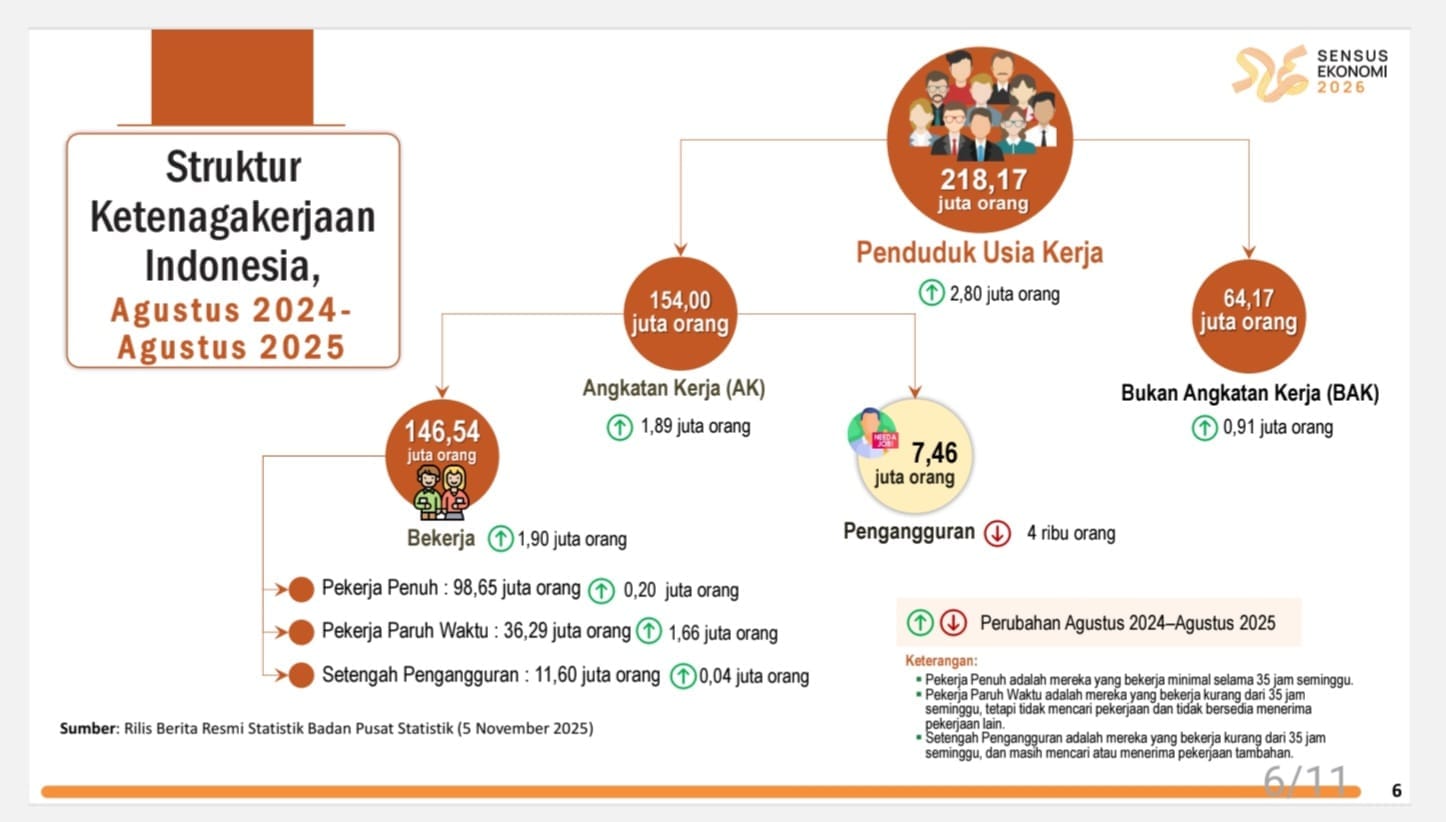
If we look at the data, the number of unemployed people with elementary, junior high, and high school education is decreasing, but the percentage of unemployed people with four-year degrees, bachelor's degrees, master's degrees, and doctoral degrees is increasing. Ideally, the labor force that is absorbed is the one with higher education. This seems like an anomaly. What is the phenomenon of this data?
First, we have to look at the number, not just the percentage. And it can be seen that the number of S1, S2, S3 graduates, from D4 earlier is indeed increasing in number. The number of people who become D4, S1, S2, S3 graduates is increasing. This is because we are indeed in the era of demographic bonus. The second is because the speed of S1, D4, S2, S3 graduates may not be matched by the speed of absorption of jobs that require these graduates. This means that in addition to minimizing the mismatch between the types of jobs and the types of graduates, the speed of absorption of jobs for D4, S1, S2, S3 graduates must also be matched. This is what needs to be done in developing countries like Indonesia, which has a large population. This also means that the labor force is large. Even 5% economic growth is not enough. Because we must ensure that the labor force can be absorbed as much as possible. This means that the economy must grow faster. If we look at it, an interesting phenomenon is that the working population with elementary school education and below is decreasing. This means that elementary school graduates who work directly will decrease. After elementary school, they are more likely to continue to junior high school, to a higher level. And this is in line with the 9-year compulsory education program, even now 12 years. This means that this is accompanied by the phenomenon of a decrease in the working population who graduated from elementary school and below. This is because it is not yet time for them to enter the labor market.
If we hear your presentation and read these data, we should be optimistic. In the midst of global uncertainty, our industry could rebound and unemployment decline...
We have to be optimistic. Because we see that the data is pointing in that direction. This is in the midst of an uncertain global situation. This means that the Indonesian economy has the strength to remain resilient amid global uncertainty. Because Indonesia is a country with a large economy. With all the resources we have, both natural resources, human resources. Then also our geographical position. And our ability to be able to complement domestic needs with the resources that Indonesia has domestically. This is something extraordinary.
From the various data owned by BPS, what are the opportunities that can be optimized from the business world?
First, from the GDP data alone, if we look at it in more detail, we will see that there is a shift in people's consumption patterns. Where now the high growth for public consumption is related to transportation or mobility. Then about communication related to data packages, mobile phones, streaming. And the second is related to restaurants and hotels. So from there we can see that indeed the demand from the Indonesian people is growing high or above 6% growth is from there. Which is related to lifestyle. If we look at business opportunities, it must be related to demand. If we enter a mall, the place that is full and in line is definitely a restaurant. So there are several malls that I have noticed that are redesigning. Redesigned to become a lifestyle center. There are movie theaters, there are cafes, there are restaurants ranging from high-end or ordinary restaurants, there are cafes just to hang out. But that's where the market is. Next, if I pay attention, people who shop must be related to lifestyle, besides food, is skincare. It's already a trend or mostly a lifestyle. It's the same as the phenomenon of people who are very happy to learn through online.