Special economic zones (SEZs) are one of the main instruments to accelerate economic growth. The concept is not just to build an industrial area, but to create an efficient investment ecosystem and become a magnet for foreign and domestic investors.
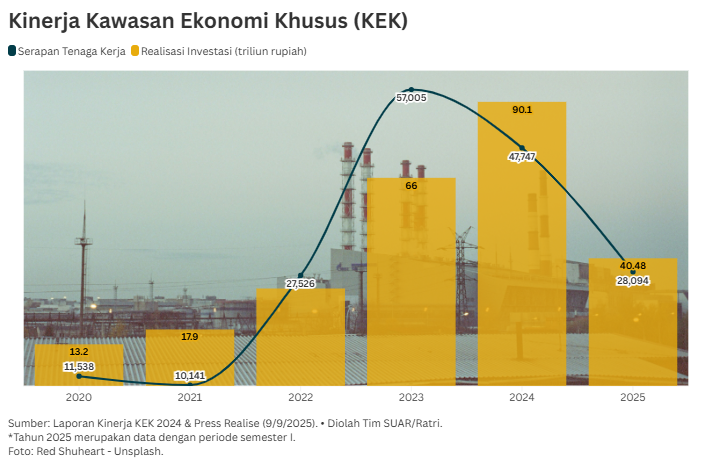
The 2024 performance report shows that this strategy is starting to pay off. Investment achievements in SEZs across Indonesia jumped significantly: from IDR 13.2 trillion in 2020 to IDR 90.1 trillion in 2024.
There are now a total of 25 SEZs, covering manufacturing, technology, and tourism sectors. This increase proves that SEZs have successfully created a more competitive business climate and attracted capital, which is an important foundation for economic acceleration.
In addition to attracting investment, SEZs also play a vital role in job creation, which is a key indicator of inclusive economic growth. Every dollar of investment that enters an SEZ has the potential to create new employment opportunities.
Based on data on the Indonesia Special Economic Zones (SEZ) website, labor absorption in SEZs shows a significant positive trend. From 11,538 people in 2020, the number jumped dramatically to reach 47,747 people in 2024. As of the middle of this year, SEZs have absorbed 28,000 workers or 56.4% of the target. However, the target was then raised to 187,376 workers this year.
This achievement not only contributes to macroeconomic growth, but also has a direct impact on people's welfare through increased employment and income. This means that SEZ development is a strategic step that does not only focus on capital accumulation, but also on the wider distribution of economic benefits.
The government also diversifies or specializes SEZs to maximize the potential of each region. Each SEZ is designed according to certain sectoral advantages. For example, Gresik SEZ and Kendal SEZ are mainstays for the manufacturing industry sector, while other SEZs such as Nongsa are developed for the digital economy and creative industry sectors.
Quoted from the Indonesia SEZ website, this year there are 6 SEZs awaiting determination by the government. One of them is the Halal Industry SEZ in Sidoarjo, East Java.
This strategy ensures that incoming investments are relevant to local potential, creating efficient and high value-added supply chains. With clear SEZ specialization, Indonesia can offer a diverse and targeted investment portfolio, attracting investors from various global industry sectors.
Despite these positive performance achievements, SEZ development still faces various challenges. Continuous efforts are needed to ensure all SEZs can operate optimally.
This does not only apply to SEZs with the largest investments such as Gresik SEZ (IDR 92.8 T) and Kendal SEZ (IDR 86.57 T). One of the main challenges is to ensure the availability of adequate supporting infrastructure in all SEZ locations. For example, road access, stable energy supply, efficient logistics facilities, and so on.
The role of the government is clearly needed to continue to simplify regulations and provide legal certainty to increase investor confidence. By overcoming these challenges, Indonesia can maximize the potential of SEZs as an engine of more equitable and sustainable economic growth throughout the region.
The SEZ strategy is a progressive step for Indonesia in facing global competition to attract investment. The success of SEZs in accelerating investment and job creation is proof of the effectiveness of this model. This is because the Incremental Capital Output Ratio or ICOR in SEZs managed to reduce the number 2-3, far from the national average which reached 6.
Thus, the encouragement of the addition of new SEZs and the improvement of the management of existing SEZs will be key to achieving the 8% economic growth target.