
Bank Indonesia's (BI) decision to hold its benchmark interest rate (BI Rate) at 4.75% at the BI Board of Governors' Meeting (RDG) in December 2025 confirms that its loose monetary policy stance will continue into next year. Liquidity expansion strategies and incentives for banks are being prepared to help BI transmit its policies to the real sector more quickly.
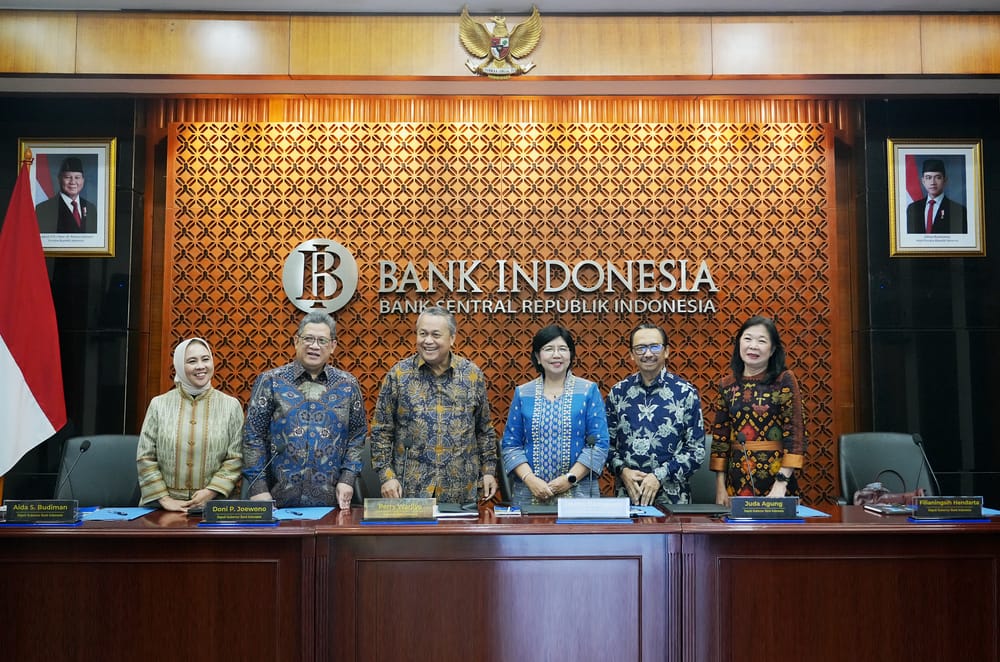
"This decision is consistent with efforts to maintain the stability of the rupiah exchange rate amid high global uncertainty while continuing to strengthen the effectiveness of monetary and macroprudential policy easing that has been pursued so far to maintain stability and boost the national economy," said BI Governor Perry Warjiyo at a press conference on the results of the BI RDG in December 2025, Jakarta, Wednesday (12/17/2025).
Perry stated that after lowering the benchmark interest rate by 125 basis points (bps) throughout 2025, followed by monetary liquidity expansion, interest rates in the money and banking markets responded in varying ways.
Cumulatively, INDONIA interest rates fell by 191 bps from 6.03% at the beginning of 2025 to 4.12% on December 16, 2025. The yield on 2-year SBNs declined by 199 bps to 4.97%, while the 1-month deposit rate fell by 67 bps from 4.81% at the beginning of 2025 to 4.14% in November 2025.
"However, the decline in bank lending rates tends to be slower and therefore needs to be continuously encouraged, namely by 24 bps from 9.20% at the beginning of 2025 to 8.96% in November 2025," Perry said in a press conference at the BI Board of Governors' Meeting (RDG) held virtually on Wednesday (12/17/2025).
As a result of this slow decline, even though bank lending grew 7.74% year-on-year ( YoY) in November 2025,undisbursed loans remained high, reaching Rp2,509.4 trillion or 23.18% of the available credit ceiling.
In fact, since the beginning of the year, BI has reduced Bank Indonesia's Rupiah Securities from IDR 916.97 trillion to IDR 735.67 trillion on December 16, 2025. In addition, BI has also purchased Government Securities (SBN) in the secondary market amounting to Rp327.45 trillion throughout 2025. Both measures aim to ensure that monetary liquidity is maintained.
Given the slow decline in bank lending rates and credit growth projections that are only reaching the lower end of the 8-11% growth target, BI has established two strategies to effectively expand liquidity for the banking sector:
- Strengthening the Macroprudential Liquidity Policy (KLM) incentives that have been in effect since December 1, 2025, by adjusting the incentive portion for banks that are quicker to lower interest rates (interest rate channel) from 0.5% to 1% of total deposits, while the incentive for banks that channel credit to priority sectors (lending channel) becomes 4.5% of DPK;
- Providing remuneration of 25 bps below the deposit facility interest rate, namely 3.50%, on bank funds placed in excess reserves to increase banking flexibility in utilizing excess liquidity for lending to the real sector and maintaining the Minimum Reserve Requirement remuneration at 1.50%.
Supplementing Perry's explanation, BI Deputy Governor Judha Agung explained that the strengthening of KLM incentives refers to the governor's council's evaluation, which shows that interest rate channel incentives have not been working well, as indicated by the slow decline in credit interest rates of 24 bps.
"As of December 16, we decided to reduce the lending channel incentive from 5% to 4.5% of total deposits, while the interest rate channel incentive increased from 0.5% to 1% of total deposits. To date, 124 banks have accepted the lending channel incentive, but only 48 banks have accepted the interest rate channel incentive. This shows that the interest rate incentive needs to be continuously promoted so that interest rates can be lowered more quickly," said Judha.
In addition to these two liquidity expansion strategies, Perry targets adjusted primary money growth of 13.3% in December 2025, which will remain in double digits throughout 2026. The synergy between BI and the Minister of Finance as the fiscal authority will be further strengthened so that liquidity flows will truly drive the economy.
"Our focus will remain on lowering bank lending rates and encouraging liquidity expansion in the banking sector so that, together with fiscal expansion and increased financing credit, this will drive the real sector," Perry concluded.
As directed
In response to the central bank's policy, the banking sector has worked hard to distribute credit in accordance with BI's directives to encourage growth and drive the real sector. This compliance is evident in a number of outstanding achievements in 2025, which will serve as a foundation for navigating business in 2026.
Read also:
 Benedictus Krisna Yogatama
Executive Vice President of Corporate Communication & Social Responsibilityat Bank Central Asia (BCA) Hera F. Haryn stated that throughout 2025, BCA will distribute credit prudently to various segments and sectors, in line with the company's commitment to supporting national economic growth.
"BCA's total credit grew by 7.6% YoY to Rp944 trillion. Meanwhile, total deposits also grew by 7% YoY. CASA remained the main contributor to BCA's funding with a value of around 83.8% of total deposits, growing 9.1% YoY to reach Rp999 trillion," explained Hera in a written statement received by SUARon Wednesday (12/17/2025).
BCA's credit quality also remained strong, as evidenced by a loan at risk ( LAR) ratio of 5.5% in the third quarter of 2025, an improvement from the previous year's ratio of 6.1%. Similarly, the non-performing loan ( NPL) ratio was maintained at 2.1%. NPL and LAR provisions are also adequate, at 166.6% and 69.5% respectively.
"In line with Indonesia's positive economic growth prospects in 2026, BCA is optimistic about continuing to encourage lending while considering the principles of prudence and disciplined risk management," Hera concluded.
That's right, stay alert
The BI's decision to maintain the BI Rate at 4.75% and focus on lowering bank lending rates is appropriate, especially after the Fed Fund Rate lowered its benchmark interest rate by 25 bps to a range of 3.50% to 3.75% in early December. However, the BI needs to be more vigilant, especially in facing increased uncertainty next year.
LPEM FEB UI researcher Teuku Riefky stated that by holding the benchmark interest rate after a 125 bps decline throughout the year, BI is signaling to investors that the central bank will focus on inflation stability after several episodes of the rupiah weakening against the US dollar.
"The policy measures taken by BI send a positive signal to investors that the central bank is prioritizing its main mandate to control the value of the rupiah rather than continuing to focus on economic growth through policy interest rate cuts," said Riefky in Jakarta on Wednesday (12/17/2025).
Riefky explained that the impact of the combination of expectations of an FFR cut and positive sentiment towards BI's decision to hold the benchmark interest rate was evident in the inflow of foreign capital into Indonesia in recent weeks, which reached USD 0.75 billion as of December 12.
"Thanks to foreign capital inflows into Indonesia, the rupiah strengthened by 0.11% month-on-month over the last 30 days and stood at Rp16,652 per USD on December 15. However, the rupiah is still in a weakening zone since the beginning of this year and has performed worse than most emerging market currencies," he said.
Sharing Riefky's view, senior economist and lecturer at the Indonesian Banking Development Institute Ryan Kiryanto hopes that BI will maintain the balance between stability and growth policies that it has pursued so far, especially by paying attention to the inflation rate of commodities consumed by the public.
"The interest rate is maintained at 4.75% so that, as the fiscal year draws to a close, our rupiah remains stable and does not depreciate, but macroprudential policies through relaxation and incentives remainpro-growth. This policy harmony must be maintained to ensure that the 'medicine' of growth continues to taste sweet, especially for the banking sector," said Ryan.