

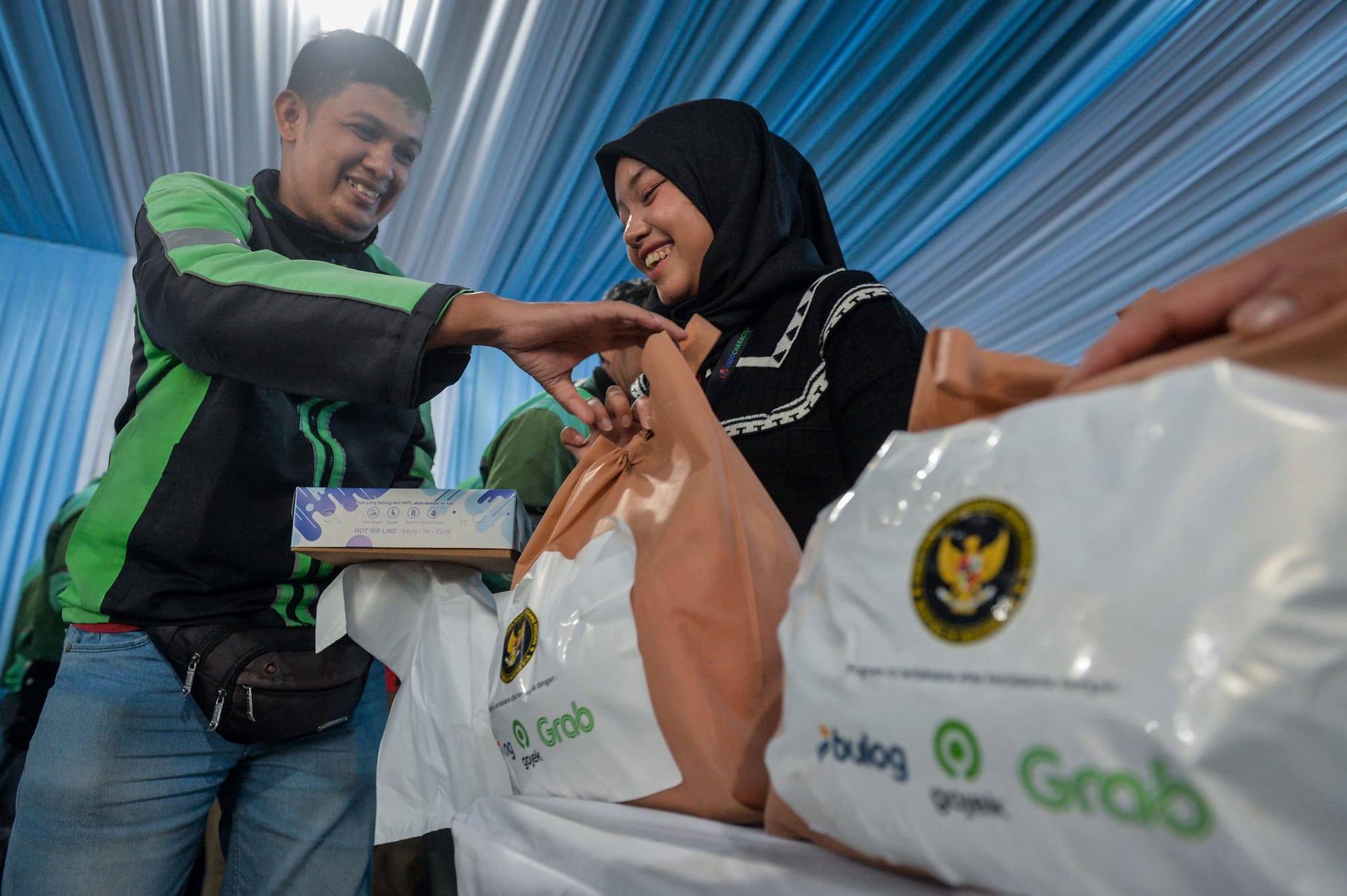
On Tuesday (1/13/2025), Grab Indonesia, a giant online transportation service provider, launched a Rp100 billion sustainable support program for driver partners as a social protection measure ahead of Ramadan and in preparation for Eid al-Fitr.
Chief Executive Officer (CEO) of Grab Indonesia, Neneng Goenadi, said that the program entitled "Grab for Indonesia" was designed in line with President Prabowo Subianto's directive to strengthen social protection for digital economy players.
"From the beginning, we believed that sustainable business growth can only be achieved when driver-partners feel safe, empowered, and have a future," said Neneng on Tuesday (1/13/2026).
Neneng claims that during its decade of operation in Indonesia, the giant technology company in Southeast Asia has contributed 50% of the total gross domestic product (GDP) of the ride-hailing and online delivery industry, as well as creating 4.6 million jobs through the digitization of micro, small, and medium enterprises (UMKM).
The "Grab for Indonesia" program is carried out in three main stages. The first stage focuses on protection, namely providing free BPJS Ketenagakerjaan (BPJS TK) for outstanding driver-partners. According to Neneng, safety is a key foundation because every day driver-partners work on the road with one important goal: to return home safely.
The second phase is appreciation, which is manifested through the 2026 holiday bonus (BHR) for outstanding driver-partners. Grab views Ramadan and Eid al-Fitr as a moment of reflection and togetherness, so this additional appreciation is expected to strengthen the sense of gratitude for the hard work of our partners.
Meanwhile, the third phase involves moving forward together through the Mitra Naik Kelas program, which is run through Grab Academy. This program encourages driver-partners to improve their skills so they can remain productive and seize new opportunities in the digital economy era.
Neneng also shared the story of Yodi, a Grab driver-partner since 2015 who upgraded to become a merchant-partner in 2018. Although he was hit hard by the pandemic and had to close his outlet and move his business to his home, Yodi bounced back thanks to the support of the Grab ecosystem and the lessons he learned at Grab Academy.
Now, he has six culinary outlets and hundreds of franchise partners in various regions, while remaining a driver partner due to the flexibility offered.
Responding to the impact on business, Neneng emphasized that all of these initiatives are long-term commitments that maintain the sustainability of Grab's business model and profit-sharing structure.
"The form of support may evolve over time, but our focus remains on protection, appropriate appreciation, and capacity building for partners," he said.
New partnership model
The launch of this program has been welcomed by the government. Acting Deputy for Industry, Employment, and Tourism Coordination at the Coordinating Ministry for Economic Affairs, Dida Gardera, considers Grab to be a pioneer of a new partnership model in the digital economy sector.
He said that the contribution of the online transportation sector to the national economy reached nearly Rp400 trillion, or around 2% of Indonesia's GDP.
"We need to maintain this partnership. The company must remain profitable, but equally important is the welfare of our partners, their families, and the surrounding community," said Dida.
According to Dida, the three-stage concept of protection, appreciation, and capacity building is a practice that goes beyond compliance, or corporate responsibility that exceeds minimum regulatory requirements.
The government itself, he said, continues to strengthen social protection for informal workers through work accident insurance, death insurance for non-salaried participants, and a 50% relaxation of BPJS Ketenagakerjaan BPU contributions.
"The government wants to provide maximum protection. We are doing this gradually by finding the optimal point, and we are grateful that companies are also taking the initiative," he said.
Similar support was expressed by Minister UMKM Abdurrahman, who emphasized the importance of maintaining a balanced ecosystem between digital platforms, driver partners, and UMKM. He called online transportation partnerships the "khittah" or best model for opening up economic opportunities due to their flexibility.
"Our presence at the Ministry UMKM, in collaboration with BPJS and Grab, is part of our efforts to ensure that our ojol friends have a better future," said Maman.
Maman considers Grab's three-stage initiative to be a constructive step. BPJS protection provides a foundation of security, BHR reflects a moral commitment even though it is not required by regulation, while the upgrade program is in line with the government's mission to encourage UMKM .
"This holiday bonus is an example of constructive partnership. It is not mandatory, but it is done to maintain mutual trust so that both parties can grow together," he said.
Regarding the assessment scheme, Maman explained that performance indicators are determined based on partner activity. Partners who do not yet meet the criteria will be evaluated and gradually improved over a period of about one month before being reassessed to receive program benefits.
Concluding his statement, Maman emphasized that the government will continue to act as the guardian of the digital economy ecosystem to ensure that it remains fair, sustainable, and provides broad benefits to the national economy.
Platform worker
Responding to online motorcycle taxi partnerships, in its policy brief , the Institute for Development of Economics and Finance (Indef) together with academics from Gadjah Mada University (UGM) encouraged discussion of the Indonesian Platform Workers Bill to become a serious agenda for the House of Representatives and the government in 2026. This push comes after the Platform Workers Bill was included in the long list of the 2026 National Legislation Program (Prolegnas).
Indef researcher Izzudin al Farras stated that the emergence of this bill is an important moment because it is the first time that the issue of platform workers has been raised to the level of legislation.
According to him, public participation, especially from academics, is necessary to ensure that discussions are conducted comprehensively and do not repeat the sectoral approach that has been taken so far.
"The structure of the Indonesian labor market is still dominated by informal workers. More than half of the workforce is in the informal sector, and in the last decade there has been a surge in solo self-employed workers, including digital platform workers," said Izzudin.
Indef data shows that the proportion of self-employed workers has increased from around 15% to 20% in the last 10 years, or an increase of around 7 million people to 31.5 million workers. Individual contract-based work, including through digital platforms, has now become an important channel for the absorption of service workers in Indonesia.
Since 2019, the number of platform workers has increased rapidly in line with the expansion of online transportation. The number of platform workers in the transportation and services sector rose from around 1 million people in 2019 to more than 2 million people in 2024. However, the increase in the number of workers has not been accompanied by an increase in income. The average income of platform workers has actually decreased compared to before the pandemic.
"Expanding participation does not automatically improve welfare. When the number of workers increases while demand remains relatively stagnant, average income is suppressed," said Izzudin.
Geographically, platform workers are concentrated in urban areas, particularly on the island of Java. Approximately 88% of online transportation workers and 81% of other gig workers are located in urban areas, with 74% of them concentrated in Java. This pattern shows that the gig economy is growing in line with the density of the metropolitan consumer market.
From a legal perspective, Nabiyla Risfa Izzati, a lecturer in labor law at the Faculty of Law, Gadjah Mada University, believes that the main issue facing platform workers is the lack of labor regulations. For more than a decade, the relationship between platforms and workers has been categorized as a partnership rather than an employment relationship, meaning that workers do not enjoy their normative rights.
"This partnership status results in uncertainty regarding wages, social security, protection in the event of termination, and maternity protection for female workers," he said.
Nabiyla also highlighted the flexibility of work that is often claimed to be an advantage of the gig economy. According to her, incentive systems and algorithms actually encourage long working hours, even up to 12–13 hours per day, with fragmented work patterns from early morning to late at night.
In addition, all operational costs and work risks, such as vehicles, fuel, and maintenance, are borne by the workers. On the other hand, the platform has strong control through algorithms in order distribution, performance assessment, and account suspension, without transparency and negotiation mechanisms.
"The control resembles a subordinate working relationship, but without labor protection," Nabiyla asserted.
Another problem is the absence of formal dispute resolution mechanisms. Because they are not recognized as employees, platform workers cannot access industrial relations dispute resolution mechanisms, so conflicts are often resolved informally with workers in a weak bargaining position.
Both agreed that the Platform Workers Bill was crucial to fill this legal vacuum. They emphasized that existing sectoral regulations, such as the Minister of Transportation's Regulation on online transportation, did not address labor protection aspects.
"We hope this bill will no longer be delayed and will be discussed within the framework of fair social protection for platform workers," said Nabiyla.