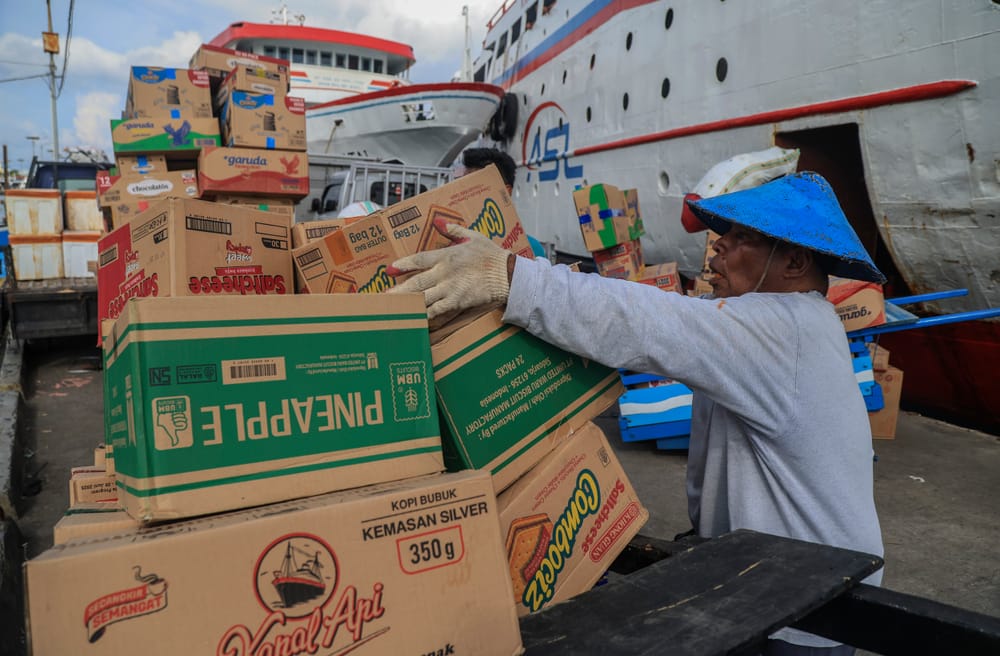
The shadow of vulnerability and uncertainty falls on 6 out of 10 workers in Indonesia due to their informal employment status. Yet, given their contribution to the economy, protection and basic rights are aspects that cannot be overlooked. Ensuring that social security programs are more inclusive and encouraging the corporatization of UMKM are two preferred solutions to mitigate the impact of vulnerability for informal workers.
This was conveyed by the panelists of the seminar "Reading the Dynamics of Informal Workers: Between Choice, Compulsion, and Policy Challenges" organized by the Manpower Policy Development Center of the Ministry of Manpower online, Friday (24/10/2025).
Head of the Planning and Development Agency of the Ministry of Manpower Anwar Sanusi stated that the informal sector is a phenomenon in Indonesia. The reason is, in an effort to pursue growth and get out of the middle income trap, Indonesia has relied on informal sector workers, especially since the Covid-19 pandemic hit.
"With Sakernas 2025 data showing 86.58 million or 59.4% of workers in Indonesia are informal, there are four things that must be considered: guaranteeing basic rights, social protection, improving skills, and a fair and sustainable ecosystem," Anwar explained.
Among these four aspects, Anwar underlined the first two. In addition to not receiving a regular income, benefits, and old-age insurance, informal workers do not have guarantees for work accidents, death, or termination of employment that can be a safety net in times of emergency.
"We hope that through this seminar, we can see and solve these four problems and what we are doing today can be our contribution so that the informal sector becomes an important player that is protected in the employment social security landscape," Anwar concluded.
Symptoms of informalization
The rapid growth in the number of informal workers cannot be separated from changes in the characteristics of the post-pandemic labor market. In addition to changes in employment status, various companies are competing to formalize employment status in order to reduce production costs and pursue competitiveness.
Tidar University Public Administration Department lecturer and labor researcher Arif Novianto explained that with the increase in the number of informal workers in Indonesia from 74.08 million workers in 2019 to 86.25 million workers in 2025, informality has changed from an exception to a new normal.
"The narrative circulating is that informal workers are considered to create independent jobs without relying on the state, showing resilience and supporting the economy. In fact, informal workers face problems of low wages, lack of legal protection, and depend on social networks," Arif said.
In his research, Arif found that the symptoms of informality began to spread since various transportation and expedition platform companies defined their workers as "partners". This label makes the company free from the obligations of wages, working hours, social security, and only pays partners based on the number of goods or services they complete.
Platform companies prove that shifting risks and responsibilities from companies to individual workers, according to Arif, is effective in reducing production costs and spurring competitiveness amid increasingly fierce global competition.
Not only in terms of wage obligations, companies are also free from legal liability, can recruit and dismiss partners at any time, and are able to reduce supervision costs by utilizing algorithms to suspend or terminate partnerships unilaterally.
"However, formalization does not necessarily create better working conditions. Even permanent employees are currently experiencing informalization, with salaried and contracted jobs starting to adopt patterns of long working hours, inhumane targets, and means of production that must be borne by workers themselves," he explained.
Examples from neighboring countries
In addition to working conditions, the elevation of employment status from informal to formal takes place very slowly. In a long-term study between 1996-2024, Economic Cluster Chair and SMERU Research Institute senior researcher Palmira Permata Bachtiar found that around 46% of informal blue-collar workers stayed in their jobs for 8-19 years.
Meanwhile, 54% had the opportunity to change jobs after 5-7 years, but only 8% of them had the opportunity to become formal white-collar workers. Beyond that, formality status does not help workers to transform, especially in terms of skills, education, and networks to grow.
"Transformation happens slowly and a small crisis can reverse the transformation. For informal low-tier workers to move, the government must design policies that increase formal employment. Transformation will be difficult without adequate formal employment," Palmira explained.
In such a situation, the much-needed social security system for informal workers in Indonesia is far from inclusive. Access to social security for informal workers remains low due to unregistered employers who are difficult to identify. Participation also requires fixed monthly contributions like formal workers.
"In fact, by accustoming informal workers to saving, sustainable social security will be created so as to reduce the burden on the government to provide social assistance in their old age. The condition is that there must be incentives that motivate them to save, in addition to the ease of requirements and procedures," he said.
Read also:
 Tria Dianti
To address vulnerability and enable informal workers to have better access to welfare, Palmira took an example from neighboring Malaysia, which launched an inclusive social security for informal workers called i-Saraan EPF in 2010. Unlike the BPJS Ketenagakerjaan system in Indonesia, i-Saraan provides very easy access flexibility for informal workers.
With an incentive of RM500 per person per year, the Malaysian government managed to facilitate 640,000 informal workers to accumulate old-age savings that can be deposited at any time and any amount, according to their income. As a result, i-Saraan managed to manage RM3.64 billion in informal workers' retirement savings and disbursed RM138 million in incentives.
"A contributing factor to the success of i-Saraan is the political commitment that encourages retirement savings for informal workers. The guarantee scheme suits the characteristics of workers: the amount of savings is free, can be deposited daily, and there are incentives from the government that motivate them to have a habit of saving from a young age," Palmira said.
Empowered business
In addition to platform-based informal workers, informal workers in the UMKM sector also need attention, with solutions that do not simply emphasize social security, but also capacity building. This is because, of the 59.5 million UMKM in Indonesia, only 17% or around 10 million have a Business Identification Number and have a formal workforce.
Bank Indonesia Deputy Director for Inclusive and Green Finance Sri Noerhidajati revealed that with a contribution to GDP of 57.14%, the informality of UMKM needs encouragement to increase productivity, easy access to financing, integration in the value chain, and adequate social protection.
"BI's main policy mix targets controlled food inflation and support for the contribution of UMKM exports, increased digital financial literacy, and economic inclusion. Strengthening is done in terms of policy, implementation, and synergy with Food UMKM , Export UMKM , Green UMKM , Tourism UMKM , and Manufacturing UMKM ," Sri explained.
BI's implementation of capacity strengthening to uplift informal UMKM is to drive corporatization, which is the formation of groups or business entities, including through the integration of a business value chain to achieve economies of scale and expand market access.
Horizontally, this practice combines several UMKM from one business sector, while vertically, corporatization is done by integrating into a large industry to achieve scalability and more easily connect with foreign buyers and banks.
Two examples of UMKM fostered by BI branch offices in Yogyakarta and Malang serve as examples. In Yogyakarta, BI fostered a horticultural farmers' association that developed marketing through an auction market and the Panenin.id application that improved production chain cooperation. Meanwhile, the Gemah Ripah II Horticulture cluster in Malang developed chili cultivation management in collaboration with Indofood.
"Throughout our strategic actions, we collaborate with ministries/agencies, universities, industries, associations, and the community itself. In this way, UMKM can connect with the market not individually, but together with strong institutions and sustainable governance," Sri said.