

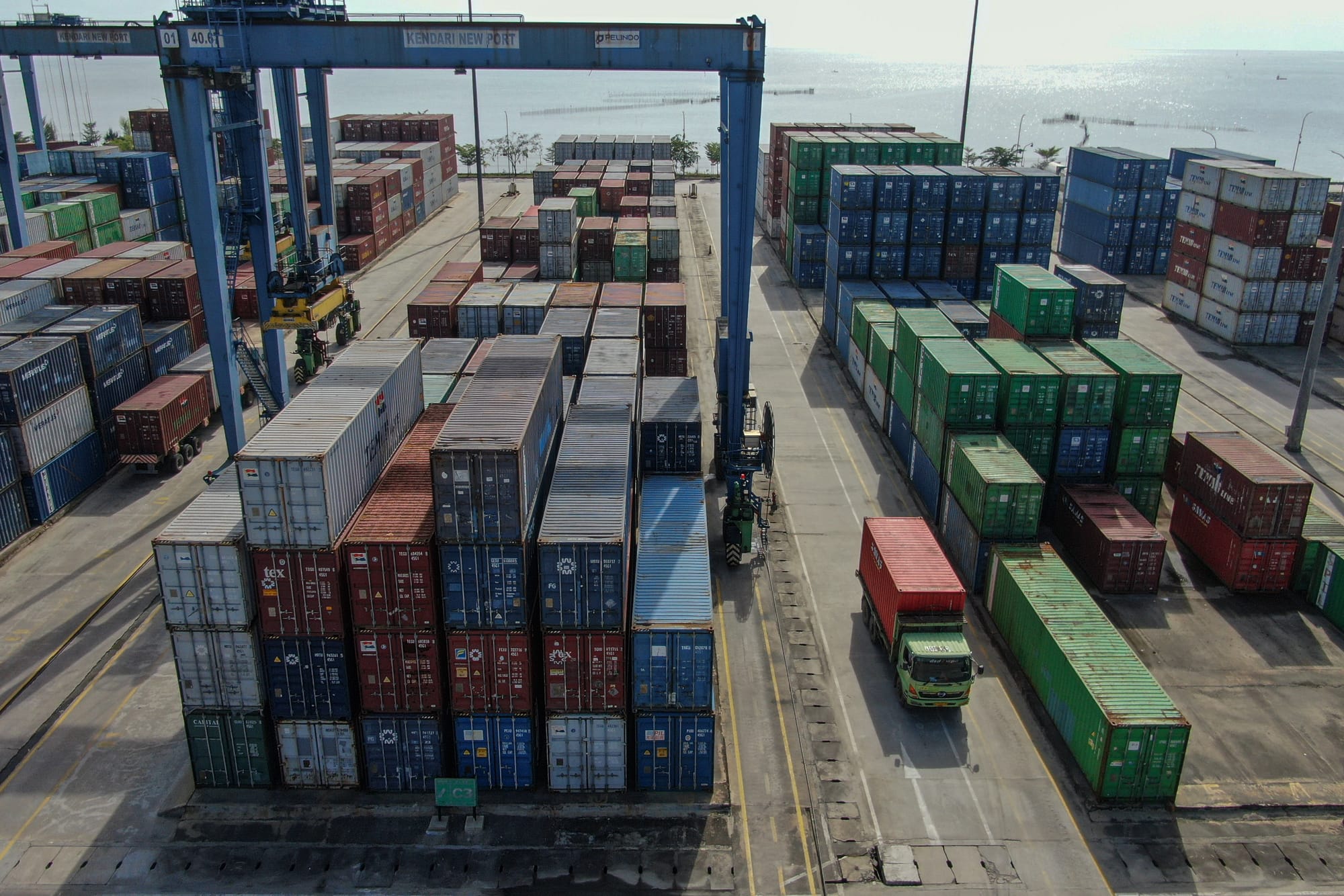
The chessboard of the world economy is shaking. From the United States-China trade war, new Trump-style tariffs, energy and food crises, to digital disruption that is changing the face of consumption and production. In the midst of this vortex, Indonesia is required not only to survive, but to dare to create strategic steps so as not to be dragged down.
Coordinating Minister for Economic Affairs Airlangga Hartarto emphasized that the business world has a central role in maintaining the direction of national development.
"The business world often loses its voice when the direction of the economy changes so quickly and is difficult to predict," he said at the launch of SUAR media in Jakarta, Thursday (21/8). Without a strong voice from business actors, said Airlangga, national productivity will be easily eroded by uncertainty.
According to him, true optimism still exists. Over the past year, the Indonesian economy grew by 5.12%, higher than previous expectations. Inflation in July 2025 at 2.37% is still within the target range of 1.5%-3.5%. The trade balance is also a surplus of USD 8.62 billion - making it a consecutive surplus in the last 62 months.
However, Indonesia cannot rest on its laurels as competition is getting tougher. We look at our neighboring competitor Vietnam, for example.
Vietnam has launched the "Vietnam 2.0" roadmap with massive deregulation and bureaucratic cuts. As a result, Vietnam's exports are now 2.5 times larger than Indonesia's, whereas two decades ago they were relatively equal.
"Other countries are also improving. Indonesia must respond quickly so as not to be left behind," said Airlangga.
The government is now preparing more systematic sectoral deregulation and digital transformation measures. One of them is through the ASEAN Digital Economy Framework Agreement (DEFA), which is believed to double the value of the ASEAN digital economy, from US$1 trillion to US$2 trillion by 2030.
Indonesia has the potential to contribute up to 40% of that value. "There's no tariff in digital economy. That's an opportunity we must take," Airlangga said.
"There's no tariff in digital economy. That's the opportunity we have to take," Airlangga said.
However, the government's role is only half the story. The most important part lies with the business world itself. Chairman of the Indonesian Employers Association (Apindo), Shinta W. Kamdani, likens this global condition to a chess game. There is a board, there are pieces, there are pawns, and there is a grand master.
"The chess pawns and the grandmaster are our skills. The economy is ultimately driven not only by numbers and formulas, but by animal spirits (John Maynard Keynes-read theory), namely the courage, imagination, and confidence of the business world. Without that, a strategy is just blank paper," he said.
"Chess pawns and the grandmaster are our skills. The economy in the end is not only driven by numbers and formulas, but by animal spirits," said Shinta.
Shinta emphasized that the Indonesian business world must dare to set its own pace, read the game board, and create a new rhythm in the global arena. For her, there are three crucial things that determine:valuation, transformation, and trust.
Digitalization and added value
Value creation has been limited to the downstreaming of commodities. In fact, the greatest added value is actually born from digitalization. "Digitalization is the highest form of value creation because it consolidates efficiency into innovation," said Shinta.
McKinsey's data backs this up: digital adoption could increase Indonesia's GDP contribution to US$140 billion or around Rp 2,300 trillion by 2030, equivalent to 9% of total GDP. This means that businesses that are able to turn data and connectivity into real solutions will be at the forefront of global competition.
The next transformation is diversification. So far, Indonesia's export markets are still highly concentrated in China, the United States, Japan and India. In fact, there are wide open opportunities in Africa, the Middle East, Russia and South America. The value of Indonesia's exports to Africa, for example, is only 1.39% of total exports; to South America only 1.11%.
"Trade diplomacy is the new weapon," said Shinta.
According to him, by strengthening the supply chain and building strategic partnerships, Indonesia can escape its dependence on traditional markets.
Diversification also involves products. Indonesia cannot keep selling raw commodities to different markets. Moving up the global value chain can only happen if Indonesian products become more sophisticated. Recent OECD data shows that 70% of global trade occurs through globalvalue chains.
However, Indonesia still seems to be lagging behind in terms of GVC integration, especially among UMKM. Gonzales' 2017 study shows that only 4.1% of Indonesian UMKM are part of the global network. Whereas in Vietnam the figure is as high as 24%, indicating far more opportunities and synergies in the neighboring country.
"Only by increasing sophistication, Indonesia can move up in the ever-changing global value chain," said Shinta.
Political will and transformation
However, true transformation is not only about goods moving across countries, but also the capacity of the workforce that can convert economic opportunities into real productivity. Shinta said Indonesia needs around 500,000 new digital talents every year to reach 12 million digital talents by 2030.
In reality, 47% of the current workforce will require reskilling and upskilling. "The biggest investment is not only in machinery and capital, but in the creation of a qualified workforce," he said. The demographic bonus will only be a strength if it is processed with good governance.
However, the business world will not be able to move optimally without a stable political foundation and political will to move forward.
Center of Reform on Economics (CORE) Indonesia Economist Hendri Saparini assessed that political stability has often been narrowly understood. "We don't just understand that political stability is simply that there are no demonstrations, then strong stability, or strong coalitions. I don't think that's what we mean by political stability," he said.
According to Hendri, stability must be redefined: not just a matter of the elite at the center, but how the central government, regions, and legislatures have the same understanding of the direction of development. "If there is no common understanding, how will we produce policies? The issues of climate change, food, energy, all require consensus," he said.
He cited the resistance of a number of provincial legislatures to the green economy agenda. In fact, without a clear energy transition and climate commitment, Indonesian export products could be subject to carbon tariff barriers from the European Union or other developed countries. The business world will clearly suffer if central and regional policies are not synchronized.
"I was invited by the provincial government, then the DPRD refused to give in to the green economy. If there is no common understanding, how can we come up with appropriate policies?" he said.
Self-confidence
Ultimately, this shows that winning global competition is not just a matter of economic strategy, but also political coordination and the courage of the business world to take a bigger role. Namely, creating a new rhythm.
With the foundation of value-added industries, digital transformation, skilled labor, and mature political consensus, Indonesia has the opportunity to become a grand master in the global arena. Not just a pawn that follows the steps of others as Shinta said.
Beyond various strategic and technical efforts to encourage the business world, it is also necessary to mobilize other efforts. Namely, building confidence that Indonesia is able to compete in the global arena.
This became an important point of the Indonesian Public Relations Convention 2025 themed Joint Innovation for a Globally Competitive Indonesia, which was held by the Indonesian Public Relations Association (Perhumas), Saturday (23/8/2025).
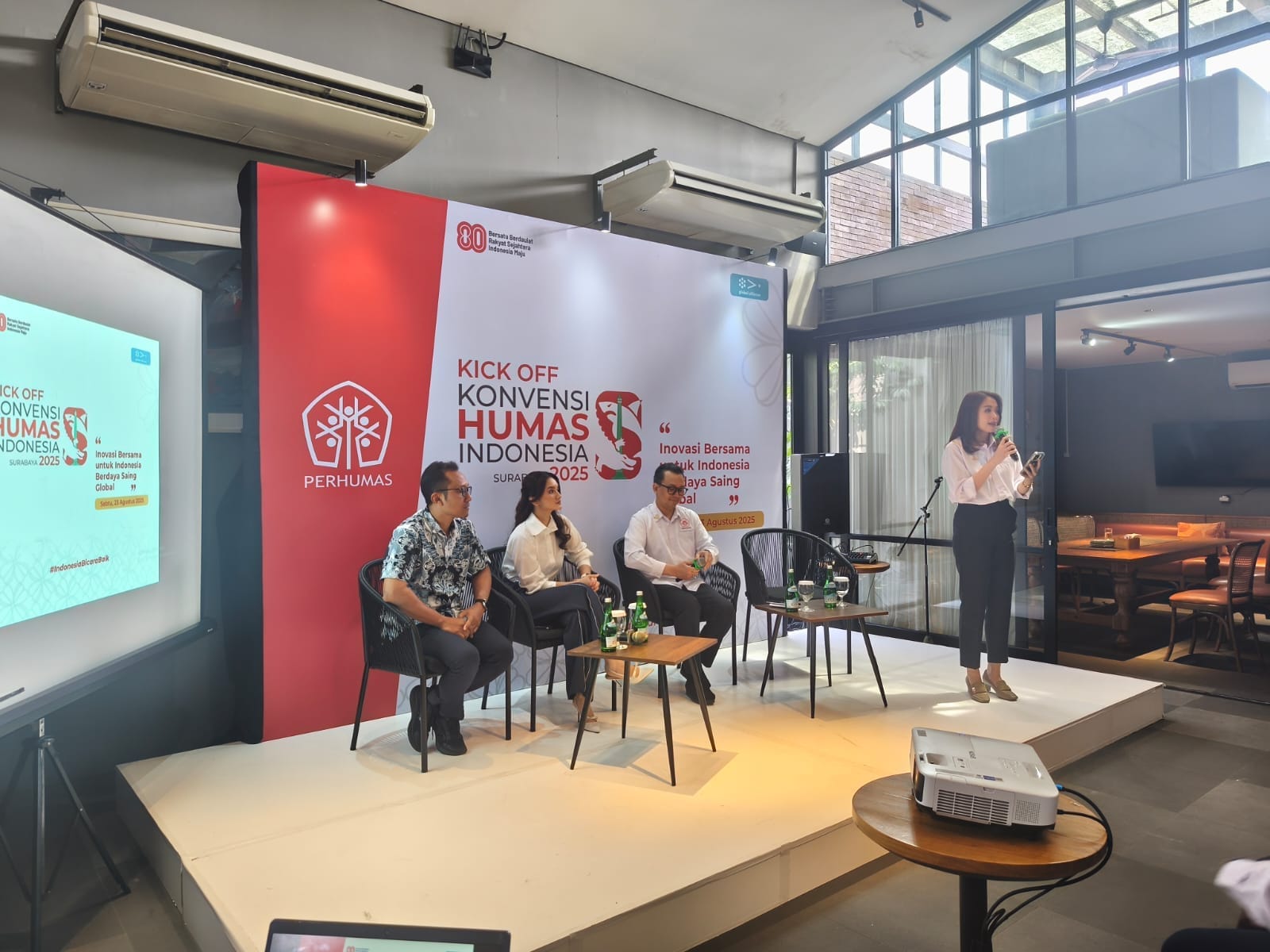
Perhumas Chairman Boy Kelana Soebroto emphasized that the Indonesia Bicara Baik campaign is still relevant today. According to him, the initiative, which began in 2015, was born out of concern over the rise of misinformation and disinformation in the public sphere.
"This movement is not easy, but it is important to continue to invite people to spread good things about Indonesia," Boy said.
He emphasized that a nation's reputation is built on a consistent positive narrative. Therefore, Indonesia Bicara Baik needs to be a collective reminder that Indonesia's soft power is built from the participation of its own citizens.
Boy emphasized that a nation's reputation is built on consistent positive narratives.
Boy mentioned the importance of the "power of five" collaboration - government, business, society, academia and media - to strengthen a common vision. "If we don't speak well of Indonesia, who will?" he said.
Boy added that the narrative of Indonesia Bicara Baik cannot be separated from the principle of openness. According to him, the message of optimism must remain factual and transparent, including through the role of the media. "We want this good talk to be not just rhetoric, but supported by data and reality," he said.
He also emphasized the importance of inviting all stakeholders to collaborate. In addition to the government and the business world, Perhumas hopes that the wider community and academics can be actively involved in this campaign. That way, Indonesia Bicara Baik does not stop in the discussion room, but takes root in everyday life.