

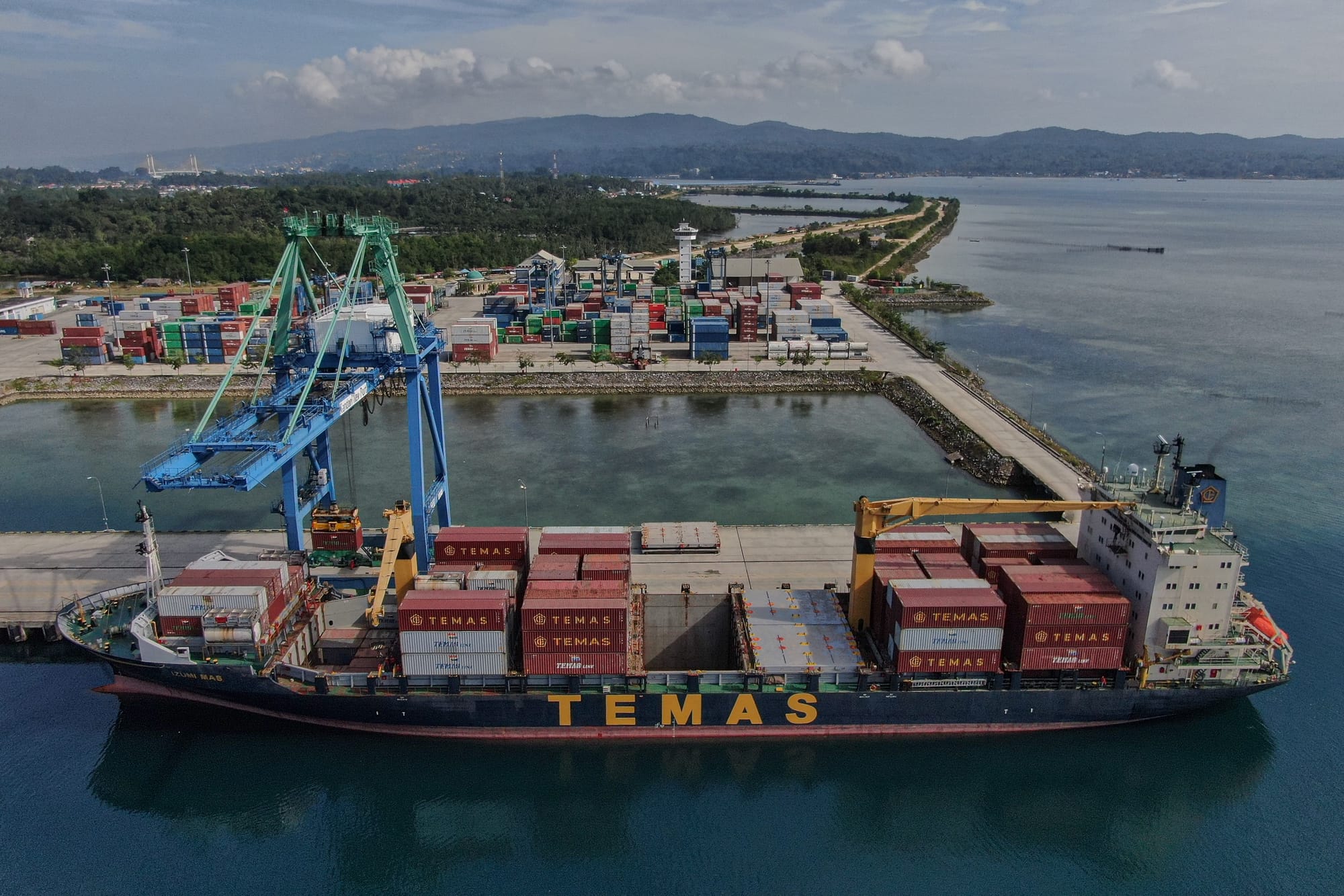
The imposition of a 19% tariff on Indonesian products to the United States (US) by President Donald J. Trump starting August 7, 2025 is one of the challenges for theshipping industry. They are challenged to take a number of adaptation steps, one of which is by exploring new route opportunities.
Since Trump announced that he would issue trade tariffs in April and only decided 90 days later, suppliers of goods from the US have been scrambling to order goods from trading partner countries including Indonesia. They imported goods from other countries before they became more expensive due to the new tariffs imposed in August.
The surge in exports to the US was also recorded by the Central Statistics Agency (BPS). Indonesia's total exports to the US in the first half of this year reached USD 14.78 billion, an increase of 33.49% compared to the same period last year of USD 12.25 billion.
The US is Indonesia's largest export destination after China. The contribution of Indonesian exports to the US reached 11.52% percent of total exports.
Chairperson of the Indonesian National Shipowner Association (INSA), Carmelita Hartoto, noted and welcomed these positive developments with the hope that these achievements would not diminish in the second half of 2025.
"We continue to follow in recent times the condition of our exports to America and see whether it will still grow or will be slowed down due to tariff changes from 32℅ to 19%. It looks like, anyway, it will be even better," said Carmelita optimistically when contacted by SUAR, Tuesday (19/08).
Although these achievements are encouraging, Carmelita does not deny that the dynamics of the trade war, in turn, will suppress export volumes. And the shipping industry, like it or not, will have to deal with it. Adaptation, according to Carmelita, is a must for an industry with a high level of risk such as shipping.
"Even if there is a decline, for the shipping industry this is something that can be overcome by adjusting the capacity of the ship or deviation looking for fatter routes. What needs to be noted is that so far our export activities are dominated by the use of foreign ships, while the red and white ships are only as feeders," he said.
Senior Consultant Supply Chain Indonesia (SCI) Zaroni said, to deal with this situation, there are several strategic steps that need to be taken.
First, market and route diversification. According to him, businesses should not only rely on the Trans-Pacific route to the US.
Seafreight companies need to strengthen networks in Asia-Africa, intra-ASEAN and the relatively more open Latin American markets. Route diversification will reduce dependence on one region that is vulnerable to protectionist policies.
The second point is to focus on non-tariff sensitive commodities. Certain products such as food, energy, and essentials remain in steady demand. Seafreight companies can shift capacity to these sectors that are relatively more immune to tariff spikes.
The third strategy is to strengthen logistics service innovation. In addition to transportation services, companies can strengthen value-added logistics services such as cargo consolidation, cold chain for fresh products, and digital tracking services that provide transparency and efficiency for customers.
Fourth, flexible capacity management. With declining volumes, vessel capacity management must be more adaptive - for example, through strategic alliances between shipping companies, vessel sharing agreements, or delaying new fleet additions.
Finally, there is a need for advocacy and collaboration with the government. The seafreight industry needs to actively dialogue with the government in encouraging export market diversification, including opening trade access with new partner countries through bilateral or multilateral agreements.
According to him, Trump's tariff policy has indeed caused real turmoil for global trade. However, smart seafreight companies will not just wait for flows to return to normal.
"It is precisely in this stressful situation that there is an opportunity to strengthen business resilience, build efficiency, and open new markets," he said.
"It is precisely in this stressful situation that there is an opportunity to strengthen business resilience, build efficiency, and open new markets," he said.
If the seafreight industry is able to transform, for example, from a mere carrier of goods to a strategic partner of the global supply chain, then the impact of protectionist policies will only be a stepping stone, not a barrier.
Executive Director of the Center of Economic and Law Studies (CELIOS), Bhima Yudhistira, confirmed the shipping industry's strategy to immediately adjust itself. In a written statement received by SUAR, Wednesday (20/08), he underlined four challenges that must be faced by the expedition industry, including shipping, in the midst of an unstable global economic climate.
First, the high tariff policy that makes freight forwarders spend more money on re-routing to low-tariff countries before exporting to the US.
Second, the supply chain is changing for both raw material and finished goods delivery due to the friend-shoring to reshoring phenomenon.
Third, shipping insurance premiums are more expensive and are passed on to freight forwarders due to the high uncertainty caused by tariffs.
Fourth, a sharp decline in volume for exports to the US, especially apparel and footwear industry products.
The shipping industry's experience of making immediate adjustments to volatile trade situations, according to Bhima, is not new. When President Trump launched a series of trade wars with China in his first term in 2018, adjustments to the routes of merchant ships had already occurred.
"But not as massive as what is happening now, because Trump's tariffs are currently targeting almost all countries in the world," he said.
Continuing Carmelita's statement, Bhima emphasized that the momentum of the trade war should be a turning point and an opportunity for the shipping industry to upgrade. So, more than just being a feeder, but the main logistics transportation that can connect Indonesian producers with alternative markets other than America, ranging from the Middle East, BRICS member countries, to ASEAN intra-regional trade.
Support for the shipping industry is also voiced by the government through the Ministry of Transportation, especially in the approval of ships entering and leaving ports in Indonesia in order to transport cargo to and from abroad.
"Since the issuance of the Job Creation Law, expedition business activities have been greatly facilitated in terms of licensing. With the ease of licensing, competition among expedition entrepreneurs is also getting tighter while export volumes are very likely not to increase significantly," said the Director of Traffic and Sea Transportation of the Indonesian Ministry of Transportation, Budi Mantoro, in a written statement to SUAR, Wednesday (20/08).
Stating that it fully understands the challenges faced by national exporters, the Ministry of Transportation always seeks coordination with relevant ministries and agencies to encourage and provide adequate support for exporters and the shipping industry to open business opportunities to potential new export destination countries to increase the volume of international trade.
Authors: Christian Wibisana and Benedict Krisna Yogatama