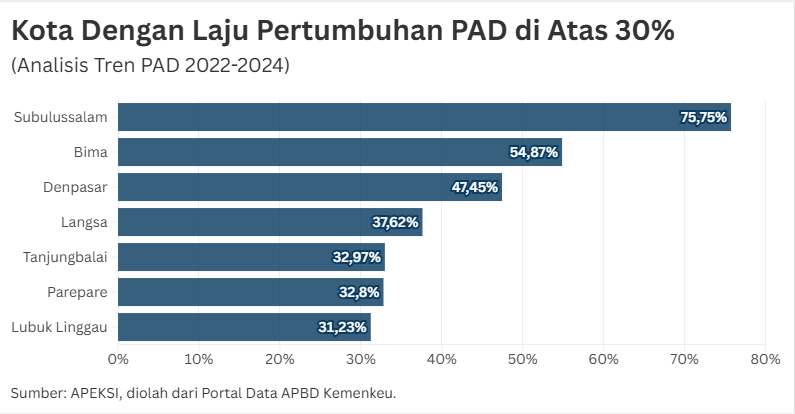
The results of data analysis during the 2022-2024 period by the Association of Indonesian City Governments (Apeksi) highlight two main growth paths. In metropolitan cities, the increase in local revenue (PAD) relies on a strong fiscal base. Meanwhile, in small cities, the increase in PAD is partly driven by the development of innovation, especially digital innovation.
Surprisingly, the highest (relative) percentage growth was recorded by small non-metropolitan cities. A total of 7.61% of cities recorded growth rates above 30%.
There are two cities with the most notable growth rates, namely Subulussalam City and Bima City. Subulussalam City recorded a growth rate of 75.75%, followed by Bima City with 54.87%.
This impressive achievement shows that rapid growth is possible even for cities with fiscal constraints (under Rp 500 billion). The report also found that this growth was driven by innovation and progressiveness in revenue management.
Key factors in boosting regional growth include implementing digitalization to intensify revenue, increasing the focus on taxable objects, and restructuring revenue management organizations. This proves that improving fiscal quality and implementing appropriate collection strategies can accelerate local revenue performance, even with limited resources.
In contrast to relative growth rates, a review of absolute (absolute) PAD growth is dominated by large metropolitan cities that already have a strong revenue base. These physically and institutionally stable cities recorded the largest increases in rupiah value, confirming their significant contribution to the national PAD total.
This dominance is due to the capacity of metropolitan cities to optimize their established tax base, allowing them to add hundreds of billions of rupiah to their revenue each year.
The three cities that recorded the highest absolute PAD growth (above Rp 690 billion) were Denpasar, Surabaya, and Medan. Denpasar was the most successful among all cities, recording an additional PAD value of Rp 802 billion while maintaining the highest relative growth rate among metropolitan cities, namely 47.62%. This was followed by Surabaya with absolute growth of Rp 711.39 billion (11.8% growth) and Medan with Rp 693.61 billion (22.1% growth).
This growth confirms that metropolitan cities, supported by their large economies of scale, remain the largest contributors to the rupiah, solidifying their contribution to the regional economy.
In general, an increase in a city's PAD, both in percentage and value, can be attributed to two main pillars. For small (non-metropolitan) cities, the key is a progressive intensification strategy through innovations such as digitization and management restructuring to tap into untapped potential.
Meanwhile, for metropolitan cities, the increase in PAD was driven by a strong fiscal base and institutional capacity that allowed for significant absolute value additions.
The success of sustainable PAD growth lies in the combination of digital innovation capabilities and efficient resource management to explore new revenue potential amid the dynamics of fiscal competition between cities.