
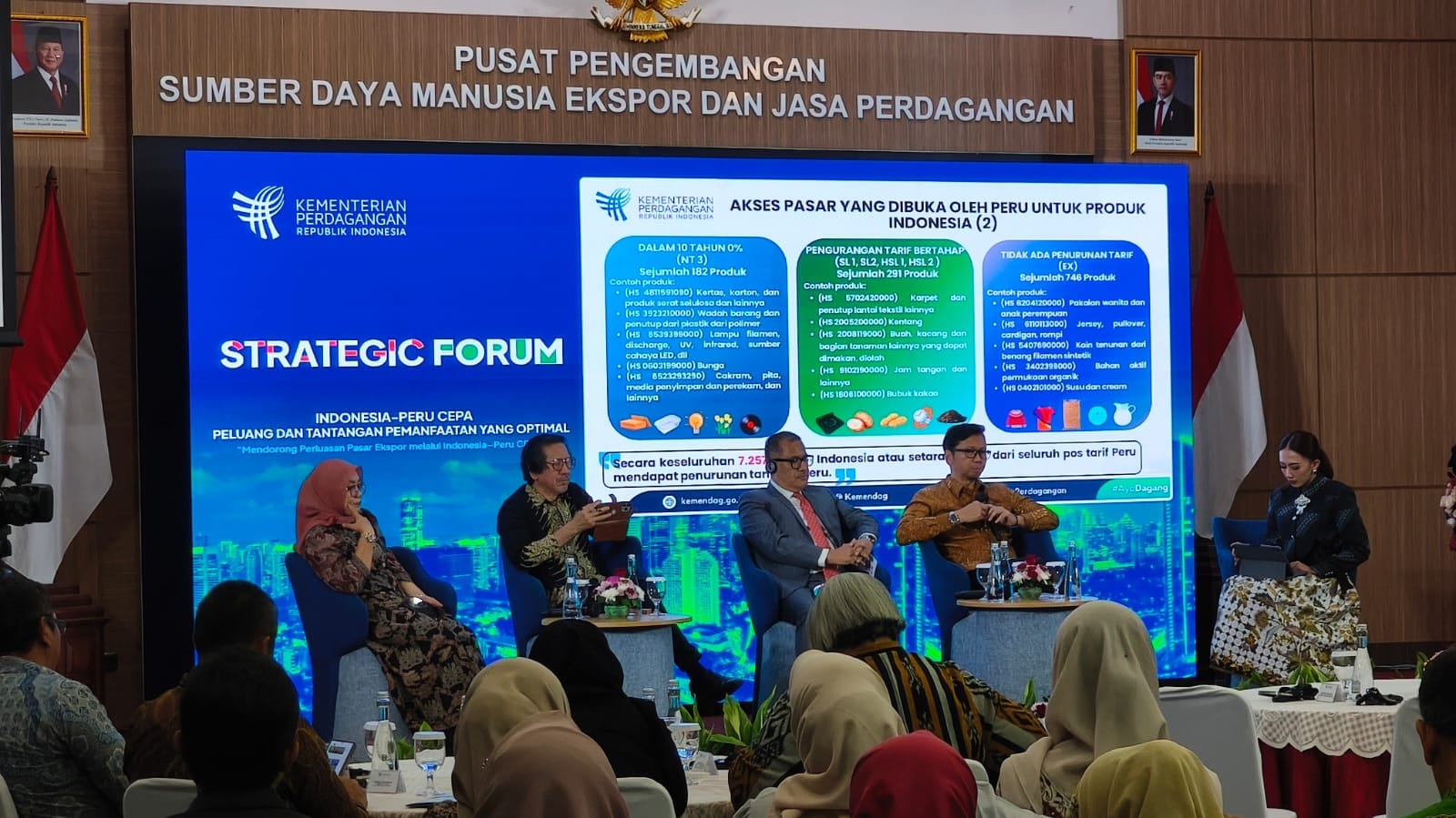
The Indonesian government through the Ministry of Trade is expanding export markets to Peru through the Indonesia-Peru Comprehensive Economic Partnership Agreement (CEPA) and also to Tunisia through the Indonesia-Tunisia Preferential Trade Agreement (PTA). These agreements aim to strengthen Indonesia's economy and trade with these two countries, especially by expanding export markets for a number of commodities.
In order to discuss a number of opportunities from the two agreements, the Ministry of Trade held a Strategic Forum at the Auditorium of the Ministry of Trade's Export and Trade Services HR Development Center (PPEJP) in Jakarta on Tuesday (25/11/2025).
I-P CEPA itself has been negotiated since May 23, 2023, until it was finally signed on August 11, 2025. The I-P CEPA negotiations used an incremental approach or the goods trade negotiations were completed first. Meanwhile, the I-T PTA is still awaiting the signing of the two countries and has been completed.
Director General of International Trade Negotiations at the Indonesian Ministry of Trade, Djatmiko Bris Witjaksono, said that Indonesia is currently harvesting trade agreements, and there are still 3 more agreements waiting to be signed.
"We still have 3 agreements to sign, European Union, Eurasia, and Tunisia. Hopefully in the near future we can also sign these three agreements," said Djatmiko.
From 2020 to 2024, Indonesia's total trade value with Peru showed a positive trend of 15.1%. Meanwhile this year from the January-September period, the total trade between the two countries reached USD 401.9 million, which increased by 20% from the same period last year amounting to USD 333.2 million.
The agreement with Peru benefits Indonesia in terms of opening new market access for various commodity sectors. There are at least 10 main Indonesian export commodities in the I-P CEPA, including passenger cars and other motor vehicles, footwear from textile materials, palm kernel oil, refrigerators, leather footwear, plastic or rubber footwear, paper and cardboard, margarine, cloves, and printing machines.
"We see that Indonesia's main exports to Peru are vehicles, so cars and other motorized vehicles, worth 120 million dollars. So this will enjoy, really enjoy the tariff reduction. Then there are also footwear, palm oil, cabinets, and others," he explained.
The impact of this agreement was felt immediately upon direct implementation. There are at least 6,110 products from fresh, chilled or frozen filets and other fish meat (HS 0304440000), electric motors and generators (HS 8501201100), motor vehicle parts and accessories (HS 8708100000), paper and paperboard (HS 4802100000), and palm oil and its fractions (HS 1511100000).
"Then in the next 5 years there are around 500 products, in 7 years there are 111 products. So it means that the majority of products that we produce or produce or even those that we export, will enjoy from this agreement," he continued.
In total, 7,257 Indonesian products or equivalent to 90.68% of all Peruvian tariff posts received tariff reductions from Peru. After this, there are still negotiations on trade in services and investment carried out 2 years after the implementation of the goods trade agreement, then negotiations on product-specific rules for certain products carried out 4 years after the entry into force of the goods trade agreement.
Read also:
 Benedictus Krisna Yogatama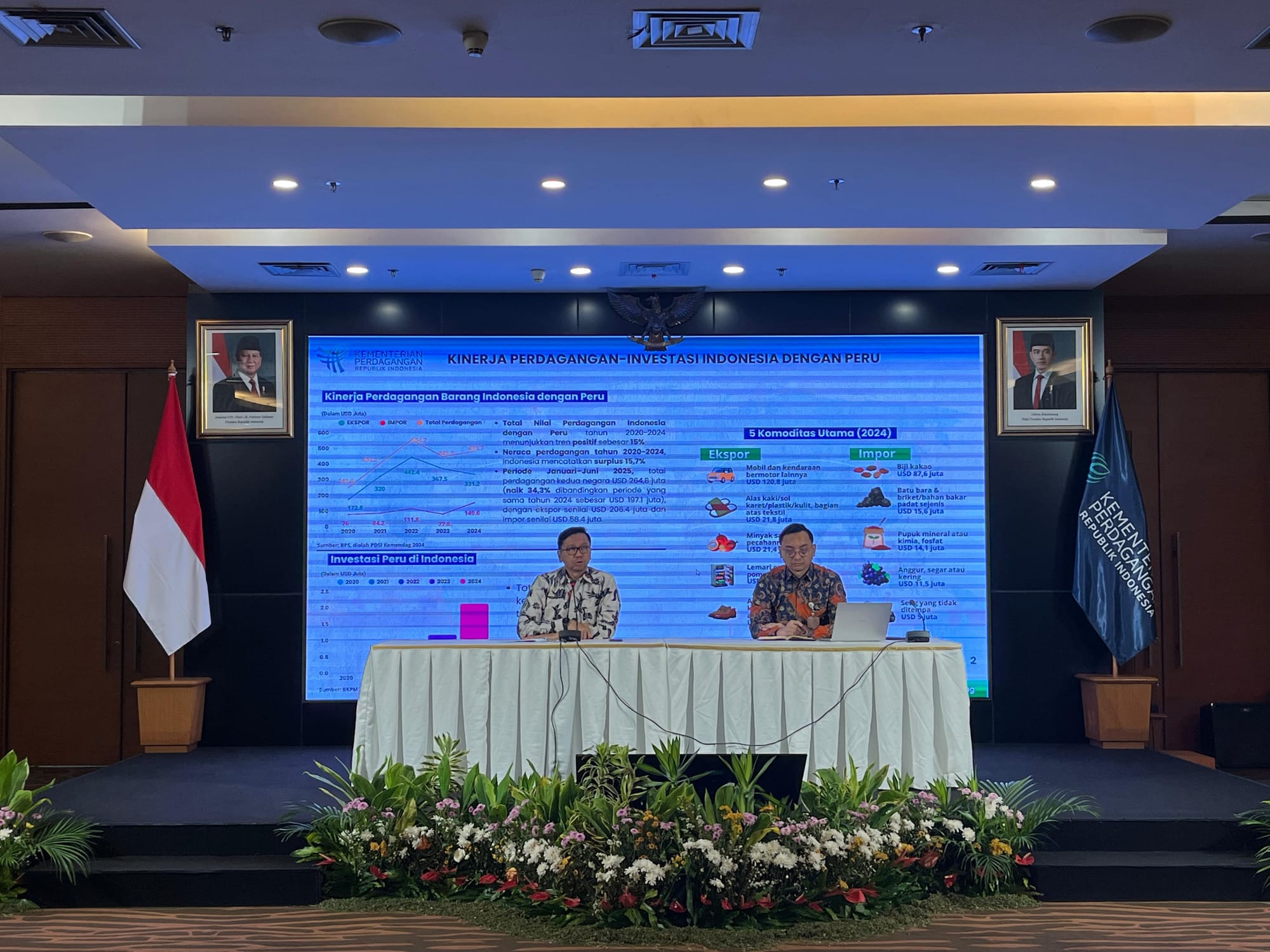
This agreement was also well received by Peru. The Peruvian Ambassador to Indonesia, Luis Raul Tsuboyama, said the agreement also aims to increase the number of exports from Peru to Indonesia. He also highlighted the importance of implementation in the future, so that it is not just a mere agreement.
"Now we need to look ahead, how we will implement it. This is exciting, but it is a small step towards more activities that will not only involve Indonesian exporters who are interested in working with Peru, but also to attract Peruvian exporters' attention and interest in the Indonesian market," Luis said.
This trade agreement certainly has a positive impact on entrepreneurs in both countries, especially Indonesia. The CEPA agreement can change the direction of Indonesia's industry by encouraging its players to improve competitiveness, product quality, and efficiency to compete in the global market.
Export success to Peru
Jahja B. Soenarjo, Vice Chairman for Trade of the Indonesian Employers Association (Apindo), said Peru is a country that has the potential to be an opportunity for entrepreneurs in Indonesia. Countries that have CEPA or PTA agreements with Indonesia are said to have greater market opportunities.
"That's where the opportunities are bigger and we are looking at who should be our partners besides the products, don't look for buyers who are only single time buyers, meaning we have to build a sustainable business with them, especially if the CEPA is not immediately in the first year, it needs patience for entrepreneurs to explore," added Jahja.
The CEPA agreement with Peru also needs to be utilized well by entrepreneurs from both countries, especially Indonesia, in order to increase the export value of domestic products.
"CEPA has great benefits, but how we execute it is more important than just seeing CEPA as something beneficial, a promise that we must prove that we are qualified to fulfill that promise," he continued.
One of the companies that already exports its products to Peru and finds this CEPA very beneficial is PT AKGoldenesia, a company that focuses on the production and distribution of palm oil, coconut, and cocoa-based products.
Export Manager of PT AKGoldenesia, Irma Nuranggraini, said that one of the advantages offered by Peru in terms of exporting Indonesian products, is the presence of Chancay Port which facilitates cargo delivery.
"There is now a new port, Chancay Port, which we hope will provide good access to the Peruvian market and beyond. So now there are two options for ports, not only in Callao," Irma explained.
PT AKGoldenesia has also exported its products to countries in Latin America such as Peru, Bolivia, Chile, and Argentina. The most demanded Indonesian products from these countries are palm oil and cocoa derivatives which have recently become trending products.
Chancay Port is a private port and logistics complex in Peru developed by China's COSCO Shipping Ports . The project itself aims to transform trade between Latin America and Asia into a major trading hub in the Pacific using environmentally friendly technology. With this port, the travel time for cargo shipments from Asia to countries in Latin America will be shorter.
Processed palm oil and cocoa products from PT AKGoldenesia are also said to have increased every year. It is possible that with this CEPA, the number will also continue to increase, by carrying out a number of utilization strategies.
"We are trying to go both ways at the moment which is we are going to do a project with a company in Peru, but for cocoa, for palm oil we are still doing research in shortening," he said.
Widyastutik, Secretary of the Institute for International Social, Economic and Regional Research at Bogor Agricultural University (IPB), said that the agreement with Peru opens the gates for agreements and exports with other countries in Latin America.
"Peru has 22 trade cooperation schemes, meaning that with 22 we can utilize the global value chain of our products, and Peru can become a gateway for our products," Widyastutik explained.
Research conducted by the university to see which countries have export potential, also named Peru as a nontraditional country.
"From the mapping , Peru has potential, so it can be used to penetrate the Indonesian market, including one to Latin America. The gate has been opened by the Ministry of Trade," he said.
Tunisia Trade
Meanwhile, the I-T PTA agreement has now been completed and is scheduled to be signed in January 2026. Tunisia is a country in North Africa that has a strategic position as a hub between the Middle East, Europe and Africa, with key infrastructure such as the Rades-La Goulette Port and Tunis-Carthage Airport.
Tunisia's export mainstays include electronic equipment, petroleum, textile commodities, dates, and olive oil. Tunisia with its limited resources and technology now relies on imports for energy, certain foodstuffs, transportation, and advanced industrial equipment, thus becoming a potential export opportunity for Indonesian businesses.
Indonesian Ambassador Extraordinary and Plenipotentiary to Tunisia Zuhairi Misrawi, said that if this cooperation is signed, it will also be an opening gate for exports from Indonesia to Tunisia and nearby countries, even to Europe.
"Logistically Tunisia has a port, so it is very promising for business people to enter Tunisia, and from Tunisia it can go to neighboring countries, Libya is very large, Algeria, then Morocco, also European countries, Turkey, Italy, can even enter from Tunisia, so that it can become a business hub with these countries," explained Zuhairi.
Tunisia's market trade opportunities are also wide open following changes in Tunisia's import patterns. As is known, Tunisia began to reduce its dependence on imports from the European Union and showed an increasing trend of imports from Asia and Africa. This shift is also in line with Indonesia's efforts to expand non-traditional markets, while opening up opportunities for Indonesia to emerge as a credible alternative source of supply, especially for food commodities, raw materials, and manufactured products.
In 2024, the value of Indonesia's exports increased by 0.92%, with 5 main commodities Indonesia managed to provide an export value of USD 40.7 million in palm oil, USD 23.7 million in telephone equipment, USD 12.1 million in coconut oil, USD 11.1 million in iron or steel semi-finished products, and USD 7 million in coffee. Later, with the trade agreement, it is expected that the export value will increase.
Trade Minister Budi Sansoto said the agreement will be signed soon.
"Tunisia hopefully will be able to sign in the beginning of the year, it's just a matter of time because the Minister of Trade (Tunisia) wants to be in Indonesia, so the timing is not right, but the completion of the negotiations is already underway," Budi said.