The SUAR team SUAR the thoughts of decision makers or leaders in companies and economic observers regarding the impact or benefits of these agreements and partnerships for the nation's progress through the World Business Survey.
Highlight
- Respondents believed that the main objectives of the Indonesian President's meeting with leaders of major world powers were to strengthen Indonesia's role in the region (40.6%), enhance economic cooperation (25%), and attract investors (15.6%).
- According to respondents, multilateral and bilateral cooperation agreements entered into by the government are beneficial to the country's economy in many ways. Among other things, they will increase investment realization (75%), improve export performance (75%), and create jobs (65.6%).
- President Prabowo Subianto's communication and leadership style in discussing economic cooperation agreements with other countries has fostered appreciation and confidence among respondents that this will increase investment flows into Indonesia and make Indonesia more advanced (65.6%).
Since being elected President of the Republic of Indonesia, Prabowo Subianto has been actively meeting with leaders of major countries around the world. President Prabowo met with Russian President Vladimir Putin (July 2024) and Chinese President Xi Jinping (November 2024).
In 2025, President Prabowo will meet with Indian Prime Minister Shri Narendra Modi (February 2025), French President Emmanuel Macron (May 2025), Brazilian President Luiz Inacio Lula da Silva (July 2025), and US President Donald Trump (September 2025).
According to the results of the Global Business Survey conducted by SUAR Team, respondents saw that the main objective of these important meetings was economic, namely to strengthen Indonesia's role in the region, especially globally, as stated by 40.6% of respondents, as well as to enhance economic cooperation (25% of respondents) and invite investors to enter Indonesia (15.6% of respondents).
Not only that, there is also another goal, which is to actively promote world peace and enhance cooperation in the field of defense. This is very relevant amid the global situation that is still marred by conflicts and wars between countries.
Multilateral and Bilateral Agreements
The year 2025 will be an important year for Indonesia to lay a strong economic foundation to move faster in the coming years. A number of achievements have been made.
At the beginning of the year, on January 6, 2025, Indonesia officially joined BRICS. Brazil, as the 2025 BRICS Chair, announced that Indonesia had officially become a full member of BRICS after receiving consensus approval from all members. Subsequently, President Prabowo attended his first BRICS meeting on July 6-7, 2025, in Rio de Janeiro, Brazil.
By becoming part of BRICS, Indonesia can reduce its dependence on any particular economic bloc.
Amid global economic uncertainty and competition among major powers, Indonesia cannot rely on just one group. By becoming part of BRICS, a country can reduce its dependence on a particular economic bloc and strengthen cooperation among developing countries such as BRICS. By 2024, BRICS member countries will account for more than 40% of the world's population and 44% of global GDP.
Not only did he attend the BRICS meeting, President Prabowo also made time to attend other multilateral meetings, such as APEC, G-20, ASEAN, and D-8. President Prabowo also attended the UN General Assembly in New York on September 23, 2025.
To strengthen bilateral economic cooperation, Indonesia signed the Indonesia-Canada CEPA Agreement on September 24, 2025, which will come into effect in 2026. Indonesia has been negotiating a Comprehensive Economic Partnership Agreement (CEPA) with Canada since 2021 in an effort to boost Indonesian exports and reduce the trade deficit with Canada.
Two days earlier, on September 22, 2025, the Indonesia-EU CEPA Agreement was signed. The Indonesia-EU CEPA negotiation process was quite difficult due to one of Indonesia's export commodities and had been ongoing for the past nine years.
Indonesia's main exports to the EU include palm oil, copper ore, and industrial fats. Meanwhile, Indonesia imports motor vehicles, industrial machinery, and medicines from the EU. The European Union's Deforestation Regulation (EUDR) has an impact on Indonesia's export commodities to the EU. With the signing of this Indonesia-EU agreement, Indonesia's exports to the European Union, especially for key commodities such as palm oil and textiles, are expected to improve.
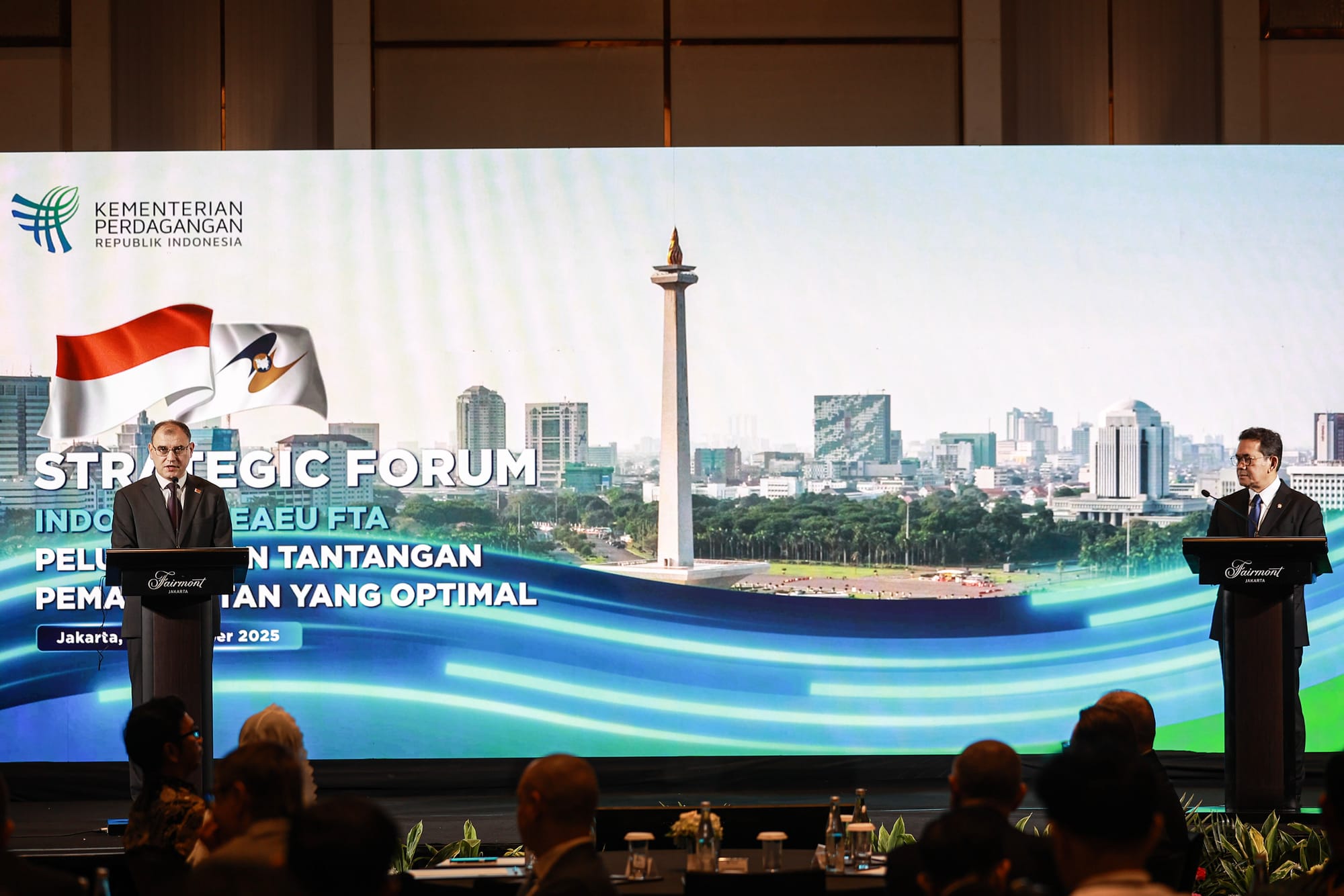
On December 21, 2025, the Indonesia-Eurasian Economic Union Free Trade Agreement (I-EAEU FTA) was also signed in St. Petersburg, Russia. The EAEU is a cooperation organization of Eurasian countries, such as Russia, Armenia, Belarus, Kazakhstan, and Kyrgyzstan, which was formed in 2014. For Indonesia, free trade with these Eurasian countries opens up opportunities for diversifying export destinations.
Regarding trade relations between Indonesia and the United States, negotiations on a 19 percent reciprocal tariff are currently ongoing, with the target of signing an agreement by the end of January 2026. Indonesia has been granted an exemption from import duties on a number of leading commodities, such as palm oil, coffee, cocoa, tea, and so on. Meanwhile, the US hopes to gain access to Indonesia's critical mineral sector.
The commodities or sectors that receive these special tariffs are labor-intensive sectors that absorb a large workforce. This agreement is a continuation of the US's decision in July to lower tariffs on Indonesian products from 32 percent to 19 percent.
The substance of the tariff agreement between Indonesia and the US has entered the stage of legal language harmonization and technical document finalization.
According to Coordinating Minister for Economic Affairs Airlangga Hartarto, all the substance of the Indonesia-US trade agreement has been agreed in principle. Discussions will now enter the stage of legal language harmonization and technical finalization of the document. The agreement document is planned to be signed directly by Indonesian President Prabowo Subianto and US President Donald Trump.
Multiple and Sustainable Impacts
Respondents believe that the agreement or treaty signed by the government will havea multiplier effect on the economy. Most respondents stated that the agreement could increase Indonesia's investment realization (75%). In addition, it could also improve export performance (75%) and create additional domestic employment (65.6%).
From the bilateral and multilateral meetings that have been held, the Indonesian Government Communication Agency reported that President Prabowo successfully secured new investment commitments worth more than Rp 1,000 trillion.
The implementation of these agreements is expected to increase investment realization in the coming years. Cumulatively, investment realization for the January-September 2025 period reached IDR 1,434.3 trillion, growing 13.7% on an annual basis. Cumulatively, as of September 2025, investment has created more than 1.95 million new jobs in various sectors.
President Prabowo Subianto's communication and leadership style in establishing economic cooperation with other countries has fostered appreciation and confidence among respondents that in the future this will increase investment flows into Indonesia and make Indonesia more advanced (65.6%).
Not only will they have a double impact, these agreements are expected to become a strong foundation for sustainable economic growth. This is for the welfare of the people, especially in overcoming the problem of unemployment, which currently stands at 7.4 million people.
Methodology and Respondent Profile
The Global Business Survey was conducted from November 5 to 25, 2025. A total of 32 sources (respondents) were selected using purposive sampling from the business community and economic observers. From the business community, the sources held various positions, ranging from directors and chief executive officers to owners.
In terms of education, respondents had a bachelor's degree (50%) or a master's or doctoral degree (50%).
In terms of age, the number of young respondents increased, with 28.1% aged up to 35 years, 12.5% aged 36-45 years, 37.5% aged 46-55 years, and 21.9% aged 56 years and above.