
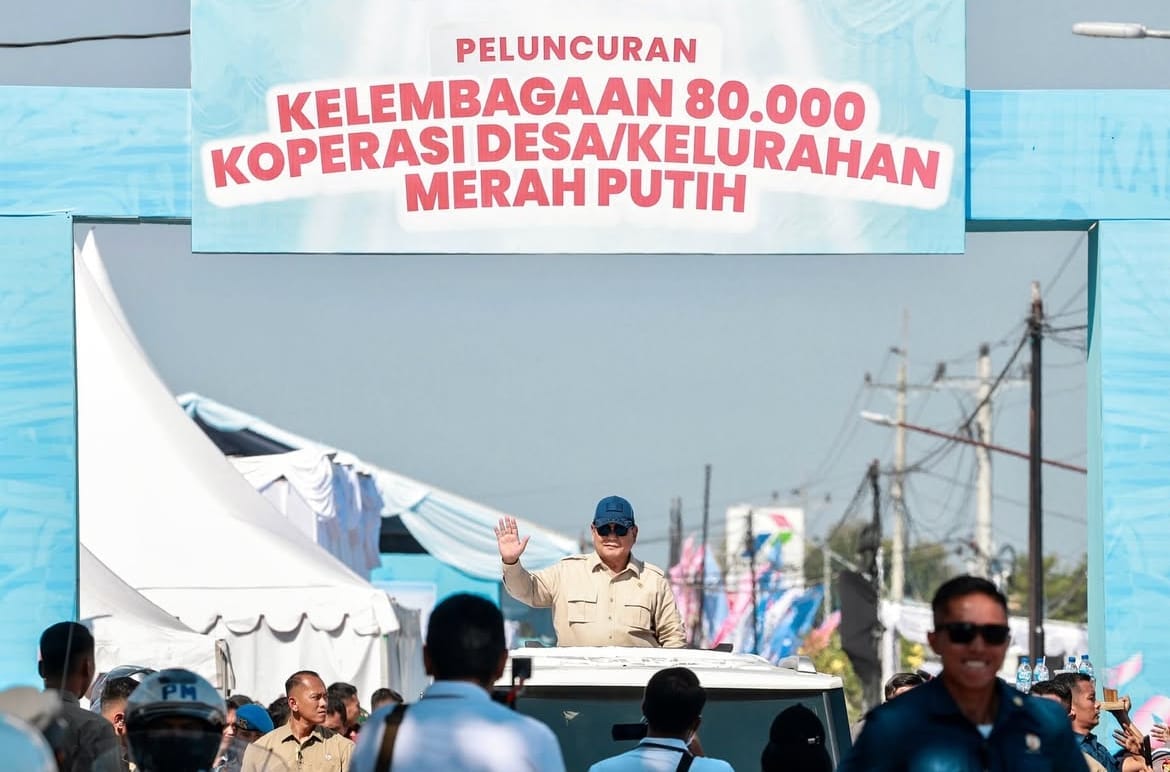
President Prabowo Subianto officially launched the institutionalization of 80,081 Red and White Village and Village Cooperatives (KDMP/KKMP) in Bentangan Village, Klaten, Central Java, on Monday (21/7). The aim is to build the village economy and improve people's welfare.
The launch was marked by the symbolic handover of the Cooperative Legal Entity Decree to five representatives of cooperative heads.
"Cooperatives are a tool for the struggle of the small people to become strong. This is a big strategic endeavor," Prabowo said in his speech, which was broadcast online via the Presidential Secretariat.
The plan to establish a Merah Putih village cooperative emerged in early March 2025 to improve food security.
There are various types of business units that can be developed such as pharmacies, clinics, savings and loan units, cooperative offices, food procurement, warehousing or cold storage, and logistics. In addition, this institution can also run other businesses in accordance with the potential and needs of the local community.
The capital for the establishment of this cooperative comes from the State, Regional, and Village Budgets, as well as other legal sources in accordance with statutory provisions.
Coordinating Minister for Food, as well as Chairman of the KDMP National Task Force, Zulkifli Hasan, added that cooperatives will be a means of distribution, empowering farmers and fishermen, as well as breaking the chain of middlemen and loan sharks.
"Today we give birth to the new face of Indonesian cooperatives: cooperatives built on the spirit of gotong royong and kinship," Zulkifli said.
Meeting the Needs of the People
In addition to warehouse facilities, cold storage, basic food outlets, and distribution vehicles, Prabowo also targets village cooperatives to become economic distribution nodes and fulfill the basic needs of the people.
"Fishing villages will have bigger coolers to make ice and keep fish, then, next to each warehouse will be an outlet, there will be food outlets, savings and loans," Prabowo said.
The President also targets to improve people's nutrition through fish distribution to villages to increase protein consumption.
Village funds of Rp1 billion per year will be optimized to support cooperative development.
"The important thing is that the management is clean and used for the people. Village heads must participate in supervising it," Prabowo said.
Similarity to cooperatives makes you pessimistic
The Head of the Association of Strategic Socio-Economic Cadres (AKSES), Suroto, said that this initiative is no different from the KUD model that once failed: top-down, without roots in the community, and with minimal entrepreneurial basis.
"Cooperatives are built top-down, there is no entrepreneurship base. This is a government project, not an answer to the needs of the people," he said.
He said that many cooperatives in the past were formed because of projects, not the real needs of the community. As a result, cooperatives became a mere administrative burden, losing their identity as a movement.
"This is like repeating an old pattern. Especially if state intervention is too dominant without true participation from grassroots communities," he said.
A similar sentiment was expressed by Mukroni, Chairman of the Warteg Nusantara Cooperative Community (Kowantara). He emphasized that cooperatives are a collection of people, not a collection of capital.
"If there is no cohesiveness, the identity of the cooperative needs to be questioned," he said.
According to him, many cooperative administrators today do not even know the direction of their business, and even think they will be paid by the government. "So when will we get paid?" he mimicked.
Learn from the Successful
But despite the doubts, hope remains. These are some examples of successful cooperatives from several countries:
- Japanese Agricultural Cooperatives (JA-Zen Noh) is the largest cooperative in the world out of 300 cooperatives ranked by the International Co-operative Alliance (ICA). Based on agriculture, Zen Noh's network has expanded into various businesses, spanning many countries. In fact, the cooperative was only formed in 1972, much younger than the giant cooperatives in Europe and the United States. Its assets are estimated to be six times larger than Honda's.
- Mondragon is one of the world's largest federations of worker cooperatives based in the Basque Region, Spain, founded in 1956 by Father José María Arizmendiarrieta to overcome poverty and unemployment after the civil war. This cooperative has grown rapidly and now has tens of thousands of employees and hundreds of business units operating in various sectors such as manufacturing, finance, and services, even reaching various countries in Europe, the United States, and Asia.
- Credit Agricole, a banking cooperative in France, has become the most solid bank owned by millions of its customers. Credit Agricole has successfully become one of the largest banks in the world with assets reaching trillions of euros and operations in more than 50 countries.
- In the United States, the NRECA electric cooperative serves almost the entire state. Formed in 1942, NRECA serves cooperatives that supply electricity to more than 56% of the country's land area, providing essential services to 42 million people and powering more than 20 million businesses, homes, schools, and farms in 48 states.
- NTUC FairPrice in Singapore has transformed into a consumer-owned retail giant. FairPrice has more than 100 supermarkets and more than 160 Cheers minimarket outlets throughout the island, as well as various other retail formats such as FairPrice Finest, FairPrice Xtra, and FairPrice Xpress.
"Their success is not due to government intervention, but because they address the real needs of farmers, from production, processing, to distribution, and put education as the main pillar," Suroto said.
Meanwhile, here are some examples of successful cooperatives in Indonesia:
- Indonesian Credit Union Movement (GKKI): Self-funded and consistently developed through member education, GKKI has 4.6 million members and Rp48 trillion in assets. One of its early figures was Margono Djojohadikusumo, who is the grandfather of President Prabowo Subianto.
- Induk Koperasi Kredit (INKOPDIT), which houses around 900 savings and loan cooperatives (credit unions) with consolidated assets of Rp46 trillion, is a successful example of a cooperative born out of self-help, solidarity and education. This model has proven to be resilient even without major support from the state.
- Koperasi Warteg Nusantara (Kowantara) was born from the collective experience of warteg vendors in Jabodetabek. Under the pressure of inflation and business competition, warteg owners formed a community as a space for mutual cooperation. Starting as a gathering of families and neighbors, Kowantara is now a legal entity with more than 10,000 members.
Suroto suggested that if the government really wants cooperatives to become a tool for the people's economic struggle, then the approach must be changed. "De-officialization is the key word, cooperatives are not an extension of the state, but a space for citizen independence," he said.
According to him, a tactical step that can be taken is to delay the disbursement of funds until the cooperative shows real internal education initiatives and business planning. Learning from existing and successful cooperatives can be a starting point.
"Well, the stimulation that is lured to be disbursed from Himbara, it should not be disbursed first, if the village cooperative has not really made an educational program for its members," Suroto advised.
Instead of immediately disbursing funds, the government could require a member education program as an operational prerequisite. Administrators need to learn from existing successful cooperatives, not from technical guidelines. The government can facilitate learning networks between cooperatives, encourage local innovation, and respect villagers' autonomy.
In addition to diagnosing cooperative policies in depth and based on scientific studies, the government can play a role in three main things: recognition, incentives, and protection. "First, provide recognition of the success of cooperatives that have managed to build," he continued. This recognition can be in the form of formal acknowledgement of cooperatives that implement their principles well, which, unfortunately, is still rarely done.
In addition to recognition, another concrete form of support is the provision of incentives such as tax breaks for cooperatives that truly carry out the basic values of cooperatives. "That is the moral right of cooperatives," said Suroto.
Third, the government should also protect the cooperative principle by cracking down on fake cooperatives that only use the name cooperative but do not implement the principle. This is because such cooperatives can damage the image of cooperatives as a whole and make it difficult for citizens who want to build true cooperatives.
With this approach, it is hoped that cooperative governance will emerge that is not only based on jargon and projects, but actually provides space for cooperatives that respond to the needs of the times to grow.