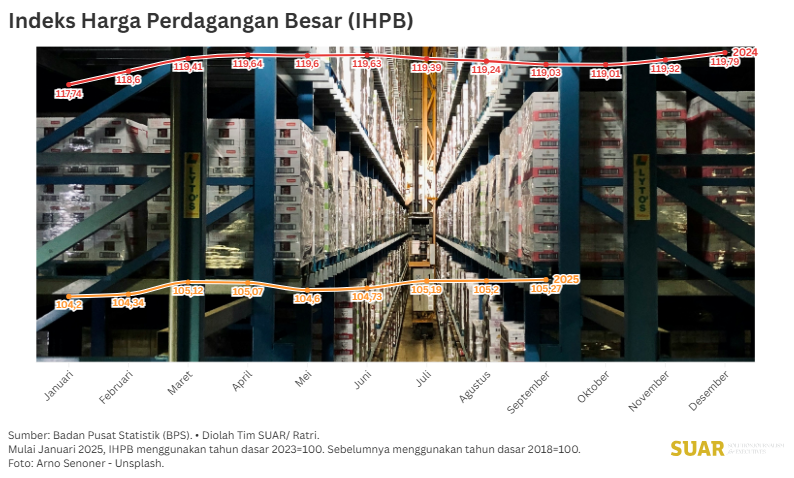
Since the beginning of this year, the trade price indicator as seen through the Wholesale Trade Price Index (IHPB) has consistently increased until September 2025. This indicator, which measures the dynamics of wholesale trade prices, also has an impact on retail trade prices that are directly felt by consumers.
The IHPB released by the Central Bureau of Statistics (BPS) measures price changes at the producer or wholesale level. Wholesale trade includes industrial sector commodities, mining and quarrying, agriculture, export and import commodity groups that are traded in large parties or volumes for producers of processed goods, retail traders, to exporters and importers.
Until September 2025, there has been a consistent upward trend in IHPB since the beginning of this year. This increase in prices at the upstream level indicates an increase in production and distribution costs, which requires serious attention as it could affect inflation.
The upward trend of IHPB in 2024 is different from that in 2025. The IHPB in 2024 used the base year 2018=100 and its development showed a consistent increase, moving from a score of 117.74 in January 2024 to reach 119.79 in December 2024. Starting January 2025, BPS updated the methodology by using the base year 2023=100, which resulted in the index score changing drastically to 103.37 in January 2025.
The base number means that in January 2025, there was an increase or inflation of 3.37% from the base year of 2023, which is simplified as a score of 100. Despite the base change, the index continued to show a fluctuating increase, reaching 105.27 in September 2025, with inflation from January 2025 to September 2025 of 1.02%.
The increase in IHPB in September 2025 was dominated by several main sectors. Agricultural, forestry, and fishery products were the largest contributors to the change in IHPB (m-to-m and y-on-y). The agricultural, forestry and fishery products sector recorded the highest annual inflation (y-on-y) of 5.74% in September 2025. Price increases in the food sector are often caused by weather factors, agricultural input costs, supply chain disruptions, and international price dynamics.
Through the BPS report, commodities that experienced an increase in prices on an annual basis(y-on-y) in September 2025 were rice, shallots, palm oil (FFB), cooking oil, and corn. Meanwhile, commodities that experienced price increases on a monthly basis(m-to-m) were red chili, broiler chicken meat, broiler chicken, palm oil (FFB), and corn. The IHPB report is in line with the September 2025 inflation report which was also influenced by chili (0.19%), shallots (0.19&), rice (0.17%), and broiler chicken meat as the main contributors to y-on-y inflation .
To suppress price hikes, especially in sectors that contribute to the IHPB, the government and Bank Indonesia have strengthened synergies through the Central and Regional Inflation Control Teams (TPIP-TPID) by adhering to the 4K strategic framework including Supply Availability, Smooth Distribution, Price Affordability, and Effective Communication.
The strategy that is often used when commodity prices soar by the central and regional governments through TPIP-TPID focuses on controlling the prices of volatile food groups or food commodities prone to volatility such as rice and chili. The strategy is implemented through strengthening food security and increasing productivity. In addition, the Government actively facilitates food distribution and optimizes cheap market operations to maintain price stability up to the retailer level, which is expected to reduce the domino effect of the IHPB increase.
Although the IHPB showed price pressures at the producer level since 2024 and continued until September 2025, price stabilization efforts have been carried out in an integrated manner through fiscal and monetary policy coordination. The main challenge going forward is to ensure that the IHPB increase is not fully transmitted into higher Consumer Price Index (CPI) inflation. Consistency in the implementation of the 4K strategy, particularly in maintaining the supply and smooth logistics of raw materials will be key to maintaining price stability at the wholesale level to support a strong and sustainable economic foundation.