

TheInternational Monetary Funds' (IMF) latest assessment of Indonesia's economy injects optimism regarding the bright economic outlook amidst increasing uncertainty. Several IMF recommendations have even been implemented by the government to strengthen economic resilience. The improved macroeconomic structure is expected to be the foundation for business expansion and faster economic turnover.
The positive assessment is based on the results of the IMF's Article IV Consultation on Indonesia between November 3-12, 2025, led by Maria Gonzales. At the end of the visit, Gonzales concluded that Indonesia remains abright spot with strong economic growth amidst a challenging external environment.
There are three main aspects that form the basis of the IMF's assessment.
- Inflation expectations are within the safe target range of 2.5+-1%.
- A calibrated policy mix that maintains credibility.
- Structural reforms through trade agreements, improving the climate for private sector-led growth, and productivity gains that enable sustainable job creation to realize Indonesia's high income potential.
On the fiscal front, Gonzales cautioned the government to anticipate a widening fiscal deficit to 2.8% of GDP this year and 2.9% of GDP next year, larger than the projected deficit of 2.7% of GDP in the 2026 state budget. Accordingly, he recommends prudent budget management to achieve budget targets, while maintaining a safe fiscal space for risk shocks.
"Keeping fiscal risks under control requires continued prudent fiscal management, as well as close monitoring of quasi-fiscal operations. Improved revenue mobilization and a focus on high-quality spending and spending efficiency will strengthen the effectiveness of fiscal policy to support growth," Gonzales wrote in a written statement on the IMF website.
On the monetary side, Gonzales praised Bank Indonesia's move to lower the benchmark interest rate by 150 basis points (bps) as well as its gradual liquidity improvement measures to strengthen credit growth. However, in order to maintain sustainable exchange rate stability, monetary operations to strengthen the foreign exchange market is one of the recommendations.
"Foreign exchange intervention can be part of the policy response, given that Indonesia's foreign exchange market is relatively shallow, so risk shocks can trigger excessive financial tightening. Intervention is directed as a dampening cushion in an increasingly vulnerable world," he explained.
Read also:
 Benedictus Krisna Yogatama
In conclusion, Mr. Gonzales hopes that the growth policies that have been implemented vertically through fiscal-monetary coordination will be followed up with ambitious horizontal structural reforms, ranging from infrastructure, deregulation, debottlenecking, to increased global integration that strengthens FDI inflows and a more dynamic and resilient private sector.
"Proactive efforts to collaborate with various trading partners through the reduction of tariffs and nontariff barriers have led to important announcements on agreements (I-CA CEPA, I-EU CEPA), while the potential agreement with the US has reached an advanced stage. These efforts are important steps for growth and productivity gains towards achieving high-income country status," Gonzales concluded.
Followed up
The IMF's recommended measures in both monetary and fiscal areas have been and are being followed up by the government. Bank Indonesia is currently spurring the deepening of the money market through a strategy of measured monetary operations, while expansionary fiscal priorities have carefully taken into account the accuracy of distribution according to the predetermined ceiling.
Bank Indonesia Deputy Governor Destry Damayanti stated that with uncertainty still high, marked by the US Dollar Index (DXY) that continues to rise and the high yield of U.S. Treasury Bonds, depreciation is not only felt by the rupiah, but also other currencies including the Thai Baht, Philippine Peso, and Korean Won. Preparing for such volatility, intervention into the forex market is one of BI's proactive monetary operations strategies.
"We have entered NDF overseas, DNDF domestically, and SPOT. That alone may not be enough. So what we are developing is structural, namely deepening the domestic forex market, among others by expanding forex monetary operation instruments, by opening forex instruments in Chinese Yuan and Japanese Yen, in addition to the US Dollar," Destry said in a press conference of the BI Board of Governors Meeting held virtually, Wednesday (19/11/2025).
According to Destry, the move to expand forex monetary operation instruments in Yuan and Yen is inseparable from market needs. With the value of local currency transactions reaching up to USD 1 billion year-to-date (YTD), banks have difficulty finding Renminbi for the transaction needs. As a result, banks are forced to convert Renminbi into US Dollars, which causes pressure on the rupiah to increase.
"Not only China, but also Japan. The LCT position as of October increased 1.6 times from last year's full year period. LCT participants, which were only 5,053 participants in 2024, have increased to 15,473. Therefore, we anticipate by opening the CNY and JPY markets for domestic needs, as recommended by the IMF," he said.
BI estimates that economic growth in 2025 is predicted to be in the range of 4.7-5.5%, and will increase in 2026. BI will continue to strengthen the policy mix through a mix of monetary, macroprudential, and payment system policies that synergize with the government's fiscal and real sector stimulus policies to encourage higher economic growth while maintaining stability.
From the fiscal side, Director General of Economic and Fiscal Strategy at the Ministry of Finance Febrio Kacaribu emphasized that the government welcomes all the positive conclusions of the IMF, which follows well the development of the Indonesian economy and is open to notes and data comparisons with the government's own. However, the government still adheres to the allocation of expenditure set, and the calculation of the deficit has been done carefully.
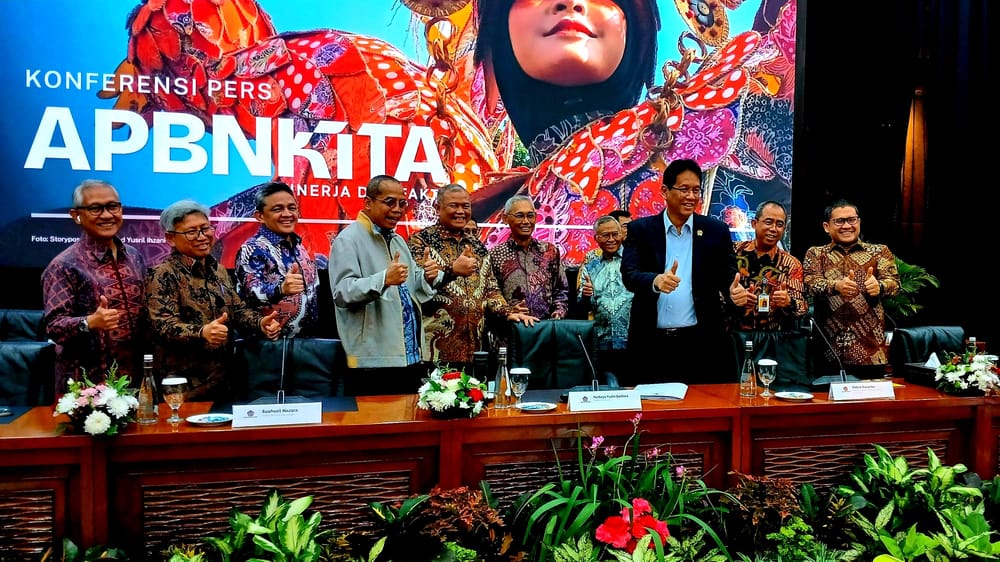
"With the acceleration of government spending, until October 2025, our budget deficit is 2.02% of GDP and smooth financing, far from the anticipated 2.8% of GDP. We have conveyed priority spending, Asta Cita, investment in human capital, and agriculture. We also discuss the quality of spending that can still be improved in the future," said Febrio at the APBN KiTA Press Conference in Jakarta, Thursday (11/20/2025).
Recover faster
Previously, Chairperson of the Indonesian Employers Association (Apindo) Shinta Widjaja Kamdani stated that with macroeconomic stability and predictable economic growth, the business world sees green shoots of recovery, and the manufacturing sector is back in the expansion zone after months of contraction.
"Investment, which increased from Rp477 trillion in Q2 to Rp491 trillion in Q3, shows rising business confidence in the medium-term prospects of the Indonesian economy. The business world now sees a more certain policy direction and more macro stability, although external pressures still exist," Shinta said.
By adhering to this stability, Shinta expects that policy transmission to the real sector is needed so that the impact of monetary and fiscal policies is truly felt on the ground. If this pace is maintained, Indonesia's preparation for an economic leapfrog phase becomes a near inevitability and bright economic projections are not just forecasts.
"Indonesia still needs a structural push that rests on three priorities: business certainty through predictability and clarity of rules; efficiency of the cost of doing business which is still a structural burden on the industry; and strengthening people's purchasing power. All three are key for the business world to maintain the momentum of recovery towards 2026 and stronger expansion next year," he said.