
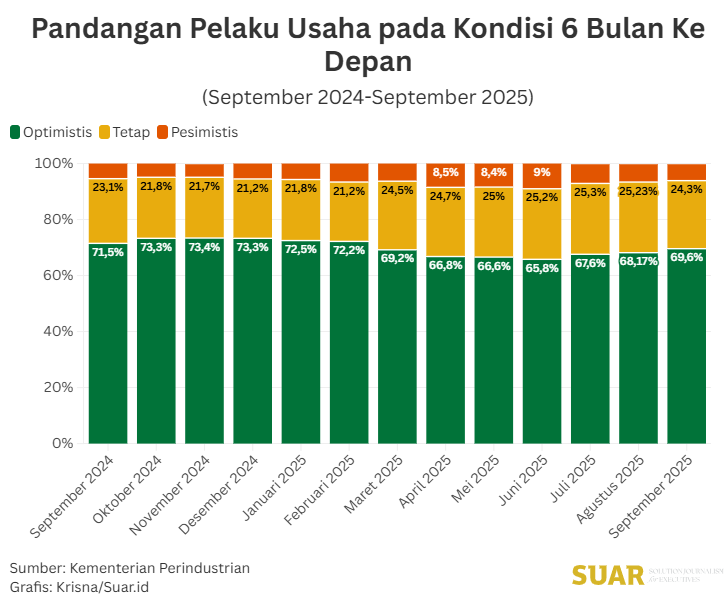
The performance of Indonesia's Manufacturing Industry continues to survive amid unstable economic conditions. This is indicated by the value of the Industrial Confidence Index (IKI) in September 2025 which was at the level of 53.02, higher than the September 2024 IKI value of 52.48.
Based on the IKI value released by the Ministry of Industry (Kemenperin) on Thursday (30/9/2025), industry players are still in an expansionary and positive phase.
When broken down, 69.6% of businesses felt optimistic. The number increased by 1.5% compared to the previous month's percentage. Ministry of Industry Spokesperson Febri Hendri Antoni Arief added, as many as 24.3% of business actors stated that their business conditions were stable and remained in an expansion position.
"This optimism will have an impact on business actors to continue to improve the quality of their business and continue to be creative to produce products or services that are beneficial to consumers," said Febri when met at the Industrial Confidence Index (IKI) Press Conference, in Jakarta (30/9).
The main factors influencing business optimism are market conditions, synchronized central and local government policies, a hassle-free licensing process, and manageable inflation.
In July, global economic growth projections were revised up to 3.0% in 2025 and 3.1% in 2026. Furthermore, Indonesia's economic growth forecast was also revised upwards to 4.8% in 2025 and 2026. In the second quarter of 2025, Indonesia's growth was 5.12%.
Febri also said that the inflation rate in Indonesia in August 2025 fell to 2.31%, in line with the inflation rate in Japan which fell to 2.7% and China which deflated to minus 0.40%. In contrast, the United States and Germany increased their inflation in August 2025.
Febri also noted that the Bank Indonesia Board of Governors meeting on September 16-17, 2025 decided that the benchmark interest rate or BI Rate fell to 4.75%, the deposit facility rate to 3.75%, and the lending facility rate to 5.5%.
In order for the business world to grow sustainably, first, efforts are needed to increase market access through trade agreements with non-traditional countries. Second, increased promotion, one of which is by facilitating trade shows, both local and international.
Third, increasing competitiveness through mentoring and capacity building of business actors to product standardization.
It was recorded that 21 out of 23 sub-sectors of the processing industry experienced expansion. Thus, which in total contributed 97.8% to the GDP of the Non-oil and gas Processing Industry in the second quarter of 2025.
The two subsectors with the highest IKI values are the Recording Media Printing and Reproduction Industry and the Beverage Industry.
Meanwhile, the two subsectors that contracted were the Computer, Electronic and Optical Goods Industry, and the Repair and Installation of Machinery and Equipment.
Government policy
The Expert Council of the Indonesian Employers Association (Apindo) Danang Girindrawardana said, the main key to business optimism lies in government policy.
Pro-business and pro-people policies can boost optimism. Examples are policies to support purchasing power and create more jobs.
"Stable basic needs prices without drastic fluctuations will increase consumer confidence, which in turn encourages optimism," Danang told SUAR in Jakarta (30/9).
An increase in the number of jobs will boost purchasing power and overall public optimism. Furthermore, the large population and market size of a country, such as Indonesia, can be a key driver of business optimism.
The inhibiting factor
LPEM FEB UI economist Teuku Riefky said that business optimism must be maintained because it is important to improve the competitiveness of the national economy.
Some of the factors that hinder business optimism include:
- Decline in orders,
- Capital and funding limitations,
- Marketing issues,
- Geopolitical instability and commodity prices,
- Infrastructure constraints, management and human resource issues,
- Inability to adapt to technological developments.
Strategies that can be taken to overcome obstacles to business optimism are to conduct in-depth market research and innovation to face competition, adopt technology, build networks with business partners, and maintain prudence in financial and HR management.
"All factors that hamper the optimism of the business world can be reduced by cooperation between business people and the government," Riefky told SUAR in Jakarta (30/9).