
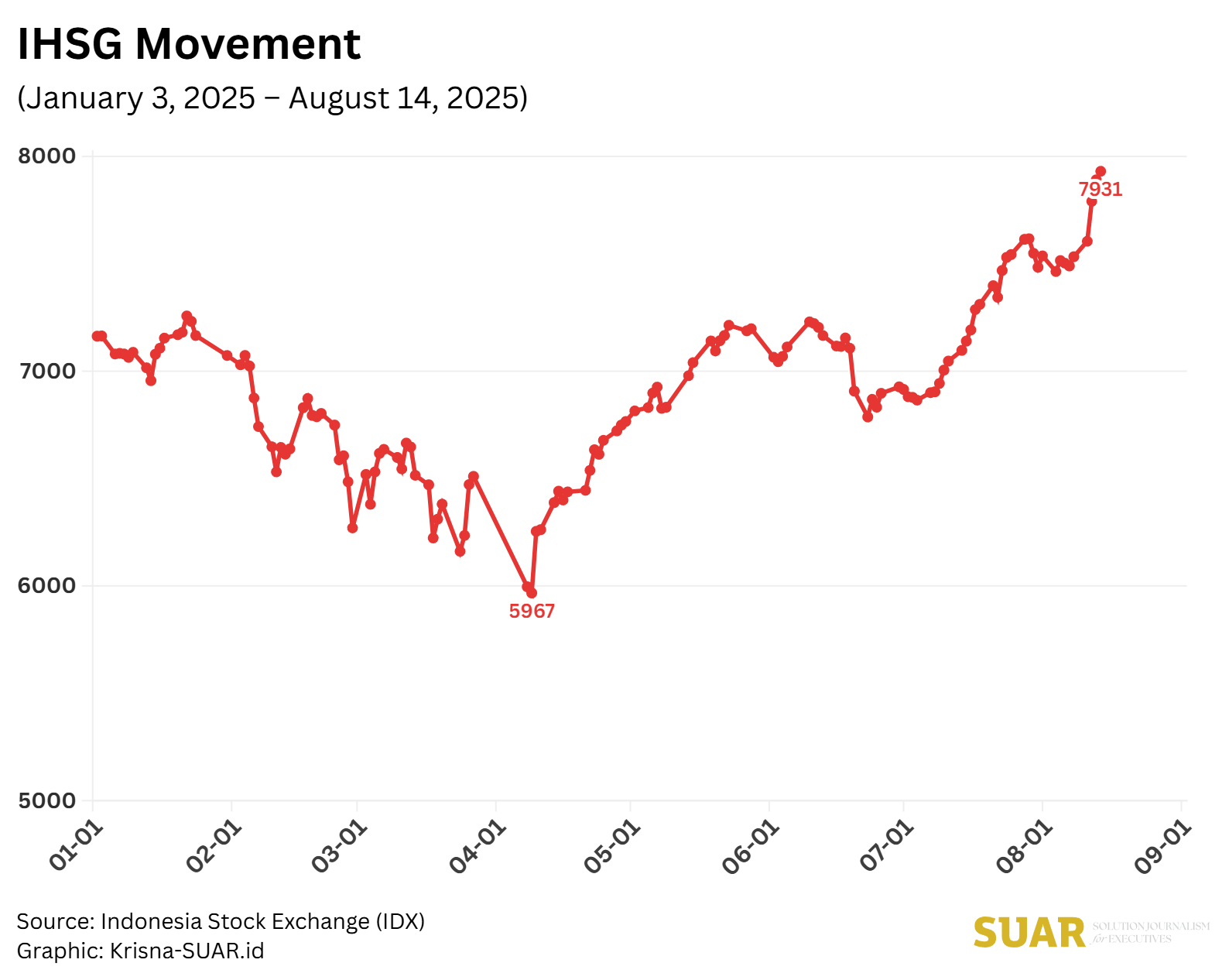
The Jakarta Composite Index (JCI) extended its winning streak for a fourth consecutive session, climbing 1.30% to 7,892.91 on Wednesday, August 13, 2025. The gain brought the benchmark index within 0.22% of its all-time high, marking its strongest performance of the year.
Foreign investors fueled the rally with a net buy of IDR 1.49 trillion, driven mainly by regular market purchases of IDR 1.52 trillion, offset by a modest net sell of IDR 34.72 billion in the negotiated market.
Technology was the key driver of Wednesday’s gains, soaring 3.98%. Healthcare rose 1.56%, property and real estate advanced 1.49%, followed by infrastructure at 1.46%. Consumer non-cyclicals gained 1.12%, while industrials climbed 0.79%. The energy sector strengthened 0.66%, financials added 0.20%, and basic materials edged up 0.06%.
Total trading volume reached 36.83 billion shares with a transaction value of IDR 21.08 trillion. In total, 346 stocks rose, 280 declined, and 173 were flat.
Permata Bank Chief Economist Josua Pardede noted that the sharp rise in the technology sector has the potential to spark further market momentum and push the JCI through a new psychological threshold in the coming days.
The technology sector led the daily gain with +4.0% and has already booked a year-to-date (YTD) surge of more than 140%. “This shows there is euphoria in growth stocks, which, if sustained, could help the JCI test the 8,000 level soon,” said Josua.
At the same time, banking also contributed significantly to the JCI’s gains. Josua explained that banking benefited from positive sentiment around Bank Indonesia’s potential rate cuts, which would lower funding costs and support credit growth.
Banking stocks are expected to serve as a main entry point for institutional—particularly foreign—investors in the Indonesian market, thanks to their large market capitalization and high liquidity.
Josua added that the banking sector’s fundamentals remain solid, with steady profit growth and sound asset quality. “This makes it a defensive option as well as a proxy for domestic economic growth,” he said.
The main catalysts behind the JCI’s surge came from global sentiment, particularly expectations of a U.S. Federal Reserve rate cut and strong foreign capital inflows into equities and government bonds. Domestically, strong first-half earnings reports from listed companies further supported the rally.
Capital market analyst Anthonius Edyson from Astronacci International also believes the JCI, having broken out of its consolidation zone, has strong potential to continue its upward momentum. “Technically, the JCI has broken through consolidation and could move toward the next resistance level,” he told SUAR.
Looking ahead, Josua forecasts the JCI will strengthen moderately in the second half of 2025, targeting stability in the 7,800–8,000 range by year-end, provided global conditions remain favorable. “BI’s rate cuts, political stability, and accelerated budget realization are the key domestic catalysts,” he said.
He highlighted that companies with strong balance sheets, clear revenue growth prospects, and exposure to banking, technology, and consumer sectors are expected to drive the JCI higher. Meanwhile, technology and infrastructure are projected to stand out the most, benefiting from both structural growth and short-term momentum from government projects.