
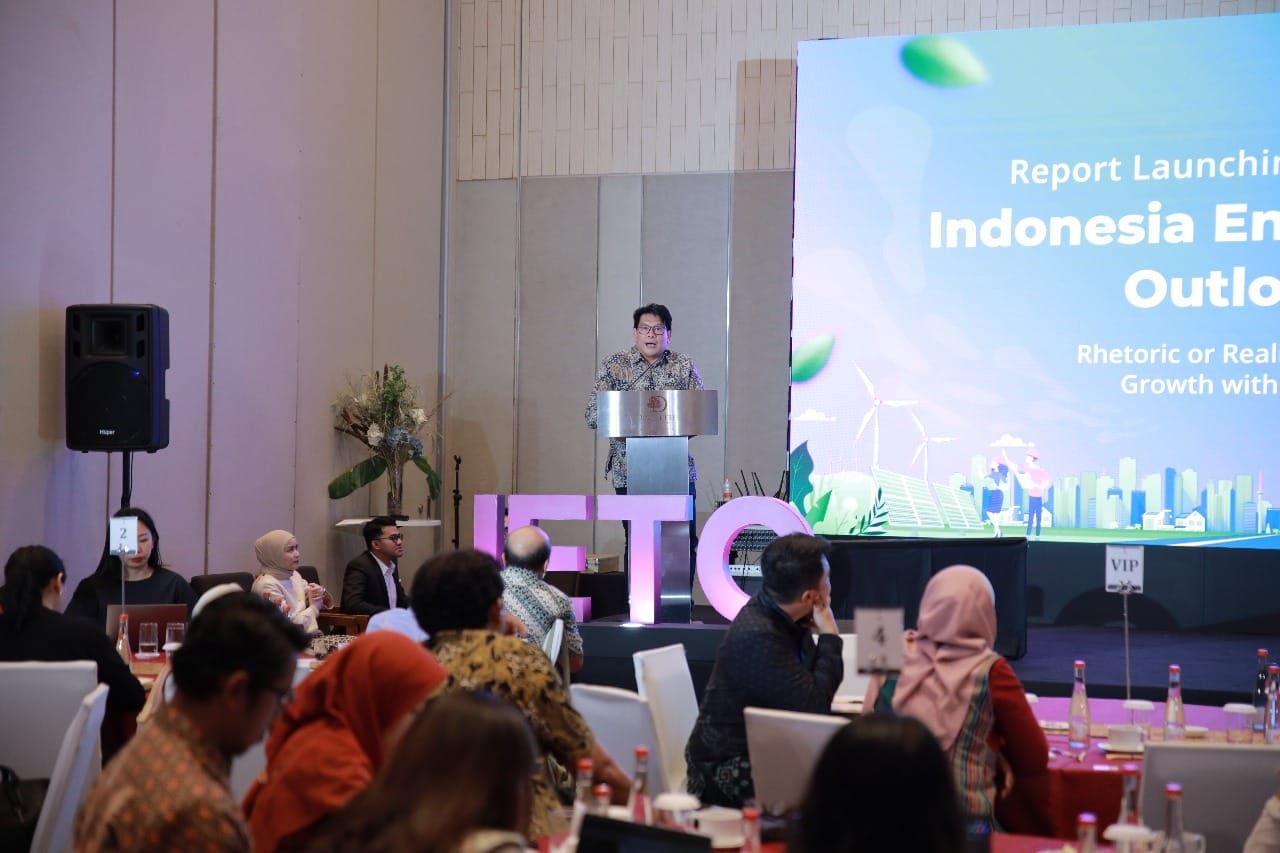
Indonesia's energy transition is still below its maximum potential compared to the direction of the global energy transition which has shifted from environmental issues to sustainability, said Executive Director of the Institute for Essential Services Reform (IESR), Fabby Tumiwa at an Energy Outlook event in Jakarta.
According to Fabby, the direction of the global energy transition is no longer just an environmental issue, but the need to address security of supply, affordability and sustainability.
Fabby cited the example of Pakistan, whose solar energy capacity increased to 30% in six years due to the power crisis.
"India is similar, experiencing a 3,500% increase in solar capacity in a decade," he said.
Fabby explained that solar and wind energy are now the cheapest sources of electricity globally, with battery storage costs falling faster than expected.
This trend has seen renewables add more electricity than fossil fuels over the past three years, and by the middle of this year renewable electricity surpassed coal at the global level.
Meanwhile, in Indonesia, the situation is different as the utilization of renewable energy is still far below its potential.
The dominance of coal reaches 65% in the electricity system and around 40% in the primary energy mix, while the 23% renewable energy target since 2014 continues to miss and is likely to only reach 16% to 17% by the end of this year.
Policy changes
Fabby said the stagnation was mainly due to policy inconsistency, dependence on coal, limited PLN network, and inadequate clean energy funding.
The gap between public commitment and government policy has led to the dominance of fossil fuels.
In fact, in the economic context, Indonesia has great opportunities that can be achieved through decarbonization, including the need for 6 gigawatts (GW) of electricity for data centers in Southeast Asia that prioritize low-carbon energy.
Fabby also mentioned the potential of Indonesian minerals that can strengthen the supply chain of electric vehicles and batteries on a global scale.
So, to accelerate the energy transition, Fabby encourages five priority steps, among others:
- Cross-ministerial policy alignment on a common roadmap. We must unify industrial, fiscal finance, trade and economic policies in a single, non-negotiable roadmap.
- The second priority is to stop fossil energy subsidies and reform electricity tariffs to make PLN's finances healthier.
- The third priority is to build a renewable energy technology supply chain at the domestic level.
- The fourth priority is to make the early retirement of steam power plants successful.
- Our last priority must be to ensure an equitable energy transition, prepare green jobs and workforce competencies," he said.
IESR electricity system analyst Abraham Oktama Halim explained that the government's ambition to achieve 8% economic growth by 2029 has huge energy implications.
According to him, the President's vision to achieve 100% renewable energy by 2035 is in line with the priority of energy independence, but has not been reflected in official planning documents.
In the National Energy Policy and the National Electricity General Plan, the share of renewable energy is only projected to reach 40% by 2040 and 72% by 2060. "This is where there is a gap between rhetoric and formal documents," Abraham said.
Abraham emphasized the importance of managing emissions on the road to 2060, not just reaching a net zero finish line.
Based on IESR's modeling, Indonesia's carbon allowance for the 1.5 degree target could run out in 2038 if it follows current emission projections. For the 2-degree target, the carbon allowance could run out in 2044.
In the electricity sector, Abraham pointed out that the on-grid renewable energy mix actually decreased from 13% in 2020 to 11.5% in 2024. This achievement misses the target of the 2021 Electricity Supply Business Plan which sets a mix of 15% by 2024.
The PLTU early retirement strategy, he said, is still weak because Permen of ESDM 10/2025 does not make an explicit road map as mandated by Perpres 112/2022. According to him, existing policies tend to extend the life of PLTU instead of stopping it faster.
In the industrial sector, Abraham noted the dominance of coal reaching 59% by 2024 and the high growth of coal consumption with an investment rate of 20% over a decade. The electrification rate of industrial processes is at a 10-year low of 12.4%. Short-term efforts should focus on energy efficiency and process improvements before going into high-cost technologies.
"Industrial decarbonization should start from the most cost-effective mitigation options," Abraham said.
In the transportation sector, Abraham emphasized that battery-based electric vehicles are the lowest-emission option in the long term. IESR modeling also shows that the emission crossover point between battery-based electric vehicles and hybrids occurs in 2032, while adoption in Indonesia only reached 5% in 2024. Therefore, a ban on the sale of fuel vehicles in 2045 would be too late to achieve zero emissions by 2060 and should be advanced to 2040.
IESR climate and energy analyst, Shahnaz Nur Firdausi, explained that in the Second Nationally Determined Contribution or SNDC, Indonesia targets significant emission reductions by 2060.
However, he said there is no cross-sector roadmap that explains how the target will be achieved. Under the current policy scenario, emissions are still at 780 million tons of carbon dioxide compared to the SNDC target of 129 million.
In the extra effort scenario modeled by IESR, more ambitious policies such as the adoption of electric stoves, a ban on the sale of internal combustion engine vehicles by 2040, and deeper decarbonization of the power sector reduce emissions to 472 million tons.
However, the achievement is still far from the target. Shahnaz believes that sectors such as freight transportation, shipping, aviation, and households have not received adequate attention.
The dilemma between economic growth and emissions reduction arises because policy governance remains fragmented and enforcement is weak.
In IESR's modeling, a 43% renewable energy share in 2060 brings emissions up to 1,100 million tons, while in the 77% scenario emissions drop to 436 million tons without hampering the economy.
For this reason, Shahnaz believes that Indonesia needs to accelerate the retirement of power plants, strengthen transportation electrification, and expand efficiency in industry and buildings.
"The question is no longer what to do, but whether Indonesia is willing and ready to do it," he said.
Must be gradual
Presidential advisor on energy, Purnomo Yusgiantoro, explained that the government sees the energy transition as part of a broader energy transformation.
According to him, Indonesia cannot stop the use of fossils quickly so it needs stages of decarbonization, environmentally friendly technology, and gradual retirement of PLTU.
According to Purnomo, structural challenges such as limited refineries, uneven transmission networks, and the lack of energy experts in the regions make accelerating the transition not easy.
Not to mention that the consumption and export of commodities such as coal, gas, and palm oil still support the economy.
Purnomo emphasized that in the transition period, fossil energy is still used but must be accompanied by environmentally friendly technological innovations. The government encourages energy diversification, efficiency, and technology investment so that power plants and industries move towards low emissions.
"If policy, infrastructure, economy and technology work together, energy transition can support national economic growth," he said.