

The government on Tuesday (22/7/2025) provided a new credit scheme for the labor-intensive furniture industry (KIPK) in Jepara amid the difficulty of accessing low-interest financing for craftsmen.
This scheme is stipulated through Coordinating Minister for Economic Affairs Regulation No. 4 of 2025, and is one of the policies of the Financing Policy Committee for UMKM.
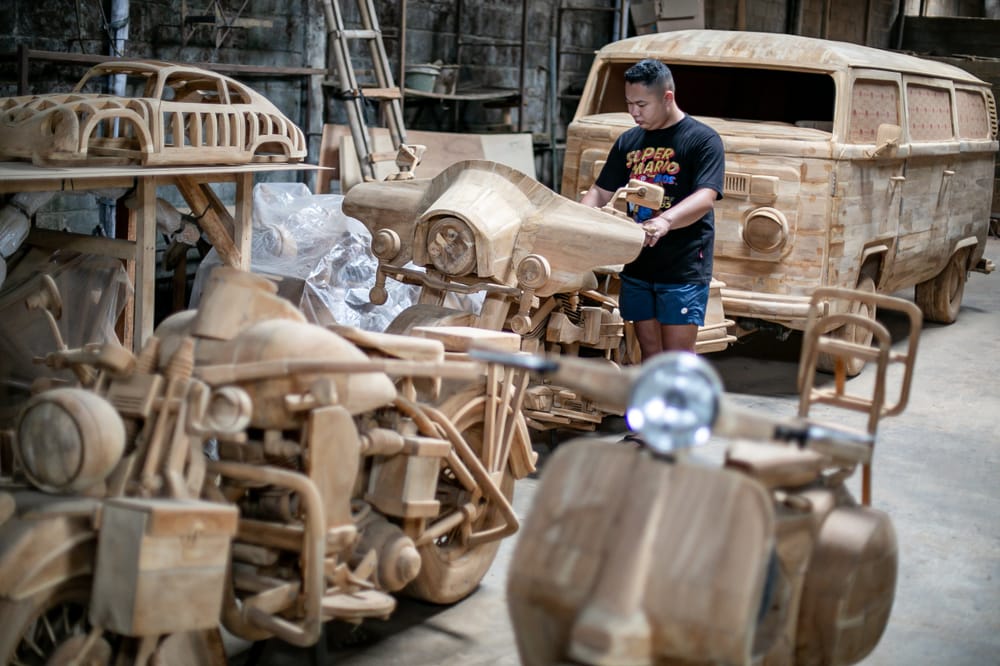
Jepara, a regency in Central Java, is known for its furniture workshops and export-scale furniture factories. However, they often experience limited liquidity or difficulty accessing conventional financing amidst global dynamics.
KIPK is specifically designed for labor-intensive sectors such as furniture, with the aim of helping businesses revitalize production equipment, increase capacity, and maintain business sustainability.
Ferry Irawan, Deputy for Coordination of SOE Business Management and Development, explained that the labor-intensive sector is an important sector in driving Indonesia's economic growth.
"KIPK is present as an investment credit or a combination of investment credit and working capital to support the needs of machine revitalization to increase productivity," Ferry told SUAR in Jakarta, Tuesday (22/07/2025).
He explained that the KIPK ceiling ranges from Rp500 million to Rp10 billion, with a maximum tenor of eight years that allows for extension or restructuring.
More importantly, the government subsidizes the interest rate by 5%, so businesses are expected to bear only a lower interest rate than regular commercial loans.
"The government ensures that the distribution of KIPK is right on target with the criteria stipulated in the Permenko. The distribution process is also based on verified data and monitored through a reporting system, as well as guidance by the Financing Policy Committee for UMKM," Ferry said.
Deputy Ferry explained that his party also did not stop at low-cost financing. There are mentoring programs, skills training for workers, and various initiatives to modernize production equipment so that businesses are able to respond to global demands, such as timber legality certification, low emission standards, and sustainability.
"The vision is not just to survive, but to grow. So that our businesses have room to innovate, increase productivity, and expand markets, without being burdened by high credit interest rates," he said.
Hindered by High Interest Rates
Chairman of the Indonesian Furniture and Handicraft Industry Association (HIMKI) Furniture Abdul Sobur underlined the problems that have been faced. Namely, collateral and high interest rates.
"While the furniture and handicraft sector requires flexible medium-long term financing because the production and export payment cycles cannot be short," Sobur told SUAR.
As a result, he said, many small businesses choose to stick with old equipment rather than modernize production machinery, even though it reduces competitiveness in the international market.
On paper, KIPK promises to be a breath of fresh air. However, in the field, business actors have the same concerns, how to make this program truly accessible to those who need it most.
"The KIPK scheme is quite realistic in concept, but it is necessary to ensure that its implementation really touches real actors, especially regarding collateral requirements, ease of disbursement, and business assistance," said Abdul Sobur.
According to him, there are still many business actors in Jepara who need facilitators or assistants so that they can understand the technicalities of registration and disbursement of funds.
Another challenge is socialization. Not many entrepreneurs, especially the lower-middle scale, know the details about KIPK. Meanwhile, the new tariff policy from the United States against a number of Asian products including furniture has made the export market uncertain.
"Apart from cheap credit, what businesses need most is stability in export demand, certainty in trade tariffs, and strengthening of the production ecosystem, including training of skilled workers and incentives for modernizing production equipment," added Sobur.
Maintaining Competitiveness
Abdul Sobur sees that if the implementation of KIPK really reaches the grassroots, many opportunities open up. Modernization of production tools can improve quality, human resource training strengthens design innovation, and market diversification can maintain business stability.
However, all of this requires a policy ecosystem that goes hand in hand. In the end, the hope is simple: that Jepara furniture is not only beautiful to look at, but also able to survive and compete in the world market.
Researcher from the Center for Strategic and International Studies (CSIS) Deni Friawan agreed that the presence of Labor Intensive Industrial Credit (KIPK) should be appreciated as a positive step by the government.
However, limited capital has been a major barrier for many furniture industry players to grow and innovate, especially when it comes to modernizing production equipment that requires large costs.
"Capital alone is not enough. There are many other issues looming, ranging from the difficulty of marketing products in the midst of fierce competition with cheap imported goods from China and Vietnam, difficulty in obtaining raw materials that are still dependent on Perhutani, to business management constraints and compliance with increasingly stringent environmental standards," said Deni.
Providing low-interest credit without thinking about how the product will be marketed, Deni said, can actually be a double-edged knife.
"They are at risk of defaulting or even getting into debt," he added, adding that when products are not absorbed by the market, credit installments are still running.
Deni emphasized the need for more comprehensive support measures: from business mentoring, digital marketing training, to education on good financial management.
"Only with a more holistic approach can a labor-intensive furniture industry like Jepara survive and grow amid global challenges," he said.