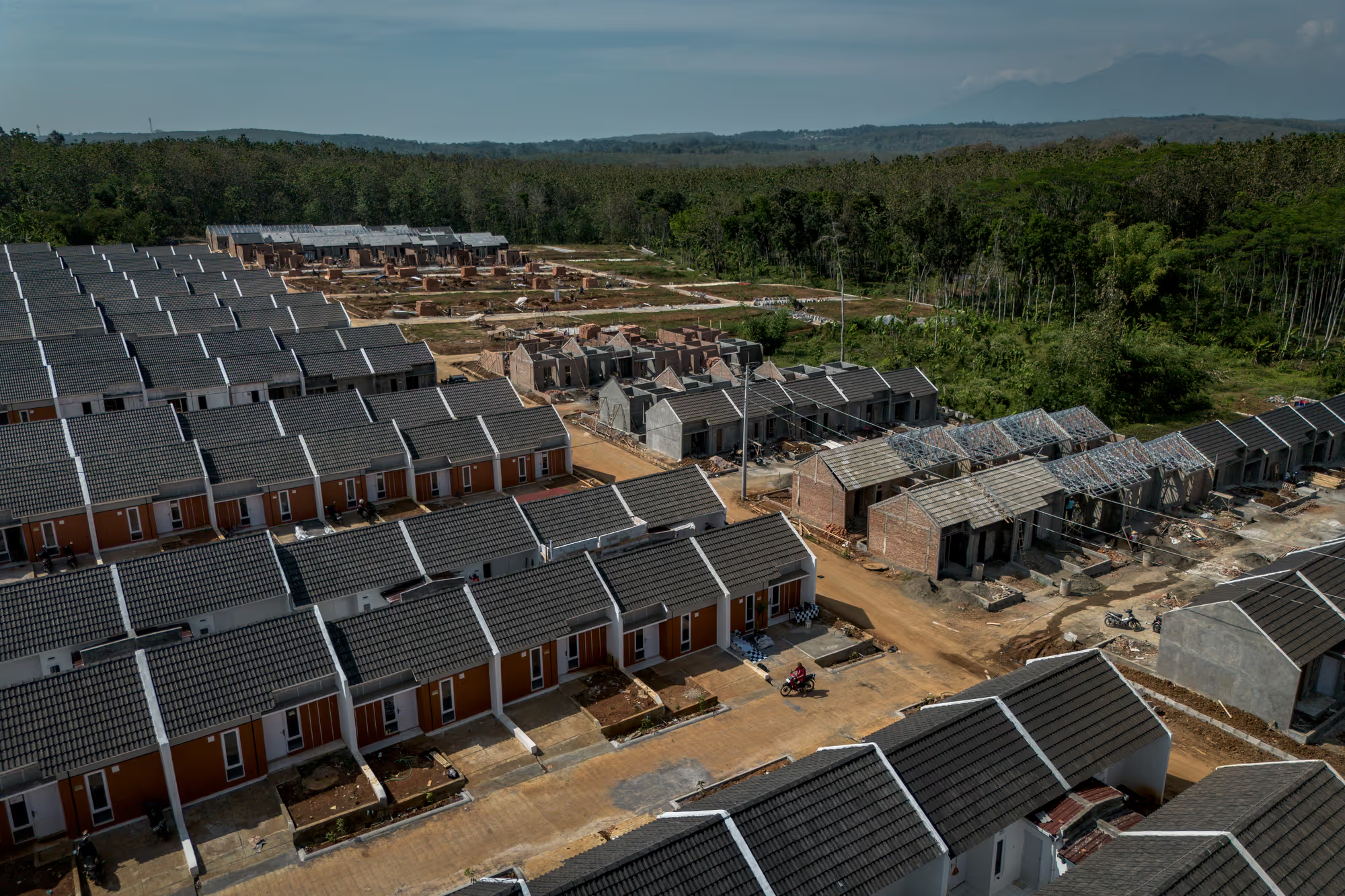
The government is rolling out a fresh wave of incentives for the property sector in an effort to spur economic growth and tackle a persistent housing backlog.
Measures include an extension of Value Added Tax Borne by the Government (PPNDTP) on home purchases and lighter down payment schemes aimed at widening access to housing.
One of the key measures is the decision to maintain the PPNDTP facility at 100 percent for home purchases until the end of 2025. Previously, it had been planned to be cut to 50 percent in the second half of the year.
“So, the technical details will be discussed further,” said Coordinating Minister for Economic Affairs Airlangga Hartarto after attending a limited coordination meeting at the Coordinating Ministry for Economic Affairs on Friday (July 25, 2025).
This policy is expected to sustain purchasing power, particularly for the middle class, which has long been the backbone of the property market. Data from the Ministry of Public Works and Housing (PUPR) shows that the construction and real estate sector continued to post positive growth of 4.5 percent year-on-year in the first quarter of 2025.
According to Ferry Salanto, Head of Research at Colliers Indonesia, this policy is a strategic step to increase public access to housing and stimulate property sector growth. “PPNDTP directly lowers home purchase prices and boosts purchasing power, especially for MBR (low-income communities), while also accelerating the absorption of ready stock projects,” Ferry told Suar via phone on Wednesday (July 30).
Additionally, the 0% down payment scheme through BPJS Ketenagakerjaan can address the long-standing issue of upfront costs for MBR. Ferry emphasized that if both measures are implemented effectively, they could significantly reduce the housing backlog.
“The combined impact could drive demand in the subsidized housing and simple landed house segments, while also encouraging developers to resume building affordable homes,” Ferry explained.
Joko Suranto, Chairman of Real Estate Indonesia (REI), said the extension of PPNDTP is a tangible sign of the government’s commitment to supporting the housing sector, which has been under pressure.
“This sends a positive signal to the public to be more confident in purchasing homes, while helping the property industry remain active. We all know that around three million housing units still need to be absorbed,” Joko said.
He added that the stimulus not only impacts home sales but also stimulates growth in around 185 downstream industries—ranging from building materials and furniture to the labor sector.
“Our hope is that PPNDTP becomes a real driver for people to buy homes and, in turn, helps revive the economy,” he concluded.
New Scheme: Rp130 Trillion KUR Housing and Zero Down Payment for BPJS Workers
Beyond tax stimulus, the government has introduced two new policies directly targeting low-income communities (MBR) and formal sector workers.
The first is Kredit Usaha Rakyat (KUR) Perumahan worth Rp130 trillion. This marks the first time KUR has been allocated to the property sector, previously associated with MSMEs working capital.
“For as long as Indonesia has stood, this is the first time we have a housing KUR. And the figure is fantastic: Rp130 trillion,” said Minister of Housing and Settlements (PKP) Maruarar Sirait, after a limited coordination meeting.
Ara, as he is familiarly known, explained that the program is awaiting the completion of a Ministerial Regulation (Permen) as its legal basis, with drafting progress already reaching 90 percent.
The scheme is expected to support the development of landed houses in rural areas and apartments in urban centers, while also boosting local contractors, construction workers, and MSMEs in building materials.
“President has always emphasized that we must help MSMEs move up the ladder,” Ara added.

The second initiative is a gotong royong scheme: subsidized housing developers have agreed to directly cover the down payment (DP) for workers enrolled in BPJS Ketenagakerjaan, averaging Rp1.7 million per person.
“In my view, this is the answer to President Prabowo’s directive: no serakanomics. This is real proof of gotong royong,” Ara said.
Addressing Two Major Challenges: Backlog and Uninhabitable Homes
The housing sector continues to grapple with two key challenges: a backlog of around 9.9 million families who still do not own homes, and 26 million uninhabitable houses.
For years, government policy has focused mainly on subsidizing mortgage (KPR) interest rates. However, the biggest obstacles remain the down payment and affordability. A combination of PPNDTP, KUR Perumahan, and zero down payment is expected to offer a breakthrough.
For existing but uninhabitable homes, the government still relies on the Self-Help Housing Stimulus Assistance (BSPS) program, which provides partial renovation funds. The remainder is expected to be covered through community gotong royong or corporate CSR initiatives.
“The best solution will certainly come from CSR and mutual cooperation (gotong royong), so that those houses can be supported,” said Ara.
New Focus: Not Just Quotas, but Absorption
This year, the government has set a target of building 350,000 subsidized houses. But the focus is not merely on hitting quota numbers—it is on ensuring homes are truly sold and occupied.
“This year’s quota is not the issue… The challenge now is absorption,” Ara explained.
Expert View: Stimulus May Miss the Mark
Mohammad Jehansyah Siregar, Lecturer and Member of the Housing and Settlement Expertise Group at Institut Teknologi Bandung (ITB), argued that all these stimulus measures will not effectively reduce the housing backlog. Instead, they could result in a loss of state revenue from the property sector.
This critical view highlights the government’s tendency to channel stimulus through banking-based financing, such as subsidized KPR, with the dual aim of boosting economic growth and helping MBR. However, according to Jehansyah, there are structural limitations that make the measures difficult to hit their intended target.
He explained that the maximum capacity for building homes for MBR is currently only around 250,000 units per year. “Even then, many are built in agglomeration areas that are not always appropriate in designation, and sometimes problematic in quality,” he added. Meanwhile, the national backlog remains in the tens of millions of units, a gap too wide to bridge through financing stimulus alone.
Moreover, demand for subsidized KPR among MBR is limited. Many either fail to meet banking requirements due to income and creditworthiness or opt for alternatives such as living with family or renting. “Most of the real demand comes from the middle class—those who are actually bankable—who are attracted by APBN subsidies, especially if the projects are located in strategic areas,” he explained.

At this stage, Jehansyah argued that financing-based housing stimulus is better managed by financial authorities such as Bank Indonesia (BI), OJK, the Ministry of Finance, and implementing banks such as BTN. The APBN, he said, should be focused instead on strengthening the foundations of housing production.
According to him, the Ministry of PKP should prioritize the provision of large-scale ready-to-build zones, land availability, infrastructure integration, and spatial planning. From there, people’s housing can be developed in a more structured and affordable way by involving developers.
“Do not get dragged into the domain of banking or MSMEs,” Jehansyah emphasized. “What’s more important is to understand the concept of multi-housing delivery systems: public housing, self-help housing, and social housing that can reach MBR in slum areas and dense metropolitan commuter regions.”
He further stressed the need for a serious evaluation of existing programs such as Rusunawa (public housing), Bedah Rumah (self-help housing), and Rumah Khusus (social housing). These should not remain routine APBN projects but must genuinely reduce the backlog, improve housing quality, and alleviate slum areas.
“Nearly three decades into reform, the issue of people’s housing has been stagnant. In fact, the backlog and slum settlements have only expanded,” he said. According to him, the current moment—when fiscal and monetary policy is focused on safeguarding macro stability—should be used to strengthen housing policy on the production side, rather than simply expanding subsidies.
With a more strategic policy direction, housing solutions will not only maintain the growth momentum of the property sector but also improve the quality of life for communities in a more sustainable and equitable manner.