Since high school, 27-year-old Leonardo Juan has lived a nomadic life, moving from one rented room to another. The constant shifts eroded any emotional attachment to the idea of a permanent home. For Juan, housing is purely functional: a safe roof at a manageable price.
The Covid-19 pandemic only reinforced that view. His family’s income fell sharply, forcing his parents to sell their house to keep food on the table. “We’ve managed without a home asset for the past two years, and it’s been fine,” he said.
The episode convinced him that financial certainty matters far more right now than owning a permanent residence. As a creative worker, Juan can work remotely. He currently shares a rented room in Bandung with his younger brother—also to help cut his sibling’s housing costs.
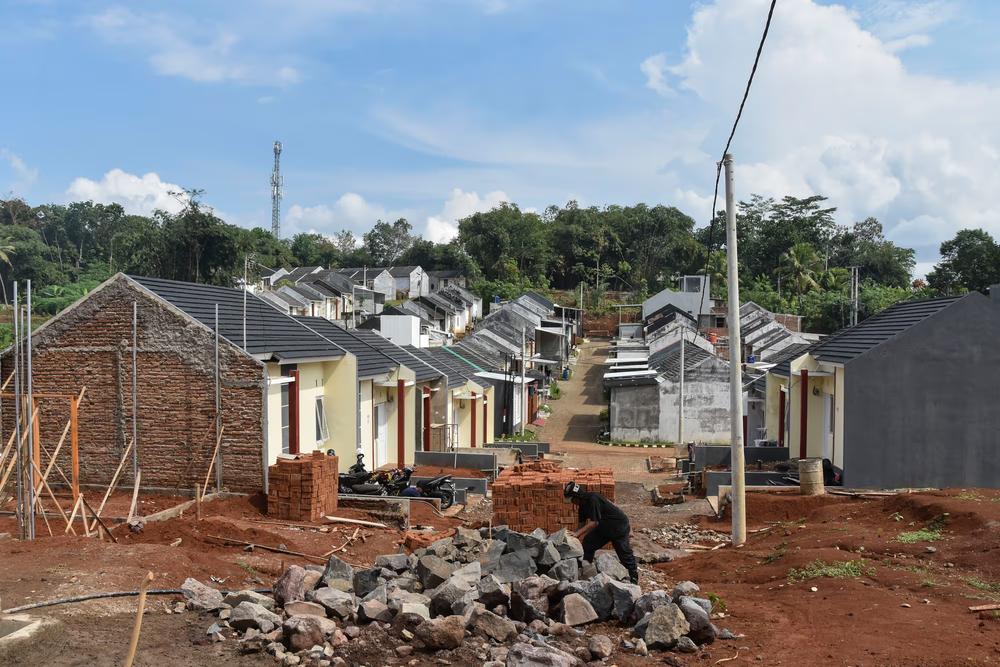
When thinking about buying in the future, he often compares his salary with property prices on the outskirts of Jakarta. Subsidized homes in Bekasi City or Bogor City now top Rp160 million, while the installments must be paid over two decades.
Subsidized homes in Bekasi City or Bogor City now top Rp160 million, while the installments must be paid over two decades.
For him, the income-to-home-price ratio is out of reach from the start. He concludes that chasing homeownership would sacrifice other, more urgent needs—especially for someone like him in the sandwich generation.
Another hurdle is location. Affordable, subsidized housing projects are often two to three hours from major office districts. Juan works in Jakarta’s Sudirman area. If he lived in Bogor or Bekasi, most of his time would be swallowed by the commute. “Growing old on the road is a losing proposition,” he said.
He has heard in passing about incentive schemes such as the Public Housing Financing Liquidity Facility (FLPP), zero-percent down payment via BPJS Ketenagakerjaan, and government-shouldered VAT. The information surfaced on social media and office group chats, then vanished. He still doesn’t know the details of these programs designed to help people buy homes.
“I’m not interested in checking the fine print yet,” he admitted. Subsidy schemes feel distant from his daily reality, because his finances force him to prioritize other needs.

There’s also the tenor of those programs to consider. A 20-year repayment horizon feels too long for Juan, compounded by floating-rate risks and today’s unstable economy.
He also weighs worst-case scenarios: losing his job or taking on more family responsibilities. Without a safety net, taking on a mortgage—even with government support—feels like running a marathon without a clear finish line.
As his family’s main breadwinner, default is not an option. “We are our own safety net,” he said, describing a generation supporting both parents and siblings.
Every financial decision must preserve that fragile balance. In Juan’s calculus, a house does not yet offer a payoff commensurate with the risk.
In the end, renting makes more sense than owning. He doesn’t have to worry about property taxes, fixing a leaky roof, or paying permit fees for renovations.
And if a landlord suddenly hikes the rent, he can move without incurring a bank penalty. For a member of the sandwich generation like Juan, that flexibility fits.
Gen Z and Subsidized Homes
Young people like Juan face hard choices in meeting basic needs such as housing. On one hand, their professional lives can be sustained by technology; on the other, they are shadowed by uncertainty. In this context, the idea of being “settled”—owning decent housing—still feels far out of reach.
It is therefore unsurprising that the youngest cohort in today’s workforce—Generation Z—has become the largest user of government homeownership incentives. According to the Public Housing Savings Management Agency (BP Tapera), Gen Z dominated subsidized-home purchases throughout 2024, with total acquisitions reaching 124,889 units.
BP Tapera’s Head of Communications Secretariat Division, Alfian Arif, said Gen Z’s dominance is based on disbursement data under the FLPP scheme. Broken down, in 2024 the FLPP realized 124,889 units for the Gen Z segment—those born 1997–2012, or aged 19–30—equivalent to 62.35%.

Those figures show Gen Z was the largest consumer of subsidized homes in 2024. Total FLPP disbursement last year reached 200,300 units. “This means FLPP is a solution for Gen Z to own a home,” he said.
In detail, FLPP disbursement to buyers aged 19–25 reached 66,746 units (33.32%), while the 26–30 age group recorded 58,143 units (29.03%).
BP Tapera data also show lower uptake in older cohorts: ages 31–35 totaled 33,916 units (16.93%); ages 36–40, 20,687 units (10.33%); and above 40, 20,808 units (10.39%).
A “Middle-Income but Tenuous” Generation
Real Estate Indonesia (REI) Vice Chair Bambang Ekajaya argues that the 2025 housing incentives still don’t fully address Gen Z needs in Jakarta and surrounding areas. He says many Gen Z households fall into the “masyarakat berpenghasilan tanggung” (MBT)—a middle-income but tenuous bracket—that receives insufficient support.
“Gen Z in the MBT segment gets hit with commercial mortgage rates—up to 12 percent—so the installment burden is heavy,” he said. By contrast, low-income households (MBR) clearly receive a 5% interest rate, VAT exemption, and BPHTB (transfer-duty) exemption.
He added that although the VAT-borne-by-government program runs until year-end, implementation is constrained by the limited availability of ready-to-occupy units. Only a portion of developers can deliver homes ready to use within the next five months. Meanwhile, Gen Z who don’t qualify as MBR must shoulder transfer fees and higher interest.
The government has raised the MBR income threshold to around Rp14 million per month. But for Gen Z earning slightly above that, all benefits vanish immediately.
This group ultimately has to take fully commercial credit, even though its contributions to the digital economy are substantial. Bambang proposes partial subsidies for MBT—such as covering half of the interest.
This group ultimately has to take fully commercial credit, even though its contributions to the digital economy are substantial.
For Gen Z who still fall under MBR, the main issue isn’t interest rates but location: subsidized homes are generally far from city centers and workplaces. Bambang sees a solution in rusunami (low-cost simple ownership flats). Unfortunately, he says rusunami is difficult to implement within the FLPP scheme.
According to him, rusunami projects are unattractive to developers because construction costs exceed the regulated selling price. REI is pursuing one rusunami pilot to simulate pricing and concept.
Bambang declined to disclose the location or developer, but hopes the government will consider it. He believes rusunami is the most suitable solution for Gen Z.
He also argues subsidized housing would be far more effective if built with a transit-oriented development (TOD) concept—integrating housing with public transport such as KRL, MRT, and LRT. Located in the urban core and surrounded by full amenities, “people can move quickly and affordably,” Bambang said.
He stressed that this concept should be prioritized to meet the target of three million homes.
Lowering Commercial Interest Rates
According to Real Estate Indonesia (REI) vice chair Bambang Ekajaya, many Gen Z consumers still do not prioritize homeownership due to multiple concerns—floating interest rates, long loan tenors, and distant locations.
He emphasized the need for education that a home is a long-term asset. “A house can be a savings vehicle against inflation,” he said.
He noted that subsidized homes worth Rp10 million two decades ago now fetch around Rp170 million, a significant increase that underscores housing’s investment potential. For Gen Z, he argued, this should factor into decision-making; education on housing’s long-term benefits needs to be strengthened.
To ease barriers, REI proposes that the government lower commercial mortgage rates for the “MBT” segment (masyarakat berpenghasilan tanggung). Even a modest reduction, Bambang said, could spur absorption of strategically located Rp500 million homes. Mid-market developers would contribute more under such a scheme. Partial subsidies could serve as an effective bridge between low-income (MBR) and middle-income buyers.
As a longer-term fix, Bambang called for strengthening the People’s Housing Committee chaired by Hashim Djojohadikusumo. The committee brings together REI, banks, developer associations, local governments, and the National Land Agency (BPN).
Cross-sector coordination, he said, would streamline permitting, financing, marketing, and subsidy allocation. “The committee can coordinate it all,” he said.
He also urged greater transparency, noting the lack of official data on current housing disbursements. Even BCA chief economist David Sumual cautioned that the government should comprehensively reassess whether the three-million-homes target remains realistic.
Policy, David said, must be demand- and supply-driven. For now, demand for housing credit—especially subsidized units—continues to rise, bolstered by incentives through the Public Housing Financing Liquidity Facility (FLPP). “Some banks’ housing credit portfolios are dominated by FLPP,” he told SUAR.
He added that most active home-seekers are still millennials, whose incomes generally allow them to service mortgages, whereas many Gen Z consumers prefer discretionary spending and have yet to set a home-buying target.
“Most home-seeker profiles are dominated by millennials because, income-wise, they can afford installments. Meanwhile, many Gen Zs still prefer to have fun and haven’t set a target to buy a home.”
Property analyst Anton Sitorus, head of research at CBRE Indonesia, said Gen Z’s interest in homeownership is very low—a phenomenon seen not only in Indonesia but globally.
He agreed many Gen Zs prioritize gadgets, travel, and fashion over buying homes, with limited income as the main constraint.
Some Gen Z buyers are interested thanks to family support or above-minimum-wage earnings.
Government Push
To address low penetration—particularly among Gen Z—the government is preparing new measures. In September, the Ministry of Housing and Settlement Areas (PKP) will relaunch 25,000 subsidized homes for “special-profession” groups, including farmers, fishers, laborers, journalists, healthcare workers, and others.
“Later, anybody [who qualifies] can own one. We’re going to scale this up because the program greatly benefits the public—the down payment is 1%, with another 5% subsidized,” said Housing Minister Maruarar Sirait.
The subsidized mortgage scheme carries a 5% interest rate—well below commercial mortgages, which can reach 12%—a draw officials say is proving popular.
The 25,000-unit tranche is part of a broader increase in the national subsidized-housing quota. In 2025, the FLPP targets 350,000 subsidized units, up from around 200,000 the previous year.
Another initiative is a sector-specific People’s Business Credit (KUR) for housing. The program’s budget is supported by the Indonesia Investment Authority (BPI) Danantara, which has committed Rp130 trillion in KUR financing for the housing sector.

Under the KUR-Housing scheme, disbursement will run along two tracks. On the supply side—geared to developers and the housing ecosystem to produce quality, livable units—the budget ceiling reaches Rp177 trillion.
On the demand side, Rp13 trillion will support communities seeking to build property-linked businesses, such as shop-houses and homestays, to boost local economies and welfare.
By Mukhlison, Harits Arrazie, and Ridho Syukra