
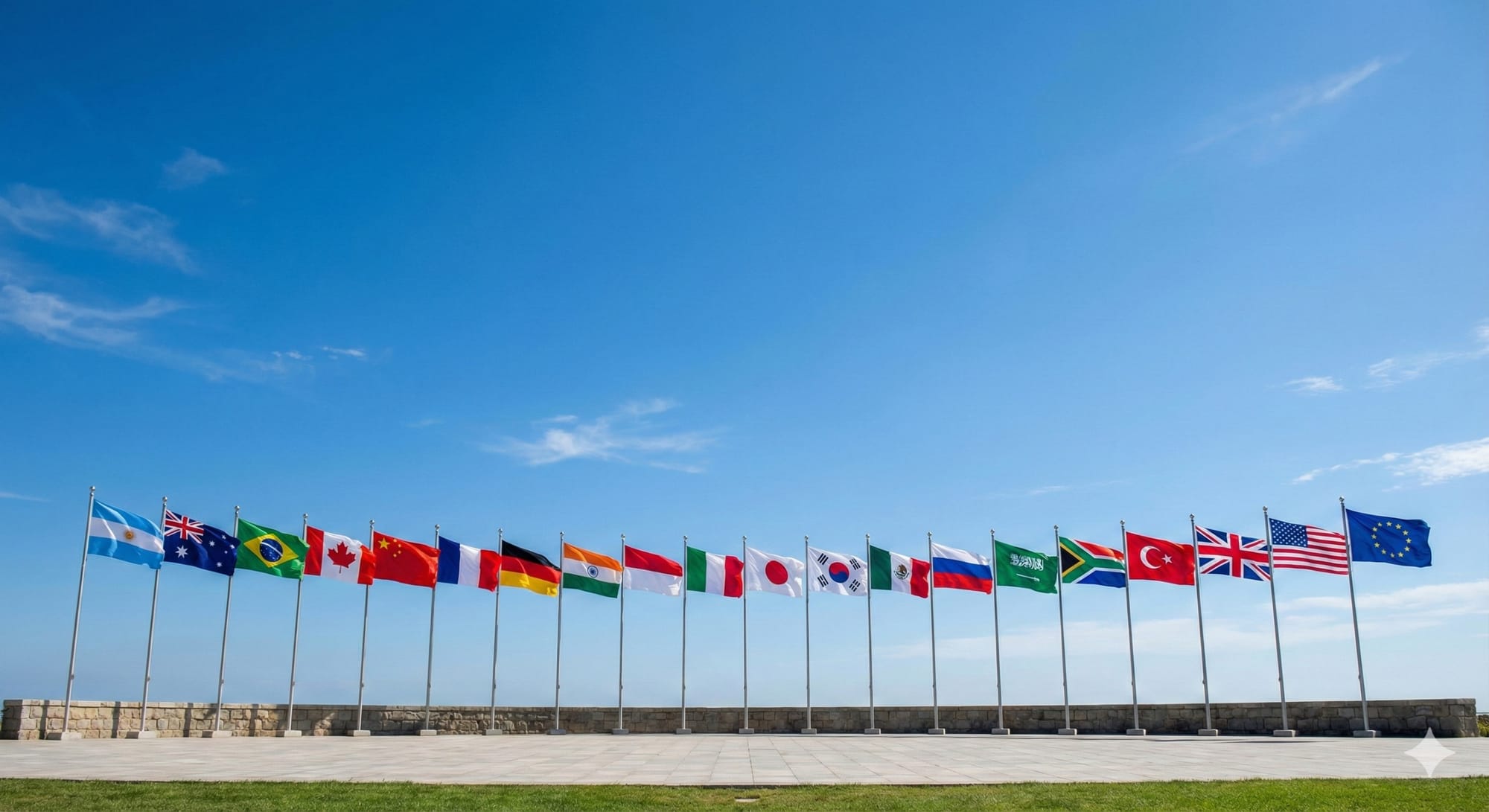
For the first time in history, the G20 Summit is being held in Africa. This moment is significant because for decades, Africa has been more often the object of global discussion than part of decision-making. In 2025, Johannesburg hosts the world's largest economic forum, representing more than 85% of global GDP, 75% of world trade and two-thirds of the earth's population.
This momentum is not just symbolic. Many consider that G20 Africa reflects a geopolitical shift, namely that economic power is no longer fully determined by the north, America, Europe, Japan, but has begun to shift to the Global South, including Indonesia, India, Brazil, and African countries.
Vice President Gibran Rakabuming Raka attended the forum on behalf of President Prabowo Subianto. In front of the heads of state and world economic leaders, he emphasized Indonesia's position as one of the motors of developing country cooperation.
"The organization of the G20 in Africa is a symbol of geopolitical change," Gibran said in his speech on Saturday (22/11/2025). "It marks a sea change, in which countries of the Global South are increasingly becoming an important part of global governance."
In a session themed Inclusive and Sustainable Economic Growth Leaving No One Behind, Gibran stated that Indonesia does not only want to pursue economic growth, but ensure that it is equitable. "Global growth must be strong as well as fair and inclusive so that all countries can benefit," he said.
To support the economic transformation of developing regions, he highlighted that access to global financing needs to be more equitable, especially for countries facing the impacts of climate change. "Financing must be more accessible, more certain, and more equitable. Energy transition, adaptation, and mitigation require innovative and affordable financing," Gibran said.
It has already begun to do so by allocating about US$2.5 billion per year, more than half of the national climate budget, to support green UMKM , agricultural insurance, and climate-resilient infrastructure.
In addition, he highlighted the importance of dialogue on the digital economy, digital assets and intelligence (AI) in global forums. "Digital assets present both opportunities and risks," Gibran said. "Therefore, Indonesia encourages the G20 to open a dialog on the digital economy and artificial intelligence."
He concluded his speech with an emphasis on inclusivity. "There is no one-size-fits-all development model. International cooperation should empower, not create dependency."
Indonesia's position
In a press conference after the meeting, Coordinating Minister for the Economy Airlangga Hartarto emphasized that the geopolitical direction of the economy can no longer ignore Africa.
"Africa is a future continent with rapid growth and strategic potential, particularly in global economic governance," he said.
Airlangga added that the agenda pioneered by Indonesia when it led the G20 in 2022 is now continued by South Africa, including encouraging the role of the Global South in supporting industrialization, sustainable development, and global economic stability.
In addition to the G20 plenary session, Vice President Gibran attended the MIKTA meeting with the leaders of Mexico, South Korea, Turkey, and Australia. A number of bilateral meetings also took place, including with the Prime Minister of Estonia, Prime Minister of Vietnam, President of Angola as Chair of the African Union, President of Finland, as well as leaders of the WTO and UNCTAD.
A number of African countries are said to have expressed interest in deepening economic cooperation with Indonesia. Deputy Foreign Minister Pahala Mansury Armanatha reinforced the narrative that the leadership of developing countries in the G20 since 2021 shows a change in global architecture. "The Global South is not only a spectator, but now a co-driver in the global economic agenda," he said.
He said that this year's Leaders' Declaration contained issues that have been of concern to developing countries, such asdebt treatment, reform of the global financing architecture, disaster risk reduction, and revamping the international financial system.
Armanatha also mentioned the G20's new step, which is to evaluate the two decades since the forum was formed. This evaluation, according to him, will be the basis for rearranging the direction of G20 priorities in the future, between the need to maintain the effectiveness of the forum and increasingly complex geopolitical pressures.
What is interesting, according to Armanatha, is the trend of African countries' interest in economic cooperation that is concrete and based on basic needs. "Some countries want to learn about agriculture, coffee, cocoa, not just high-tech economic matters, but fundamental ones," she said.
Meanwhile, Deputy Minister ofFinance Thomas Djiwandono emphasized that thefinance track in the G20 had been completed before the leaders' session was held. However, he highlighted that the major issue raised by Indonesia remains focused on reforming access to international financing. "Developing countries, including Indonesia, strongly emphasize fairer global financing," Thomas said.
On the concrete opportunities side, Airlangga said that a number of countries, including Angola and Ethiopia, expressed interest in conducting follow-up visits to Jakarta starting next year. Indonesia also noted Finland's interest in data center technology and telecommunications cooperation, as well as the continuation of several investment discussions such as PT Dahana's cooperation with Rheinmetall for explosives facilities, and the continuation of energy investment of around Rp2.6 billion through related SOEs.
Anticipating AI
A few days earlier, just a few kilometers from the G20 venue, the Bloomberg Africa Business Summit 2025 took place. Chairman of the Indonesian Chamber of Commerce and Industry (Kadin), Anindya Novyan Bakrie, took his turn to speak in a panel session titled Making Global Business Work, starting with a message that the world is currently at an important crossroads, and countries of the Global South must choose carefully how to move.
If Gibran speaks from the perspective of the state, Anin brings a more technical and realistic tone, the voice of an economic actor who understands well the rhythm of the market. Anin underlined the need for collaboration in building a shared economic future. Anin reminded us that relations between the two regions have long historical roots that date back to the 1955 Asia-Africa Conference in Bandung. "Since 1955, we have believed in South-South collaboration," she said.
According to him, cooperation opportunities are still wide open, especially after the visit of South African President Cyril Ramaphosa to Jakarta some time ago. "About a month ago the President of South Africa visited Indonesia. We had a good discussion, but I think our relationship base is still low," he said.
Economic facts show the gap between potential and realization. Indonesia has an economic value of around 1.3 trillion US dollars, while South Africa is in the range of half a trillion US dollars. But the volume of trade between the two countries still stands at around US$2.5 billion, a figure that Anin says clearly does not reflect their strategic capacity.
Anin then highlighted the structural changes in Indonesia's economy towards green industrialization and downstream resources. She sees this phase as opening up new space for partnerships, especially in a sector that is now the target of many countries, namely critical minerals. But he emphasized one important condition. "We don't mind working with the East or the West, but the added value must remain," he said.
For her, if the Global South only becomes a supplier of raw materials or a consumer market, then the pattern of economic inequality will continue to repeat itself. In this case, Anin reminded that developing countries need to be more pro-active in working together, and not just a low-value complement to the world supply chain.
"We are optimistic about Africa. South-South collaboration is strong and needs to be strengthened for more sustainable and smart growth together."
In addition to collaboration, during the panel session, Anin warned that the world may be repeating an old mistake: trusting technology too quickly without understanding the risks.
"In digitalization, especially AI, we need to be part of the development," Anin said. "But we should also be cautious of the possibility of a Western bubble like the dot-com era of 2000," she adds.
His concerns are fundamental. According to him, even the technology players themselves do not fully understand the direction of AI development. "Both engineers and actual users still find it difficult to predict the direction of the technology's development," he added.
However, he does not dismiss the possibility of AI as a catalyst for economic transformation, as long as developing countries are not just consumers. "I believe in AI. There will be many jobs lost, but also new jobs created. We need to utilize it to increase productivity."
The panel session also featured other economic luminaries, such as Egypt's Minister of Foreign Investment and Trade Hassan El Khatib and President of International Standard Chartered Bank PLC, Benjamin Hung. But among the cross-continental conversations, Anin's message came to the fore: the global future does not belong to Silicon Valley or Beijing, it belongs to Jakarta, Pretoria, and developing countries that choose to walk together.
Read also:
 Benedictus Krisna Yogatama
For Deni Friawan, a researcher in the economics department at the Center for Strategic and International Studies (CSIS), the G20 conference in Africa is not just a turn to host, but a momentum that has its own symbolic meaning. "In rotation, yes, it is indeed Africa's turn now," he said, opening the conversation at the end of a voice message, Sunday (11/21/2025). "But if you look at the context of today's global economy, the G20 in Africa has deep symbolic and practical meaning."
The meaning, according to Deni, comes from two contradictory things: underdevelopment and potential. For decades, Africa was seen as far behind other continents. However, in recent years, a number of countries in the region have shown a striking surge in progress. Ethiopia is one of them.
"The population is still young, they just finished an internal war, stability is starting to form," Deni said. "And in economic principles, countries that start from a low level usually have the highest growth potential, until they slow down like Japan, Europe, or the United States."
But the big change does not mean that the center of the world economy will move to Africa anytime soon. Deni makes this point without metaphor or ambiguity.
"If the center of the world economy shifts to Africa? No," he says with a chuckle. "Today the economic center remains in developed countries." According to him, the world is in a different phase. After the era of North America and Europe, it is now Asia's turn. He calls it Asia's moment.
"Now it's the Asian era. Because there is China, there is ASEAN, such as Vietnam, Indonesia, Thailand," he explains. "Africa might be after that. But today, not yet."
Africa's potential, he says, is no illusion. The combination of young demographics, large domestic markets and critical mineral reserves puts the region on the global geopolitical and economic radar. From nickel to rare earths to future energy commodities, these assets make Africa more relevant than ever.
But relevance does not automatically mean readiness. "Even though there is stabilization, we cannot ignore that there are still civil wars and military juntas," he said. "Africa is still too risky for many investors."
For Indonesia, Africa is an opportunity, but one with long distances and structural challenges. "The potential is great, especially for resource securing," says Deni. "But there are two obstacles: distance, and complementarity."
He explained that Indonesia and many African countries have similar economic structures: both are developing countries that rely on natural resources and labor.
"Therefore, the comparative advantage is lacking," he continued. "Unlike Indonesia's relations with developed countries in East Asia or North America, where there are differences in economic structures that make cooperation easier to form."
However, small examples like Indomie show that market penetration can happen through channels that are not always formal or strategic. "Indomie is one proof. In Africa, people think it's their product," he says. "With a young population and increasing purchasing power, it shows the potential is huge."
For Deni, the point of the G20 in Africa is not about whether the continent is ready to lead the global economy, but about the world finally giving representation to a region that has been on the sidelines for decades.
"This is the momentum to show that Africa and developing countries have a voice in shaping the world order," he concluded. "Because when it comes to long-term growth potential, they are the last big market. After Asia, yes Africa."