
Forex-studded export prospects do not only exist in the United States and China. Therefore, Indonesia continues to seek trade cooperation with several countries to boost export performance and manufacturing growth.
At least, in September, there have been three trade agreements successfully agreed or signed. Namely, the comprehensive industrial cooperation between Indonesia-Turkey, the Indonesia-European Union Comprehensive Economic Partnership Agreement IEU-CEPA, and most recently the Indonesia-Canada Comprehensive Economic Partnership Agreement (ICA-CEPA).
Previously, in August 2025, Indonesia had also entered into a trade agreement with Peru.
These measures are part of the government's strategy to strengthen Indonesia's position in the global supply chain and increase the added value of downstream products.
Indonesia-Turkey Industrial Cooperation
Indonesia and Turkey are strengthening comprehensive cooperation in the industrial sector. The goal is to boost the sustainable economic growth of both countries on the sidelines of the 12th Annual Teknofest Aerospace and Technology Festival in Istanbul on September 20, 2025.
As the first step of cooperation, Indonesia and Turkey formed a Joint Committee for Industrial Cooperation covering 14 strategic sectors. Namely, ranging from battery technology, electric vehicles, textiles, to the halal industry.
The breakthrough made by the government by embracing Turkey has received a fairly positive response from the business world. One of them is the Chairman of the Indonesian Export Association Benny Soetrisno.
Benny sees Turkey as a developing country that is very strategically located and is a transit center for trade between Europe and Asia. "Indonesia can learn from Turkey about its manufacturing technology, and vice versa, Turkey can learn from Indonesia about agriculture," Benny told SUAR in Jakarta (24/9).
Both countries can be strong trading partners because they have many similarities. Most of Turkey's population is also Muslim, so there is potential for the development of the halal industry.
Indonesian Employers Association (Apindo) Expert Council Danang Girindrawardana said that Turkey is the most potential market and must be secured. He also assessed that Turkey could be an alternative export market besides China.
Therefore, according to Danang, the government's move to establish industrial cooperation with Turkey is very appropriate, because both countries can exchange knowledge. Moreover, Turkey is also great with its technological capabilities.
"Many potential products can be developed for the Turkish market. Establish strong cooperation, don't be half-hearted," he said.
Minister of Industry Agus Gumiwang Kartasasmita has held abusiness meeting with a number of leading industry players in Turkey. Some of them are:
- Karadeniz Holding. This large business group engaged in the energy, finance, real estate, ships and logistics sectors expressed its interest in exploring cooperation in the shipyard sector and the provision of powership.
- Kale Group, the largest manufacturer of ceramics and building materials in Turkey. The Minister of Industry explained that Kale has a great opportunity to support national priority programs. Namely, the construction of three million people's homes which will absorb a large supply of ceramics.
- Erisler, a Turkish food producer that already has a partnership with Indonesia. Currently, Erisler distributes wheat flour for animal feed. But in the future, they are committed to expanding their business into the food industry.
- Tümosan, a manufacturer of tractors and diesel engines. According to Agus, the cooperation opportunity with Tümosan is in line with President Prabowo Subianto's program to achieve food security.
Indonesia-European Union Partnership(IEU-CEPA)
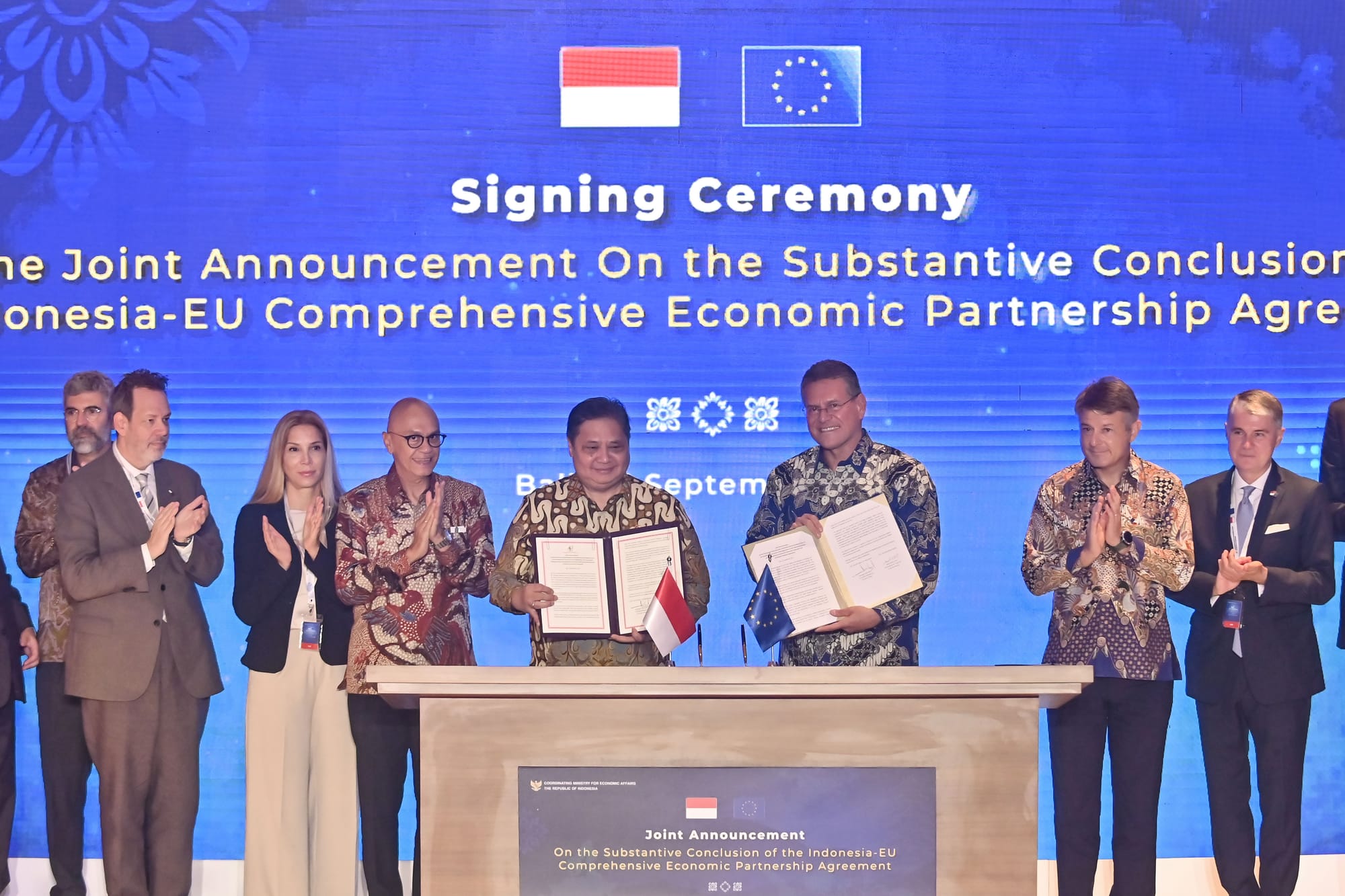
After almost a decade-long negotiation process, Indonesia and the European Union have reached an important milestone in their long-term partnership. Namely, the signing of the substantive Indonesia-European Union Comprehensive Economic Partnership Agreement (IEU-CEPA).
Coordinating Minister for Economic Affairs, Airlangga Hartarto, and European Trade Commissioner, Maroš Šefčovič, signed the IEU-CEPA at Sofitel Nusa Dua, Badung, Bali, on September 23, 2025.
Indonesian Palm Oil Association (Gapki) Chairman Eddy Martono said that with the signing of the IEU-CEPA agreement, Indonesia's CPO export journey to Europe will be easier and will not be complicated anymore. He even hoped that the IEU-CEPA agreement could double the performance of Indonesia's CPO exports to Europe.
Although tariff barriers have been removed, palm oil exports still have to pass through the "high wall" of the European Union Deforestation Regulation (EUDR). Although, the implementation of the regulation has been delayed again.
"IEU-CEPA is good news. But if the EUDR cannot be fulfilled, then zero tariffs are useless. Our exports will still be hampered," Eddy told SUAR in Jakarta (24/9).
Eddy reminded that the key to the success of Indonesia's palm oil exports was not only the elimination of tariffs, but also the ability to fulfill non-tariff regulations. Currently, the government and business players are said to be finalizing a strategy so that the implementation of the EUDR does not burden the palm oil industry, especially smallholders.
Indonesia-Canada Cooperation (ICA-CEPA)
Canada's first bilateral trade agreement with an Asian country paves the way for the removal of more than 90% of trade tariff barriers.
The agreement was signed by Indonesian Trade Minister Budi Santoso and Canadian International Trade Minister Maninder Sidhu at West Block, Parliament Hill, Ottawa, Canada, on September 24, 2025.
Apindo Chairperson Shinta Kamdani appreciated the government for continuing to add to the list of international trade cooperation, including with Canada which is a good new start.
Canada is a major country in the Americas. With the ICA-CEPA agreement, Indonesia's export performance can be improved and Indonesia has new alternative export markets.
"The more new export destination markets, the more foreign exchange will increase and the business world has many options to market its products," Shinta told SUAR in Jakarta (25/9).