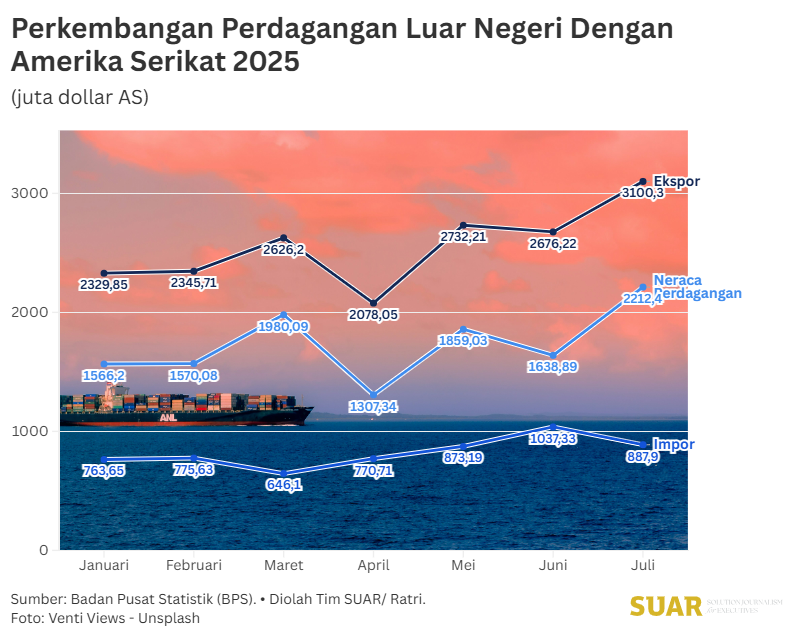
Ahead of the implementation of the United States' reciprocal tariffs on Indonesia as of August 1, 2025, there was an increase in Indonesia's non-oil and gas exports to the US in July 2025. The positive momentum during the first half of the year is expected to continue despite adjustments in response to the US policy.
The Central Bureau of Statistics (BPS) release on September 1 regarding the development of Indonesia's exports and imports showed an increase in Indonesia's non-oil and gas exports to the United States in July 2025. The value of Indonesia's non-oil and gas exports to the US in that month was recorded at USD $3,100.30 million, an increase of nearly 16% compared to June.
This increase also caused the RI-US trade balance in July to increase to USD $2,212.40 million or up 34.9%. The total cumulative surplus from January to July 2025 reached USD 12,134.03 million, strengthening the position of the US as one of the most profitable trading partners for Indonesia.
The increase in exports to the US in July is very likely closely related to the new tariff policy imposed by the United States starting August 1, 2025. There is a phenomenon of "export acceleration" or front-loading by Indonesian exporters to avoid higher tariffs in August and beyond. Exporters are trying to maximize their product shipments to the US market before the new policy takes effect.
Based on BPS data, non-oil and gas exports to the US are dominated by three main commodities, namely electrical machinery and equipment, clothing and accessories, and footwear. Exporters engaged in these sectors accounted for the largest non-oil and gas surplus.
The outlook for Indonesia's trade with the US in the following months will change. After the US tariff policy comes into full effect, there is a potential for a decline in exports. The effect of front-loading in July, demand that should have been executed in August onwards, has been fulfilled earlier.
The value of Indonesia's non-oil and gas exports to the US remains the second largest contributor to Indonesia's total export value after China. To maintain the momentum of a positive trade balance amid these global challenges, the government and business actors need to take anticipatory steps, including by expanding markets to other potential countries.