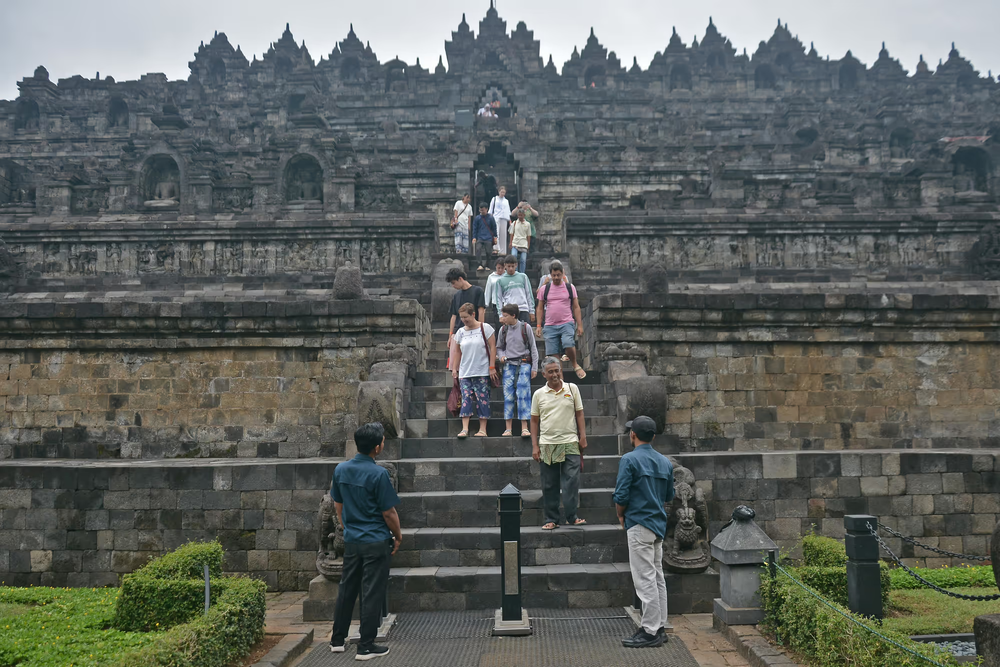
Indonesia’s premium tourism and hospitality industry continues to grow even as household purchasing power shows signs of strain. The trend highlights how the country’s upper-income segment still retains strong capacity for discretionary spending.
For many middle-class travelers, affordability dictates choices. Syahrul Muttaqin, a Finance Ministry employee, opted for trips to Malaysia and Singapore in 2025, citing airfare differences: Aceh-Jakarta flights cost Rp3.6 million round trip, while Aceh-Kuala Lumpur was less than half at Rp1.4 million.
“For me, Jakarta and Kuala Lumpur are quite similar, so I might as well go to Kuala Lumpur,” he said.
That reflects the middle-class perspective. What’s more interesting is the trend among the upper class.
According to Lokadata research, average annual household spending on entertainment among the upper 1 and upper 2 classes has risen. In 2024, upper 1 households spent Rp1.5 million on entertainment, up from Rp1.2 million in 2019.
The upper 2 class spent Rp600,000 in 2024, up from Rp500,000 in 2019.
Meanwhile, entertainment spending among middle and lower-class households remained flat.
Lokadata uses Nielsen’s criteria to define upper classes: higher education levels, significant income, access to more resources, and influence over consumer trends.
Chief Data Officer of Lokadata, Ahmad Suwandi, explained that this surge in spending does not reflect evenly distributed financial health. “The increase in non-food spending between 2019–2024 is driven by a paradox: on one hand, macroeconomic growth and rising GDP per capita; on the other, the middle class actually shrank by 9.48 million people,” he said.
He attributed this spending surge to three main factors: economic polarization, shifting priorities among the middle class, and digital acceleration. For example, the upper class remains financially stable, boosting luxury spending and premium travel.
“Middle and upper classes may visit similar destinations but at different levels of experience. The upper class leans toward premium activities like diving or sailing, while the middle class chooses more affordable options like concerts or popular attractions,” he added.
Data from Statistics Indonesia (BPS) also highlight the resilience of premium tourism. The occupancy rate (TPK) of five-star hotels in May 2025 reached 51.70%, up from 50.11% in April.
Other BPS data reinforce optimism in the sector:
- Five-star hotel occupancy rates were highest in Bali (58.10%), followed by Yogyakarta (53.94%), South Kalimantan (52.69%), East Kalimantan (52.67%), and Jakarta (51.31%).
- Foreign tourist arrivals in May 2025 reached 1.31 million, up 14.01% year-on-year.
- Domestic tourist trips in May 2025 totaled 97.67 million, up 17.81% year-on-year.
This shows that despite concerns over purchasing power, the public’s desire to travel and seek new experiences remains high, fueling positive growth in tourism.
The Mandiri Spending Index (June 2025) also confirms strong upper-class purchasing power in tourism. During the May holiday period, upper-class spending grew 41% on airline tickets, 4% on hotels, and 12% on restaurants.
Bank Mandiri’s Chief Economist Andry Asmoro noted: “This indicates that the upper-income group still has sufficient funds for tertiary needs such as travel, especially during long holiday seasons.”
Business Caution
Hariyadi BS Sukamdani, Chairman of the Indonesian Hotel and Restaurant Association (PHRI), struck a more cautious note. He acknowledged that optimism must be tempered by challenges facing the industry, particularly weakening consumer purchasing power and government policies.
He pointed out that certain regions like Bali and Yogyakarta enjoyed significant hotel occupancy increases in May due to holiday travel.
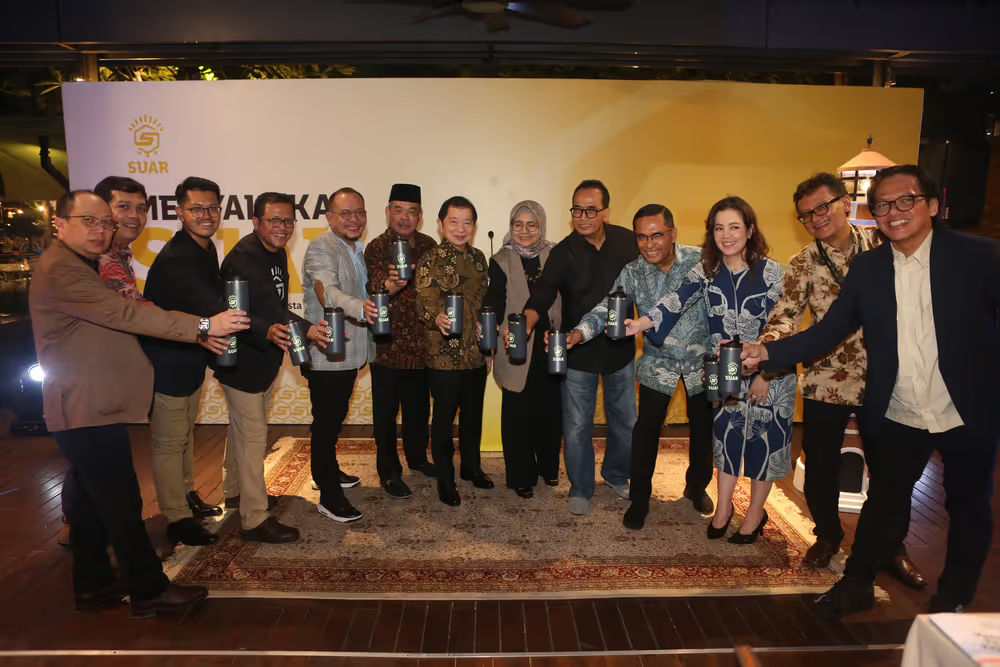
“Bali in May, June, even starting April, was already crowded with incoming tourists,” he told SUAR (July 24, 2025).
Jakarta also saw rising five-star hotel occupancy, but competition over room rates is tightening, pushing prices down. “At certain times, yes, Jakarta sees improvements. But to say the rise is significant—Jakarta is not there yet,” he said, noting many hotels are still operating at around 50% occupancy.
Hariyadi highlighted the millennial and Gen Z phenomenon of frequent travel, often spending savings on trips. While this drives demand, PHRI notes that such spending doesn’t necessarily reflect solid purchasing power.
In fact, declining room rates at four- and five-star hotels indicate weaker overall consumer capacity.
“Purchasing power keeps declining. So even if five-star hotels are busy, we must check whether four- and five-star hotels are lowering prices to fill rooms,” he explained.
He warned of three major challenges for the hospitality sector through year-end:
- Falling consumer purchasing power – the biggest concern, directly impacting the ability to travel and pay normal room rates.
- Government budget cuts – limited and delayed government spending, affecting tourism-related activities tied to public budgets.
- Regulatory restrictions – bans on school study tours and graduation ceremonies in hotels, which significantly hit the MICE (meeting, incentive, convention, exhibition) and education-event segments. “With weakening purchasing power, coupled with these restrictions, the impact on occupancy is substantial,” Hariyadi concluded.