

Trade tensions that are accelerating geoeconomic fragmentation are causing the world economy to transform rapidly in a short period of time. Simultaneous changes in supply chains and recalibration of global investment triggered fears of a slowdown in potential regions. Market diversification and multilateral mechanisms need to be followed up immediately in anticipation of a knock-on effect that could hamper Indonesia's economic growth performance.
The situation is clearly described in the latest Chief Economists Outlook report published by the Center for the New Economy and Society of the World Economic Forum (WEF) on Thursday, September 25, 2025. The 34-page report synthesizes the results of 35 surveys conducted by WEF from May 2023 to September 2025, involving 72 chief economists from 20 countries.
The WEF showed a change in respondents' attitudes in predicting the global economy from May 2025. A total of 61% of respondents said expectations would besomewhat weaker, while 39% said expectations would bemuch weaker. 82% of respondents pointed to the US reciprocal tariff policy as the culprit for increased geoeconomic fragmentation.
Under such circumstances, even if global trade volume increases by US$300 billion in the first half of 2025, mass frontloading practices and supply chain changes that increasingly rely on Chinese exporters are shifting market destinations away from the US. In other words, instead of being beneficial, tariff policies are fueling the development of new economic magnets outside the US.
"China's economic growth has been relatively robust, although signs of a slowdown are starting to show. While GDP grew 5.2% YoY, industrial growth slowed by the same percentage, as did retail sales which only grew 3.4% this year," the report read.
Not only China, but the East Asia and Pacific region more broadly is also experiencing an economic slowdown. The WEF revealed that Japan's export growth fell to 2.6%, the lowest in four years, partly due to a 10% drop in shipments to the US since tariffs came into effect.
"As a result of this slowdown, 78% of respondents think fiscal policy in the East Asia and Pacific region will tend to stabilize, while 64% of respondents said monetary policy will not experience significant changes, followed by slow and uneven adjustments to the global trading system," noted WEF.
For some time to come, the natural resources and energy sectors will face systemic risks, particularly in the tug-of-war between rare earth mineral potential and the impact of over-exploration on climate change. Long-term disruption will be caused by, among other things, the environmental risks of these exploration activities.
Meanwhile, in the long term, established global economic institutions, from the WTO to the UN, should prepare themselves for restructuring. Beyond retaining the pillars of the old rules, global economic institutions must coordinate crisis response, establish common rules, and mediate conflicts effectively.
Diversification is key
The possibility of an economic slowdown in the East Asia and Pacific region triggers broader concerns of a knock-on effect for Indonesia's economic performance, particularly in 2026. Key measures are necessary to anticipate this possibility.
Indonesian Employers Association (Apindo) Economic Policy Analyst Ajib Hamdani assessed that in the context of the global supply chain, the business world will face the impact of obtaining imported raw materials. Therefore, domestic policy mitigation must aim to protect and encourage regulations for low cost economy.
"On the supply side, Indonesia's domestic economy can produce competitive goods and services. Meanwhile, from the demand side, the government must focus on job creation policies to support people's purchasing power. Both are done simultaneously for sustainable economic growth above 5 percent," Ajib said when contacted by SUAR, Tuesday (30/9/2025).
Not only the business world, the government has prepared a number of measures to anticipate an economic slowdown. Spokesperson for the Coordinating Ministry for the Economy Haryo Limanseto emphasized that the state budget is focused as a shock absorber through accelerated spending realization, in addition to ensuring monetary synergy and liquidity stabilization of the rupiah exchange rate.
"The government continues structural reforms through the acceleration of deregulation with Government Regulation Number 28 of 2025 concerning the Implementation of Risk-Based Business Licensing which is effective on October 5, 2025. This regulation integrates the system in online single submission to encourage ease of doing business," Haryo explained in a written statement received by SUAR, Tuesday (30/9/2025).
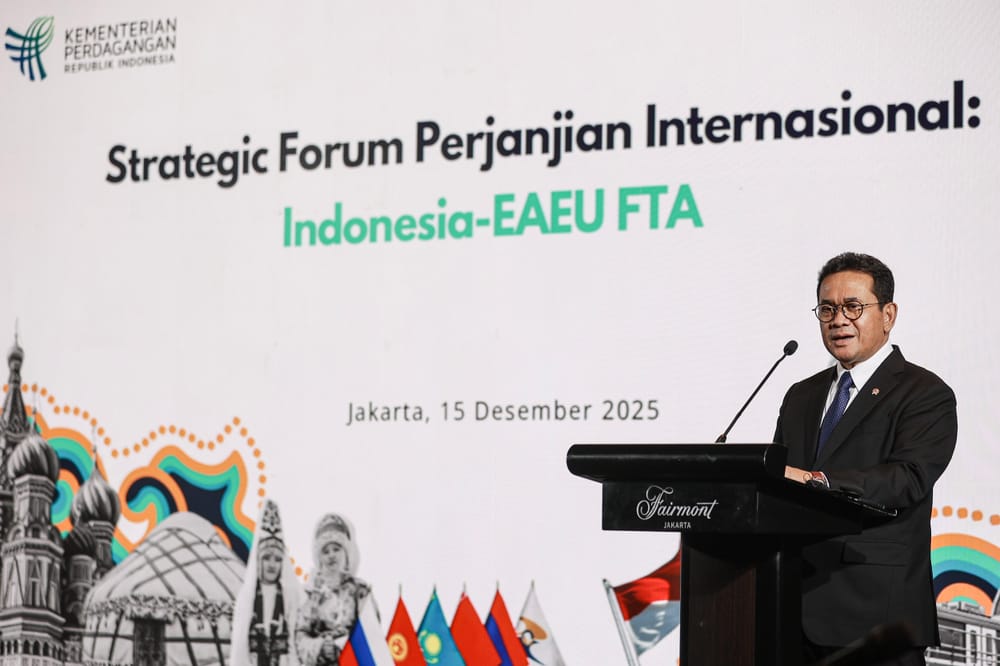
For the business world, the government recommends diversifying export markets and utilizing bilateral, regional, and multilateral free trade agreements , including maximizing the benefits of newly agreed FTA schemes such as ICA-CEPA and IEU-CEPA.
"To make the most of the scheme, businesses are expected to start focusing on increasing added value by shifting the focus of exports from commodities to high value-added products," Haryo concluded.
Create a comprehensive mechanism
Although it is not easy, reading geoeconomic shifts can be seen by observing the behavior patterns of the actors involved as key players over the past few years.
University of Indonesia Department of International Relations (HI UI) geoeconomics lecturer Shofwan Al Banna Choiruzzad underlines the US behavior that shows the will to reorganize the global economy by offensively excluding China from the economic circuit. Now, the US is not only targeting"Made in China" products, but also targeting"Made With China".
"This makes the position of developing countries whose economies are heavily connected to China very vulnerable. In fact, China is the main trading and investment partner in many of these countries. If the country depends on international trade, its economic conditions can deteriorate," said Shofwan when contacted by SUAR, Tuesday (30/9/2025).
Investor caution and protectionist maneuvers to protect the domestic economy are also a side effect of global uncertainty that puts pressure on the economy. In this situation, according to Shofwan, economic diplomacy should not only be seen through the lens of economics and trade.
"Strategic anticipation is needed by building a more comprehensive mechanism to strengthen multilateralism and build a safety architecture to bring economic certainty at the regional level. ASEAN, CP-TPP, and the European Union need to build a joint mechanism to respond to the uncertainty that Donald Trump will continue to raise," he explained.
Accelerating the industrialization of strategic sectors and diversifying markets as a first step for the business world is important to be followed by a rearrangement of government fiscal priorities. The ultimate goal: strengthening society's resilience amid increasingly volatile turmoil.
"The government needs to ensure that, in the midst of an uncertain global situation, resource allocations are properly channeled and not wasted on the wrong programs," Shofwan concluded.