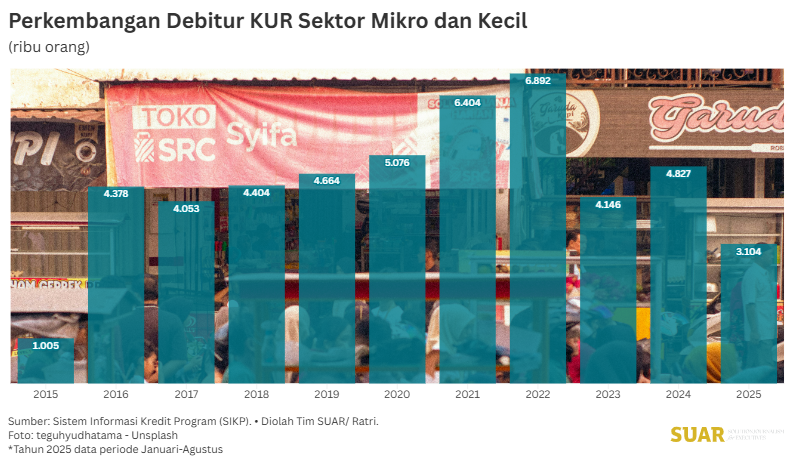
As the driving force of the national economy, micro, small and medium enterprisesUMKM) need real government support. Until August 2025, the realization of the distribution of People's Business Credit (KUR) was almost 60% of the target.
During the 2015-2025 period, the government consistently supported the development of UMKM through the distribution of KUR, which tended to increase. The significant increase in KUR disbursement was especially evident in 2022, when the realization reached Rp 373 trillion, exceeding the target of Rp 365.5 trillion. Although it declined in 2023, the target was again increased in 2025.
The increase in KUR distribution cannot be separated from the government policy, which since 2020 has reduced the KUR interest rate from 7% to 6%. Meanwhile, the super-micro business sector is even only subject to an interest rate of 3%. Meanwhile, micro and small-scale KUR debtors who receive credit again or upgrade are subject to a tiered interest rate increase.
Although the KUR target continues to be increased until 2025, the decline occurred because the KUR interest subsidy budget was cut to Rp 38.28 trillion (24.82%) from Rp 47.78 trillion in 2024. Due to the lower interest subsidy, the government needs to optimize the distribution of KUR funds by paying attention to the capabilities of channeling banks, so that micro and small businesses can survive and thrive - in order to boost the national economy.
More broadly, the KUR program not only provides capital, but also serves as a catalyst for national economic growth. UMKM are the backbone of the Indonesian economy. By supporting the sustainability and expansion of UMKM through KUR disbursements, the government is effectively stimulating economic activity, which is expected to have an impact on increasing people's purchasing power.
This capital assistance ensures that UMKM continue to operate and innovate, so that they can survive amid the current economic challenges.