
Statistics Indonesia (BPS) reported the general inflation rate in October 2025 at 2.86% annually (Year on Year/YoY). With less than two months until the end of 2025, Indonesian inflation is still below the upper limit of the government and Bank Indonesia (BI) target of 3.5%.
On a monthly basis, BPS recorded inflation of 0.28%, while year-to-date inflation reached 2.10%. When viewed from a monthly perspective, this inflation is the highest in the last five years for the October period, after inflation in the same month from 2021 to 2024 was always below 0.20%.
Deputy for Distribution and Services Statistics at BPS, Pudji Ismartini, explained that all expenditure components experienced inflation in October 2025, with the largest portion coming from the personal care and other services group. This group recorded inflation of 3.05% and contributed 0.21% to national inflation.
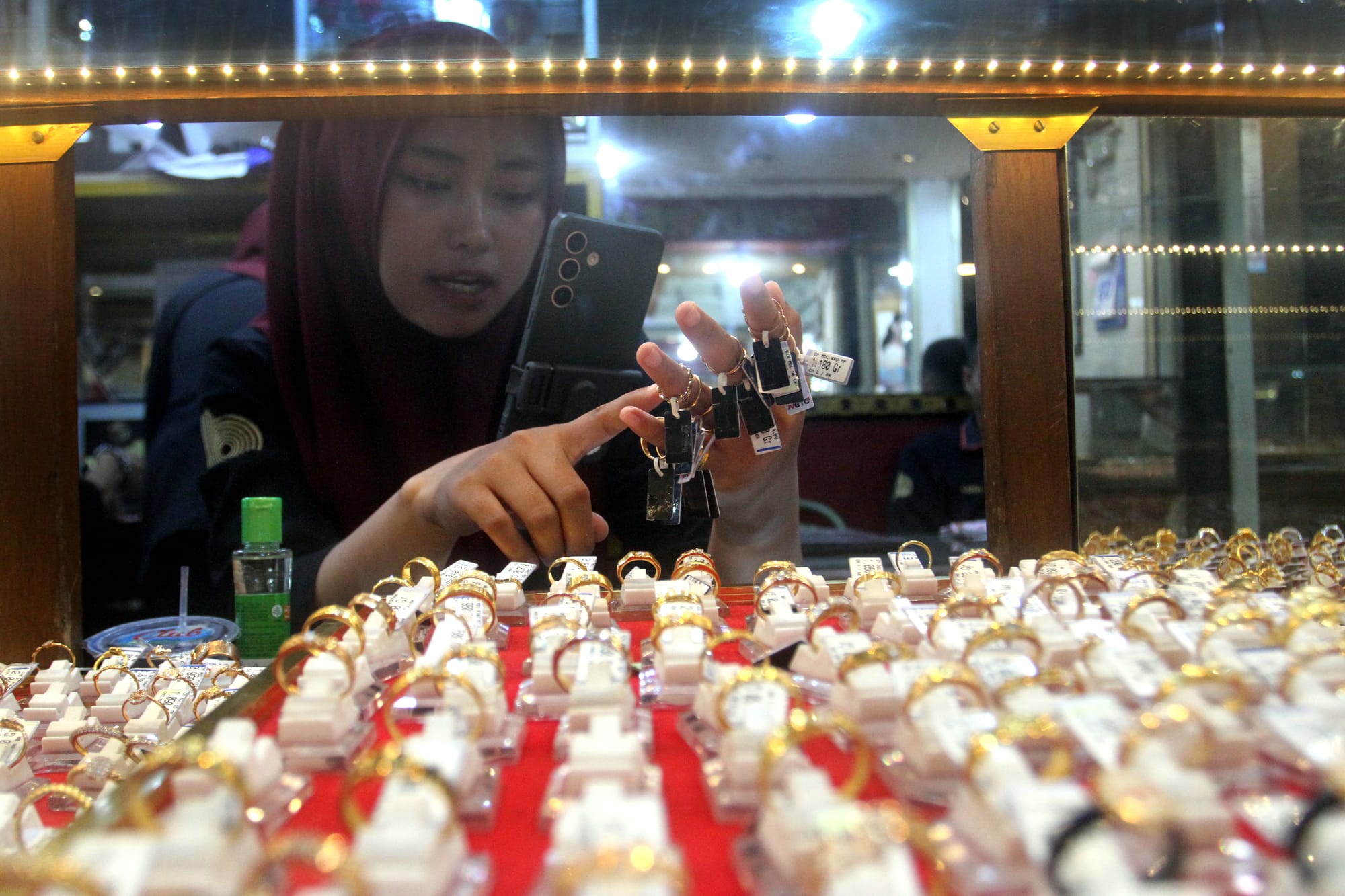
"This group is the largest contributor to monthly inflation, and the dominant commodity is gold jewelry," said Pudji in a press conference, Monday (3/11/2025).
BPS noted gold jewelry as the main commodity driving inflation in October 2025 with a contribution of 0.21%. The increase in gold jewelry prices has been going on for 26 consecutive months, with an inflation rate in October 2025 reaching 11.97%. "This is the highest inflation in 26 consecutive months since the occurrence of inflation," said Pudji.
When compared to previous years, inflation in gold jewelry has increased sharply. In October 2023, inflation was recorded at 0.92% with a contribution of 0.01%, while in October 2024 it was 4.44% with a contribution of 0.06%.
Historically, BPS noted that there has always been inflation in every October since 2021, except in 2022 which experienced deflation of 0.11%. The inflation rate for October 2025 of 0.28% is the highest compared to the 2021 to 2024 period, where inflation was recorded at 0.12%, 0.17%, and 0.08% respectively. Unlike previous years, Pudji said that the main commodity contributing to inflation in October 2024 and 2025 was gold jewelry.
Gold price
In addition to gold, several other commodities also contributed to inflation in October 2025, such as red chilies with a contribution of 0.06%, chicken eggs 0.04%, and chicken meat 0.02%. Based on its components, the largest inflation came from the core component of 0.39% with a contribution of 0.25%, which was influenced by the increase in the price of gold jewelry and tuition fees for academies or universities. Government-regulated price components contributed 0.02%, while volatile prices contributed 0.01%.
Economic, currency, and commodity observer Ibrahim Assuaibi explained that the surge in gold prices in October 2025 was triggered by limited supply in the official market. Gold stocks at Antam and Pegadaian are dwindling, so people are switching to buying at jewelry stores at much higher prices. This condition, he said, is pushing retail gold prices to touch around IDR 3 million per gram, increasing pressure on prices at the consumer level.
In his estimation, almost half of the public's savings funds in banking have shifted to precious metals and gold jewelry. "Because it is considered safer and does not lose value," he said. According to him, people see gold as a long-term investment tool that is more stable than saving cash, so demand remains high even though prices rise.
From a global economic perspective, Ibrahim believes that geopolitical tensions are the main driver of the increase in world gold prices, which then has an impact on domestic inflation. He mentioned the conflict between Israel and Iran, the situation in Europe after Ukraine's attack on Russian ports, and the United States' plan to attack Venezuela as factors that are driving up oil prices and increasing interest in gold.
"Actually, what makes the price of precious metals soar is the war between Israel and Iran," said Ibrahim.
In addition to global factors, the weakening of the rupiah exchange rate also strengthens the pressure on gold prices in the domestic market. Ibrahim explained that the strengthening of the United States dollar due to the temporary shutdown of the federal government is weakening the rupiah. Bank Indonesia's intervention in the foreign exchange market has not been strong enough to withstand this pressure, so gold prices continue to rise.
Ibrahim added that the combination of global and domestic factors makes gold jewelry play a major role in the formation of 2025 inflation. People in various regions, from villages to big cities, continue to buy gold as a form of long-term investment amid economic uncertainty. "Not only precious metals, but also gold jewelry. In small towns to big cities, people still choose jewelry because it is considered safer," he said.
Not the only one
Meanwhile, a researcher at the Department of Economics at the Centre for Strategic and International Studies (CSIS), Deni Friawan, believes that the increase in inflation is not only influenced by gold jewelry, but also by food commodities such as red chilies, chicken eggs, and chicken meat, which are classified as daily consumed food ingredients. According to him, Indonesian inflation is still very dependent on changes in the prices of basic necessities which quickly impact people's purchasing power.
Read also:
 Benedictus Krisna Yogatama
Deni added that the demand boost from the Free Nutritious Meal program and the realization of government spending towards the end of the year also put pressure on prices. When spending increases while supply is not ready, prices will be pushed up. "MBG contributes to increased inflation because our supply cannot keep up with the increase in demand," he said. According to him, there needs to be caution in fiscal policy so that the growth impetus does not create new inflation.
Gold does contribute to inflation, but Deni believes it is not significant because gold's portion in inflation calculation is relatively small. The increase in gold prices is mostly due to global factors, such as central banks in various countries buying gold as a hedge against the United States dollar. "The price of gold in Indonesia is rising due to two things: the world gold price is increasing and the rupiah is depreciating against the dollar," he said.