

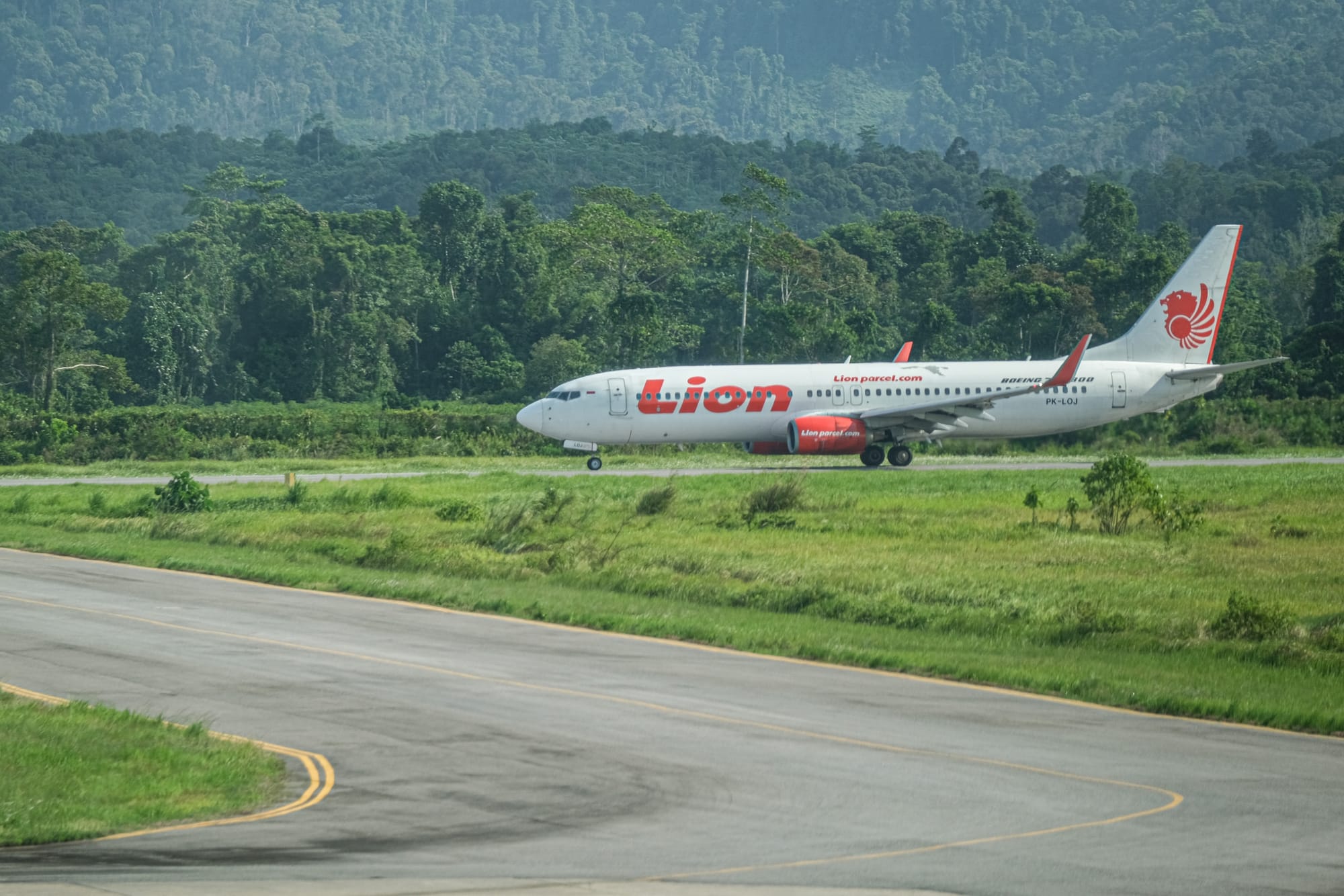
Welcoming the Christmas and New Year (Nataru) 2025 holidays, the government again lowered airfares by 13-14 percent as part of the government's economic stimulus to encourage mobility and economic growth.
The ticket discount applies to economy class domestic tickets with departure schedules from December 22, 2025 to January 10, 2026.
Travelers can start purchasing tickets from October 22, 2025 to January 10, 2026, according to a press release from the Ministry of Transportation.
An estimated 3.6 million passengers will enjoy these discounted tickets.
Transportation Minister Dudy Purwagandhi said that the policy of lowering airplane ticket prices is a form of government commitment to ease the burden on people who want to celebrate Christmas and New Year.
"We take this step so that connectivity between regions is maintained and community mobility runs smoothly with more affordable rates. We want to ensure that all people can enjoy air transportation services, especially during Christmas 2025 and New Year 2026," said Dudy in Jakarta in a press release on Tuesday (21/10).
The decrease in airplane ticket rates is the result of adjustments to a number of cost components, among others:
- Government-borne Value Added Tax of 6 percent, specifically for domestic and economy flights
- Fuel surcharge (FS) for jet aircraft is 2 percent, Propeller FS is 20 percent,
- Aircraft Passenger Services by 50 percent, Aircraft Landing, Deployment and Storage Services by 50 percent, a reduction in fuel prices at 37 airports, as well as advance and extended services and longer operating hours.
Looking forward to discounts
This airplane discount was welcomed by traveler Timothy Kinmekita Ginting, a private employee in Jakarta. He admitted that he was very interested in buying cheap tickets because he and his family always go at the end of the year.
"I am very interested in lowering airfares at the end of this year, because usually at the end of the year prices go up. So, if the government reduces tariffs, I would be very interested and happy," he said.
He often takes domestic flights to Bali for vacation or transit to continue his flight to another country. "Usually I fly to Bali for transit before continuing to Melbourne, Australia. However, due to the decline in domestic airline tickets at the end of the year, it seems that I am quite interested in planning a vacation to domestic destinations, taking advantage of this year-end discount," he said.
However, Muhammad Rizqy Ramadhan did not feel the same way. According to him, there is no noticeable price difference in domestic airplane ticket prices.
"Because the difference is only Rp100,000-Rp300,000, which for me is not too big," he said.
He admitted that compared to 2020-2022, ticket prices at the end of this year are cheaper, but not cheaper than prices in early 2025.
"Airplane ticket prices for several destinations also remain unchanged if booked suddenly," he said.

Small impact
Responding to this, Yusuf Rendy Manilet, Economist of CORE Indonesia, assessed that the discounted airplane tickets were not necessarily effective in driving public consumption.
The policy, he said, is more symbolic than giving a real boost to people's purchasing power.
"The lower middle class tends to hold back consumption and focus more on basic needs. So when stimulus is given in the form of flight discounts, the impact on aggregate consumption tends to be limited because the segment that can afford to travel by plane is the upper middle class whose proportion is relatively small. This means that the multiplier effect on the national economy will not be too large," Yusuf told SUAR.
Moreover, he said, Bank Indonesia's Consumer Confidence Index (CCI) data showed a moderate signal. In September 2025, the CCI was recorded at around 115.0 points, down from 117.2 points in August.
Although still above the optimistic threshold, the decline signals households' caution about economic conditions. In fact, the job availability subindex stands at only 92 points, below the optimistic level.
"This indicates that future economic expectations are weakening, so the tendency to restrain consumption remains high. In a situation like this, discount-based stimulus for non-primary needs such as air travel is difficult to trigger massive spending at the national level," he said.
From a fiscal perspective, this policy is more symbolic to maintain optimistic sentiment and year-end consumption activity rather than a structural solution to weak purchasing power.
"Moreover, the segment of airplane ticket discount lovers tends to be limited to groups that already have travel plans or relatively established financial capabilities. In other words, this policy risks only shifting the consumption time of certain groups, not creating new consumption from the wider community," he said.
He encouraged stimulus to be directed to sectors with a wider spillover effect, such as basic household consumption or public transportation used by the lower middle income group. "There the fiscal multiplier effect is much more pronounced."