

Wearing a red uniform, Arif Muhaimin, 24, stands alert at the reception desk of a two-star hotel in South Jakarta. His hands deftly grab the walkie-talkie when a guest reports that something has been left behind in their room. He reassures the guest, smiles, and then coordinates with the cleaning staff.
This routine has been part of his daily life since he started working at the hotel several years ago. "When I hear that the minimum wage is going to increase, I really hope it will," Arif told SUAR on Tuesday (12/24).
His current salary is right at the minimum wage threshold. For him, a raise would boost his motivation to work. "If it goes up, I'll be more motivated. I'll feel like my work is more appreciated," he said.
On the contrary, the announcement of the 2026 provincial minimum wage increase was not new news for Tina Chandra Ningrum (26). The woman, who works as a junior social media specialist in South Jakarta, admitted that she was already accustomed to seeing wage increase patterns that, in her opinion, were almost never significant.
The graduate of a well-known university in Central Java said that his income was almost immediately spent on daily necessities.
"Right now, the increase is only around Rp200,000–300,000. If you calculate it, that's only enough for a week's worth of gasoline or food. It doesn't make life any easier. And that's if you're really frugal," he said.
Fortunately, Tina did not need to rent a room because she lived with her family. This meant she was still able to set aside a small amount of savings, even though it was limited. "At most Rp1-2 million, and that's if I really resist my desires," she said.
Even so, he admits that he still has to cut back on many things, from rarely going out to limiting his socializing. "Sometimes halfway through the month, I'm already low on cash, with only Rp300,000 left. It feels like it runs out really quickly," he said.
When her finances were running low, Tina chose to look for additional income or borrow from her parents.
"If I can find additional income, that's the first thing I'll do. If I have to, I'll borrow from friends or my mother. It's sad, really, because I should be able to help my parents, but instead I'm borrowing money," he said.

Competitiveness
The minimum wage increase announced by the government recently has sparked pros and cons from various groups. For workers, wage increases are an important factor in meeting basic needs that continue to rise in line with inflation.
Meanwhile, entrepreneurs consider this policy burdensome amid a slowing global economy. Some even say that wage increases threaten the sustainability of their businesses, especially in labor-intensive sectors.
Moreover, the increase in operational costs is often not accompanied by an increase in employee productivity, leading to a decline in competitiveness in domestic and international markets.
According to Senior Economist at the Institute for Development of Economics and Finance (INDEF), Tauhid Ahmad, Indonesia is often positioned regionally as a country with competitive labor costs. However, this advantage has become a long-term trap.
"We have relied on cheap labor for too long. As a result, investment in education and improving the quality of human resources has stagnated. When industry needs higher technology, the workforce is not ready to keep up. Ultimately, productivity does not increase," he told SUAR.
Tauhid said the problem is structural. First, the quality of education and training does not fully meet the needs of industry. Second, the industrial structure still relies on labor-intensive, low-tech sectors.
"If wages continue to be suppressed, companies will tend to hire more low-cost workers rather than invest in technology," said Tauhid.
In the long term, this backfires; productivity is low, wages are difficult to increase, and workers are easily replaced.
A decent life
Through the enactment of Government Regulation No. 49 of 2025, the government has set Wednesday (12/24) as the deadline for governors to announce the 2026 Provincial Minimum Wage (UMP) and Provincial Sectoral Minimum Wage (UMSP).
The president of the Indonesian Trade Union Confederation (KSPI), Said Iqbal, said that Indonesia's minimum wage still lags behind the real needs of workers, mainly due to food inflation and a decline in real wages.
Based on inflation data of 2.86 percent and economic growth of 5.04 percent, KSPI proposed an increase in the minimum wage in the range of 6.5–7.9 percent, even opening up the option of up to 10.5 percent.
"The concept of an index of 0.2–0.7 actually widens the wage disparity between sectors and regions," said Said Iqbal. According to him, a single increase would be fairer in maintaining workers' purchasing power and preventing a widening wage gap.
Based on the Government Regulation on Wages, the 2026 minimum wage increase is calculated from the inflation rate plus the product of regional economic growth and a specific index, known as alpha, which is set at 0.5-0.9.
Alpha is the contribution of labor to economic growth. The determination of the alpha value takes into account the principle of proportionality for the standard of a decent living (KHL).
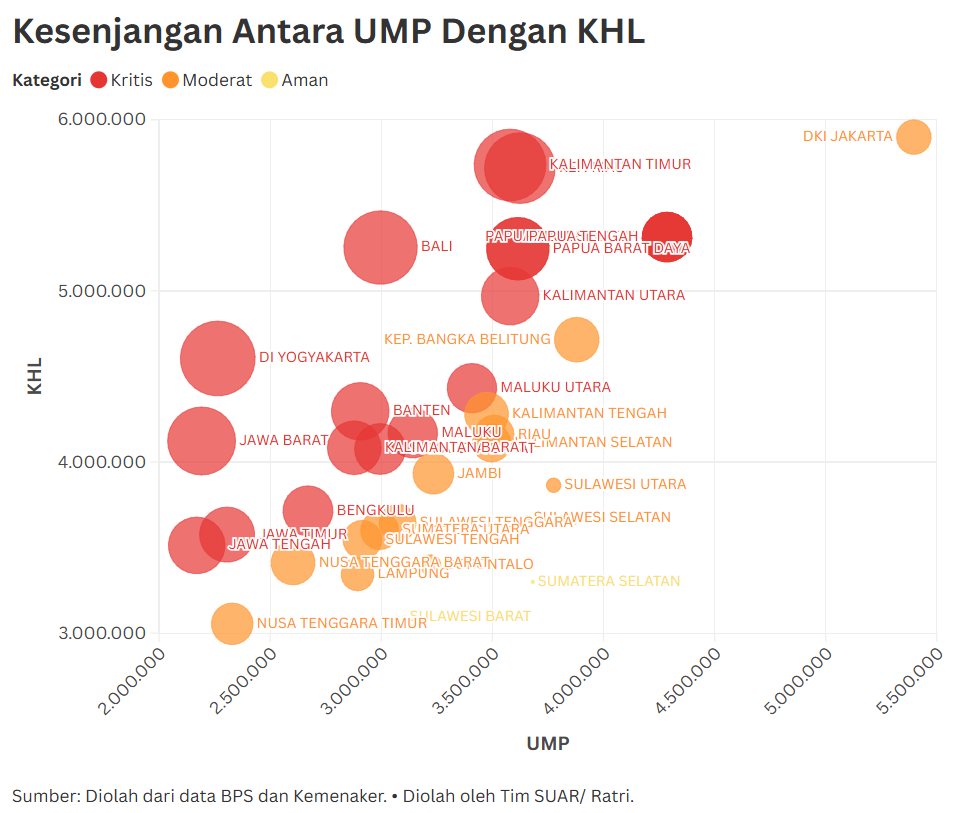
Based on releases from several local government websites, so far 21 provinces have announced the 2026 UMP through a Governor's Decree. Meanwhile, the highest 2026 UMP is in Bangka Belitung at Rp4.03 million, and the lowest is in the Special Region of Yogyakarta at Rp2.41 million.
The highest increase in the 2026 UMP is in Central Sulawesi at 9.08 percent, and the lowest is in West Nusa Tenggara (NTB) at 2.72 percent.
Most recently, on Wednesday (12/24), Jakarta Governor Pramono Anung officially set the 2026 Jakarta Provincial Minimum Wage (UMP) at Rp5,729,876, an increase of 6.17% from the previous year's Rp5,396,761.
Thus, the total increase in the minimum wage in Jakarta is IDR 333,115. This policy was taken based on the calculation of the alpha index value of 0.75 in accordance with Government Regulation No. 49 of 2025.
The decision was immediately rejected by labor unions in Jakarta, which proposed a minimum wage equivalent to 100 percent of the Decent Living Needs (KHL), or Rp5.89 million.
However, the UMP set by the Governor of Jakarta is only Rp5.73 million with an index of 0.75.
"There is a difference of around Rp160,000 from what the workers proposed. All Jakarta workers agree that the UMP must be 100 percent of the KHL," said Said Iqbal.
According to him, this figure does not reflect the real conditions of workers, most of whom are still paid the minimum wage even though they have been working for years.
"It's strange in Jakarta, working for 5 years, 10 years, even 20 years, still getting paid minimum wage. The middle class is now starting to eat into their savings because purchasing power continues to decline," Said said.
Limited in every way
However, the business world warns of limited room for maneuver. APINDO Chairwoman Shinta Kamdani said that a number of labor-intensive sectors are still growing below the national economic average and are even experiencing contraction. The textile, footwear, furniture, and automotive industries are facing cost pressures and weakening demand.
"This policy (wage determination) needs to be implemented carefully and proportionally, so that it remains in line with the capabilities of the business world and the diverse employment conditions in each region," said Shinta.
Shinta pointed out that Indonesia still faces significant structural challenges in employment, with approximately 7.47 million people unemployed, around 11.56 million underemployed, and more than 60 percent of workers in the informal sector, which is vulnerable and offers minimal protection.
Deputy Chairman of KADIN for Regional Autonomy and Member of the National Wage Council (DPN), Sarman Simanjorang, emphasized that the UMP is actually intended as a safety net for new workers.
"Those who have worked for more than a year will have their raises determined by the company's wage structure and scale," he said. Therefore, the minimum wage debate should not be repeated every year.
According to Sarman, the relevance of the UMP formula can only be answered if all parties, especially employers and labor unions, are given equal consideration. He emphasized that UMP increases need to be adjusted to real economic conditions so as not to burden businesses beyond their means.
"In the future, we must be able to come up with the right formula that is acceptable to all parties, so that the annual increase in the minimum wage continues to guarantee business continuity and worker welfare," said Sarman. If this polemic can be ended, he believes that policy energy should be shifted to efforts to increase productivity and the quality of the workforce through strengthening vocational education and training.