
Exports ofcompletely built-up (CBU) cars manufactured in Indonesia throughout November 2025 were dynamic and showed a positive trend. Based on data from the Indonesian Automotive Industry Association (Gaikindo), CBU exports in November 2025 were recorded at 46,920 units, up 3.4% compared to the previous month, which reached 45,379 units.
Gaikindo General Secretary Kukuh Kumara said that on an annual basis (year on year), CBU export performance also showed strengthening, growing 26.4 percent compared to November 2024, which stood at 37,130 units.
The main factor driving CBU exports is stable global market demand and high market demand for ready-to-use units, even amid the global economic slowdown. "CBU car exports in November 2025 rose, and the situation shows that the automotive industry is still the backbone of the Indonesian economy," he told SUAR Jakarta (11/12/2025).
Cumulatively from January to November 2025, CBU car exports were recorded at 473,971 units, an increase of 10.6% compared to the same period in 2024, which stood at 428,613 units.
Meanwhile, vehicle component exports in November 2025 also weakened significantly. Total shipments were recorded at 9,558,868 pieces, down 22.2 percent compared to October 2025, which reached 12,287,422 pieces. However, on an annual basis, the decline was more moderate, only 11.4 percent from November 2024.
Toyota once again led CBU exports throughout November 2025 with 13,973 units, followed by Daihatsu (12,258 units), Mitsubishi Motors (11,211 units), and Suzuki (3,303 units). Hyundai was in fifth place with 3,195 units, followed by Honda with 1,862 units. Three other brands fell below 1,000 units: Isuzu (618 units), Wuling (490 units), and Hino (10 units).
Kukuh said that unlike CBU, the performance ofcompletely knocked down (CKD) car exports actually declined. Total shipments in November 2025 were only 5,026 units, a 9.6 percent correction from October 2025, which reached 7,140 units. However, when compared to the same period last year, CKD performance actually grew by 70.3 percent from the previous 2,952 units.
In the CKD category, Mitsubishi Motors was the largest contributor with 3,286 units. Hyundai followed with 1,080 units, then Suzuki with 660 units.
As for components, Toyota is the largest exporter with 8,300,476 units, followed by Honda (1,147,434 units) and Hino (102,764 units). Hyundai and Suzuki are still at a much smaller volume, with 5,362 units and 2,832 units, respectively.
Achievement of Exporting 3 Million Toyota Cars
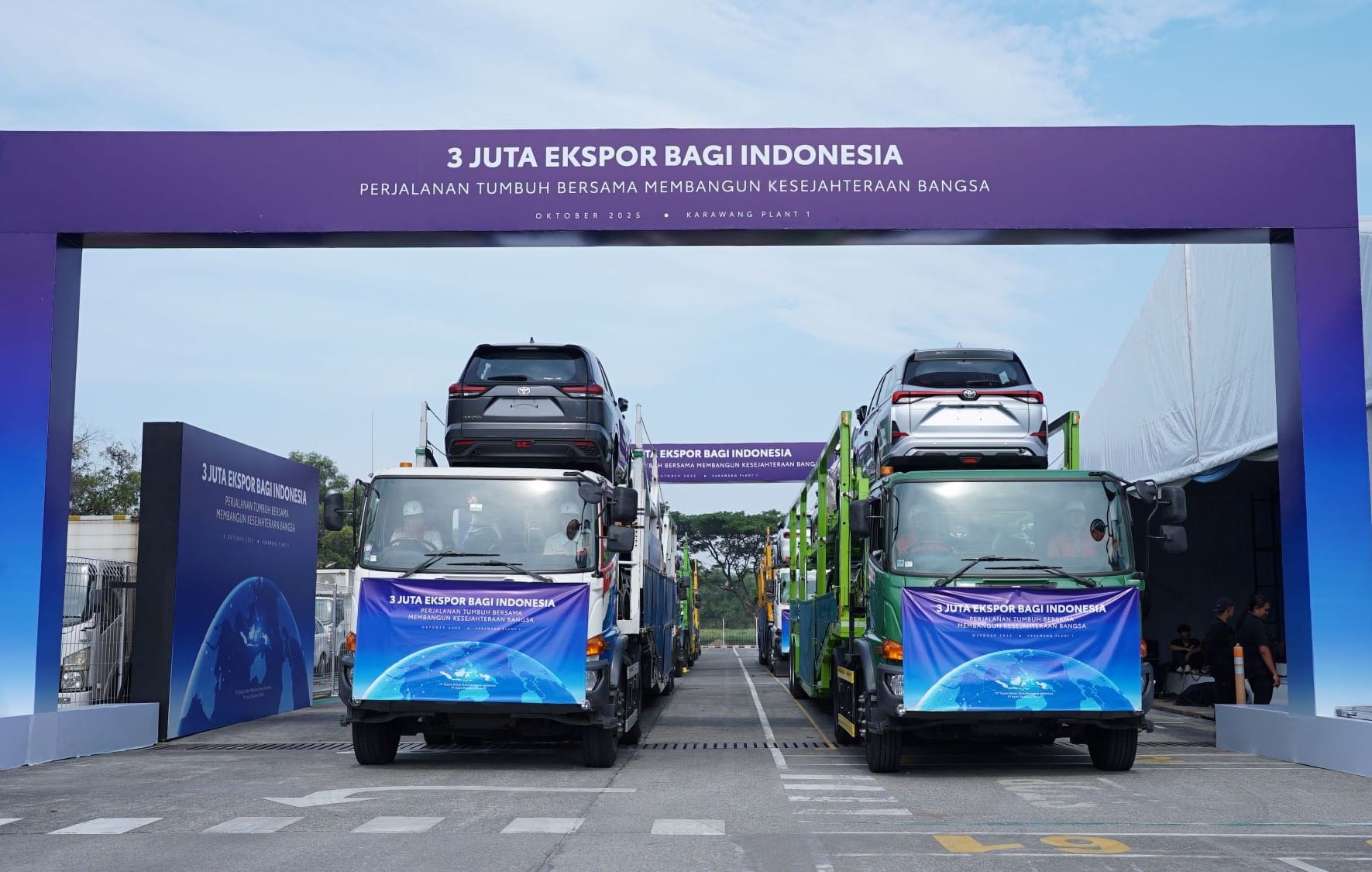
PT Toyota Motor Manufacturing Indonesia (TMMIN) has achieved a significant milestone in its journey in the national automotive industry. In 2025, the total export ofcompletely built-up(CBU) cars produced by Toyota in Indonesia will exceed three million units. This is an accumulation since Toyota first began operations in Indonesia in 1987.
TMMIN President Director Nandi Julyanto said that this achievement confirms Toyota's position as the largest automotive manufacturer in Indonesia, as well as being a milestone for the domestic industry.
"This is the first time Indonesian automotive manufacturers have achieved exports of three million units," he said in a press release received by SUAR Jakarta (12/12/2025).
See also:
 Agung Mahesa Fikri
Cumulatively, car exports from TMMIN have reached around 2.7 million units in the first quarter of 2025. "So exports of three million units will definitely happen this year. Last year we already reached around 2.7 million units. It's just a matter of timing. But what is certain is that it will be in the second half of 2025," he said.
Export growth in 2024 experienced some pressure. Gaikindo data shows that in 2024, the Astra group, which includes Toyota and Daihatsu, recorded exports of 276,865 units. This figure is down 6.20% compared to 2023, which reached 295,172 units.
Automotive Industry Competitiveness Improves
Automotive observer I Made Dana Tangkas said that Indonesia's CBU car exports have shown significant growth from year to year, despite monthly fluctuations, indicating that the competitiveness of the national automotive industry is improving.
Brands under Astra (Daihatsu, Toyota) are the leaders in exports, followed by Mitsubishi, Hyundai, and Suzuki, with popular models such as the Avanza being the mainstay.
He said there is a shift towards electric vehicles (EVs), with new challenges related to regulations and competition, but also great opportunities to increase exports through trade agreements. The dynamic global automotive industry demands continuous innovation, especially in electric vehicle technology.
"The latest trade agreement could open up export opportunities to new markets, and manufacturers must keep abreast of the latest developments," said the President of the Indonesian Automotive Institute (IOI) to SUAR Jakarta (11/12/2025).