
The government revealed that the realization of subsidies and government compensation funds was in line with the established budget. However, the accuracy of subsidy distribution requires synchronized and precise data to ensure the accuracy of recipients, while closing the leakage gap that has caused subsidies to be received by the very well-off.
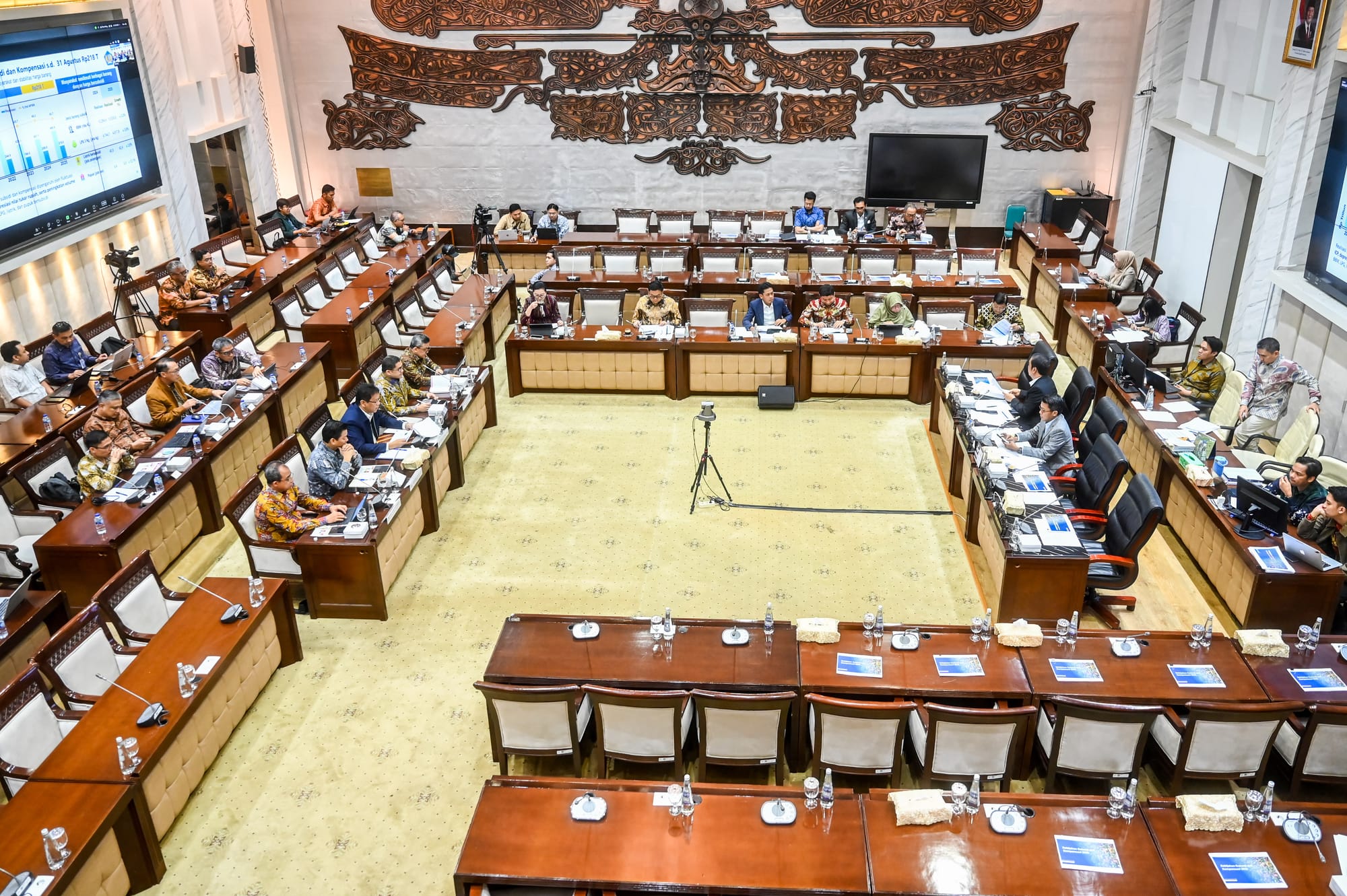
The explanation was conveyed by Finance Minister Purbaya Yudhi Sadewa in a working meeting discussing the realization of subsidies and compensation in the 2025 State Budget with Commission XI of the House of Representatives at Nusantara I Building, Parliament Complex, Senayan, Jakarta, Tuesday (30/9/2025). The morning meeting was Purbaya's second meeting with the commission chaired by Muhammad Misbakhun since he was appointed on September 8, 2025.
In presenting the data on subsidy realization, the State Treasurer agreed with the view of the commission chairman that subsidies are one of the government's tools to help people enjoy the economic cake. However, if misdirected, subsidies can actually exacerbate themarket imperfection that was originally the reason for their existence.
As of September 2025, the government has realized subsidies amounting to IDR218 trillion or 43.7% of the 2025 APBN ceiling of IDR498.8 trillion. The largest subsidies and compensation were allocated to cover the economic prices of diesel oil, kerosene, and 3 kg LPG amounting to IDR88.9 trillion or 63.9% of the APBN ceiling of IDR139.1 trillion.
Meanwhile, electricity subsidies for poor and vulnerable households amounted to Rp50.1 trillion or 55.9% of the APBN ceiling of Rp89.7 trillion. Specifically for electricity, Purbaya stated that all previous year's electricity compensation and payment shortfalls have been paid one hundred percent by the government amounting to Rp39.5 trillion to PT PLN (Persero).
"So far, the government has borne Rp1,700 for every liter of Pertalite and Rp5,150 for every liter of Solar. The realization shows that the distribution of subsidies is in line with the budget target. This is a form of fiscal alignment that continues to be evaluated so that it is right on target," said Purbaya.
Despite the realization of the target, the distribution of subsidies is still often misdirected. This is reflected in the fact that people in deciles 8-10 still enjoy energy subsidies and compensation. Decile is the division of community groups into ten levels based on the level of economic welfare, starting from decile 1 (poorest) to decile 10 (most prosperous).
Deciles 8 and 10, those with per capita incomes of IDR 6,500,000 to above IDR 20,000,000 per month, still enjoy energy subsidies and compensation, with benefit receipt rates between 9-11%.
In detail, decile 8 communities received subsidies and compensation for electricity up to Rp20.7 trillion and fuel up to Rp7.8 trillion; decile 9 communities received subsidies and compensation for electricity up to Rp18.7 trillion and fuel up to Rp7 trillion; and decile 10 communities received subsidies and compensation for electricity up to Rp16.6 trillion and fuel up to Rp6.3 trillion.
"I think this is the reason why energy subsidies continue to rise from year to year. Now, the National Socio-Economic Single Data (DTSEN) already exists, but it has not been utilized by the Ministry of Energy and Mineral Resources. I will ask BPKP to survey the distribution of the subsidy, so if there is any fraud, we can immediately take action," he explained.
Contacted separately, Vice President (VP) Corporate Communication of PT Pertamina (Persero) Fadjar Djoko Santoso said that Pertamina itself had received the full payment of the Compensation Fund for 2024. "We express our gratitude and appreciation to the government," Fadjar said on Tuesday (30/9/2025).
Must be more precise
The people's representatives gave a sharp spotlight to Purbaya's explanation. Andreas Eddy Susetyo from the PDIP faction said that in addition to fuel and electricity energy subsidies, fertilizer subsidies must also be considered. The reason is that fertilizer subsidies, which have reached Rp200 trillion, have been received more by old fertilizer factories, causing high and inefficient cost of goods sold (HPP).
"With the cost plus mechanism, this inappropriate fertilizer subsidy policy has been in effect since 2003. The subsidy mechanism needs to undergo an overall transformation, one of which is diverted to a more modern and efficient factory, so that it is right on target," said Andreas.
Sharing the same view as Andreas, Melchias Mekeng from the Golkar faction demanded that the Ministry of Finance evaluate the verification process of subsidy distribution, which is too complicated and bureaucratic, but does not result in the right distribution.
"In the past, fertilizer subsidies were large, but the people had difficulty accepting them. Now, farmers say fertilizer subsidies are smooth after Mr Prabowo cut too many regulations. I am worried that if the process is too long, SOEs will have to ask for funding from the market with high interest rates, making them uncompetitive," he said.
Habib Idrus Salim Aljufri from the Prosperous Justice Party (PKS) faction explained the irony that when state aid that should be a guide is not enough to reduce the burden on the poor, energy subsidies are actually enjoyed by the rich.
"Social assistance coverage for the poorest quintile has not been enjoyed. Indications of leakage indicate that subsidies are effective in holding volatility, but inefficient for the poor directly. Therefore, in the future state budget, precision targeting is key," Aljufri emphasized.
He warned that there should not be a distance between fiscal good intentions and the experience felt by the little people, especially in the government's duty to ensure the basic needs of the people with affordable food prices, education, health, and a sense of security to protect the people.
"A wise government will not fall into poverty when it provides the best for its people. Subsidies are not pampering, but investment so that people can grow and be protected, like parents protect their children," he concluded.
Partnership and transparency
As a classic problem, the inaccuracy of subsidy distribution data cannot be solved by one ministry/agency. Center of Reform on Economic (CORE) Indonesia economic researcher Yusuf Rendy Manilet believes that the preparation of DTSEN is a strategic step by the Prabowo Subianto administration that must be supported.
"This integration must include collaboration between the Ministry of Social Affairs, the Ministry of Finance, and the Ministry of Communication and Digital (Komdigi), and be combined with the population records of the Population and Civil Registry Office so that the validity of the recipient's identity can be guaranteed," Yusuf said when contacted by SUAR, Tuesday (30/9/2025).
Synchronized and accurate data integration needs to be followed up with verification and regular updates in the field, including by conducting audits to assess the actual economic conditions of recipients. Data deletion and reactivation of poverty data, according to Yusuf, need to be carried out periodically as long as the requirements are met.
"System digitization, which is the use of a transparent, accountable, and AI-based digital platform, can be used to detect manipulation and streamline data synchronization with the fertilizer and electricity sectors," he explained.
Another important factor is partnership and transparency, which should be the principle, among others by involving independent institutions such as the Ombudsman and coordinating with local governments to match local data to strengthen the credibility and effectiveness of the program.
"So far, outdated data and data collection errors are the main causes of the leakage gap. People who are no longer poor are still recorded as recipients, while those who are truly entitled are neglected. System digitization will play a major role in closing this gap," Yusuf concluded.
Previously, Chairperson of the Trade Division of the Indonesian Employers Association (Apindo) Anne Patricia emphasized that the state budget must be able to balance three interests at once: maintaining fiscal sustainability, creating expansion space for productive sectors, and providing a social cushion amid global uncertainty.
"This is not just choosing a full power or conservative attitude. The challenge is how to keep the economic engine hot, but not overheating," he told Suar through a written statement, Sunday (21/9/2025).