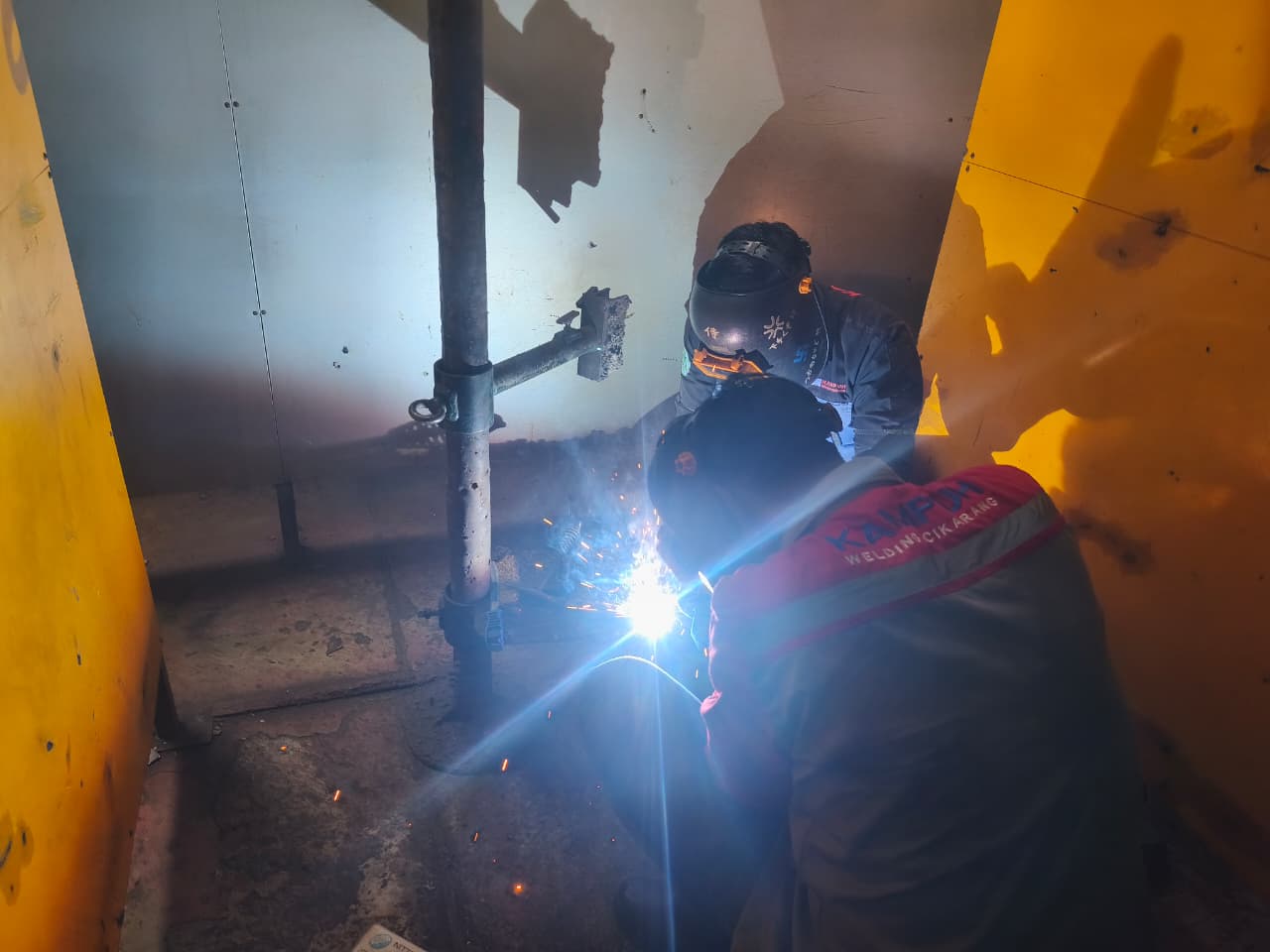
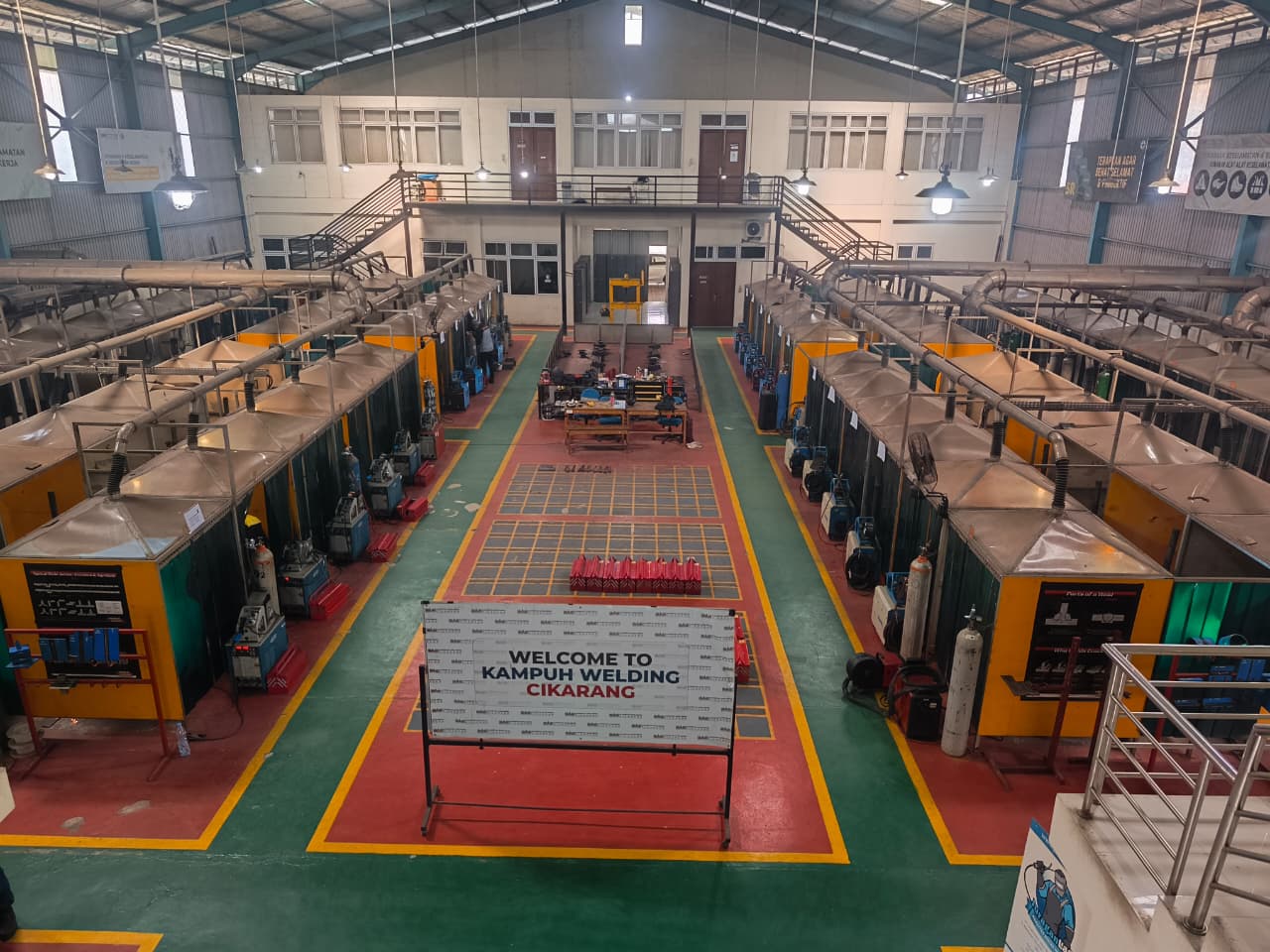
In the rectangular-shaped welding training area, rows of two-by-two-meter practice booths stand tightly against each other. There are 74 booths. Each is filled with one to two students, accompanied by an instructor. The sound of metal sizzling and sparks emanating from each booth.
Each booth is equipped with welding machines, welding cables, electrodes, ground clamps, welding tables, slag hammers, and other tools to support the welding process. Everyone who goes back and forth from the booth wears a welding helmet, welding gloves, leather apron, and safety shoes.
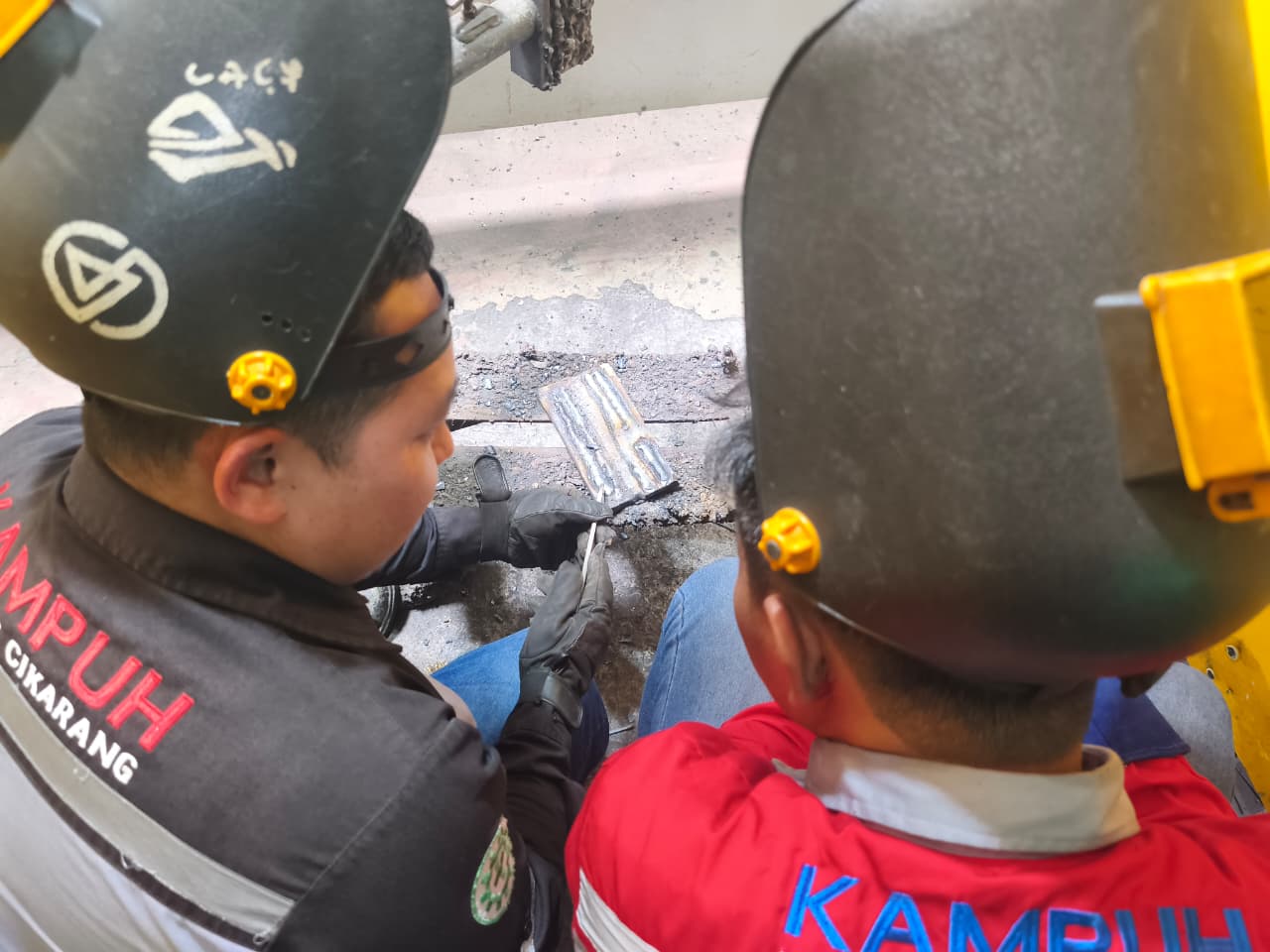
In the first booth, two metal plates were placed flat on the welding table. After putting on his helmet, Agus took the electrode and tried to connect the two plates horizontally. This activity performed by Agus is called 1G, which is the welding of plate joints in a horizontal position. In welding science, 1G is a fundamental position and skill that prospective welders must master.
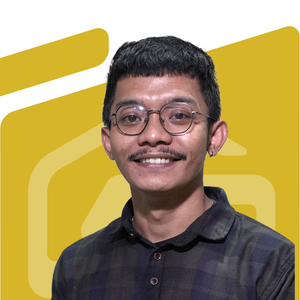
Agus is one of the students studying welding at the Kampuh Welding Cikarang Private Vocational Training Institute. The 25-year-old man from Garut has been studying for 14 days. "I took the 23-day work package," he said.
Before learning to be a welder in Kampuh, Agus traded clothes and shoes in Garut. Feeling bored, Agus wanted to try a new job. He decided to learn to become a welder because he felt that he had a greater chance of employment than other skills.
"There are many sectors in welding, from manufacturing, workshops, to shipping," he said.
Agus chose to study at Kampuh because he already knew its reputation. Established in 2017, Kampuh Welding Cikarang is a branch of Kampuh Welding Surabaya which was established two years earlier.
To date, Kampuh Welding Cikarang claims to have produced more than 3000 professional welders with national and international certificates.
Kampuh offers various types of training, ranging from basic skills training such as 1F, 2F, 3G, 1G, to advanced levels such as 3G, 5G, and 6G. The same goes for welding models, such as SMAW, GMAW, GTAW, FCAW, and OAW.
After completing his training, which has 9 days left, Agus wants to immediately apply and test his new skills. He wants to work in Indonesia first. In the future, Agus would like to work abroad. So far, he wants to work in Japan, Germany or South Korea. "The salary is good, much higher than in Indonesia," he said.
Most of the instructors at Kampuh Welding Cikarang have experience working in Japan. Agus said that the stories shared by the instructors during the training made him even more convinced to go to Japan.
Burhan is one of them. The Banyumas-based instructor worked as a welder at a shipyard in Japan from 2008 to 2011. According to him, Japan currently needs a lot of young workers because it is experiencing an aging population. "So the chances of being absorbed are greater," said the 39-year-old man.
According to monthly statistics from Japan's Ministry of Health, Labor and Welfare (MHLW) through the Hello Work network, as of June 2024, there were 71,959 job openings in the manufacturing sector and 71,455 in the construction sector, the two sectors that employ the most welders.
Burhan said that Japan is indeed tempting in terms of wages. In his experience, an apprentice can be rewarded with a wage of Rp13 million. "A permanent worker can earn Rp24 million if gross. Cut here and there, the net is around Rp18 million," he said. The comparison of monthly income with Indonesia, according to him, is still far away.
He also emphasized the strict discipline and safety at work in Japan. Workers arrive about fifteen minutes before the start time for taiso exercises and briefings, then enter work on time. In risky areas, seat belts and safety signs are an absolute requirement, and violations can result in being sent home. "Safety is number one," he says.
General Manager of Kampuh Welding Cikarang Repindo Merdeka explained that the training at Kampuh is designed so that graduates have industry-recognized skill standards, especially for those who want to work in Japan.
The main program focuses on mastering the 3G position and FCAW process, with certification of expertise from Nippon KaijiKyokai (NK), a Japanese ship classification society that is an important reference for the international shipping industry.
However, Kampuh Welding Cikarang does not yet have an administrative license to send participants directly to Japan like Kampuh Welding Surabaya. They only act as a provider of skills training and certification, while job distribution is carried out through other institutions.
"We prepare their skills and certificates first so that when opportunities arise, they are ready," Repindo said.
Read also:
 Mukhlison Widodo
Repindo explained that for participants who want to join the Specified Skilled Worker (SSW) program or deepen the Japanese language, Kampuh Welding Cikarang will partner with other institutions or recommend them to continue studying at Kampuh Welding Surabaya.
This step is taken so that students can fulfill all the requirements for job departure to Japan, both in terms of skills and administration. He emphasized that discipline and mental readiness remain the main basis instilled from the start, so that Kampuh graduates are able to compete in the global market.
Director of Kampuh Welding Cikarang Arif Suyanto said that the institution he leads is currently taking care of the administration to be able to become a sending organization (SO) or an official institution that is legally tasked with recruiting, training, and sending and accompanying apprentices or workers abroad. Arif said, this step was taken so that Kampuh Cikarang could follow in the footsteps of Kampung Welding Surabaya.
"We will take care of it one by one in the future. First, SO first. Later, if it goes well, we can continue to become P3MI," he said.
Scholarship Potential
The government is preparing a new financing scheme to support training institutions such as Kampuh Welding Cikarang in producing skilled workers. Previously, Coordinating Minister for Community Empowerment Muhaimin Iskandar said the President is committed to providing two financing schemes for prospective migrant workers, namely interest-free loans and skills scholarships.
"This scheme is intended so that the cost of training and certification is no longer a barrier for workers who want to prepare themselves professionally before leaving abroad," he said as a speaker at the Suar Roundtable Decision: The Economic Power of Indonesian Migrant Workers, Thursday (18/09/2025).
Read also:
 Benedictus Krisna Yogatama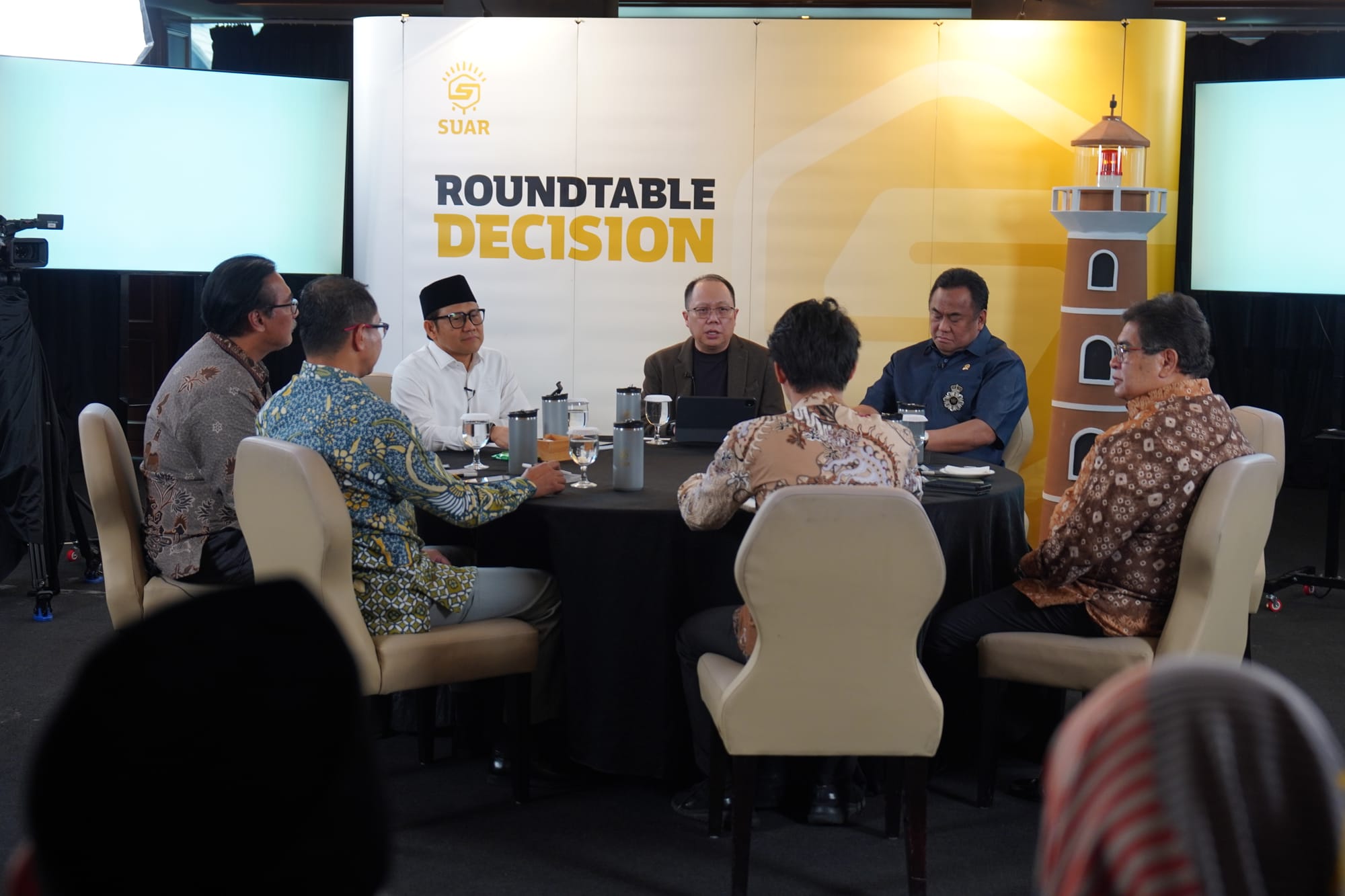
According to Cak Imin, this step is in line with the government's policy direction to increase the portion of skilled migrant workers. Therefore, job training institutions (LPK) and vocational schools will be encouraged to cooperate with universities and migrant centers so that the training process becomes faster and more targeted. This effort is also part of the institutional reform under the Ministry of Protection of Indonesian Migrant Workers (P2MI), which now functions as the coordinator of financing, training, and labor placement.
In this context, the People's Business Credit (KUR) for Migrant Workers has been launched with a maximum interest rate of six percent and a loan ceiling of up to one hundred million rupiah without collateral. This scheme is expected to reduce the practice of high-interest informal loans that have burdened prospective workers. Easier and faster financing support, Muhaimin said, is an important step to expand access to skills training, including welding, which is in high demand by prospective Indonesian migrant workers.
Responding to this idea, Burhan thinks that such assistance should be provided by the government. He admitted that he met many students who failed to leave to become migrant workers because of the cost. "The cost of learning welding is already expensive, especially if you want to go abroad. It can be two to three times as much," he said.
In line with Burhan, Agung thinks that if the discourse is realized, it means that the government is also paving the way for citizens who want to work abroad. For Agung, such an opportunity could be a way to take the skills he learned to a higher level.