

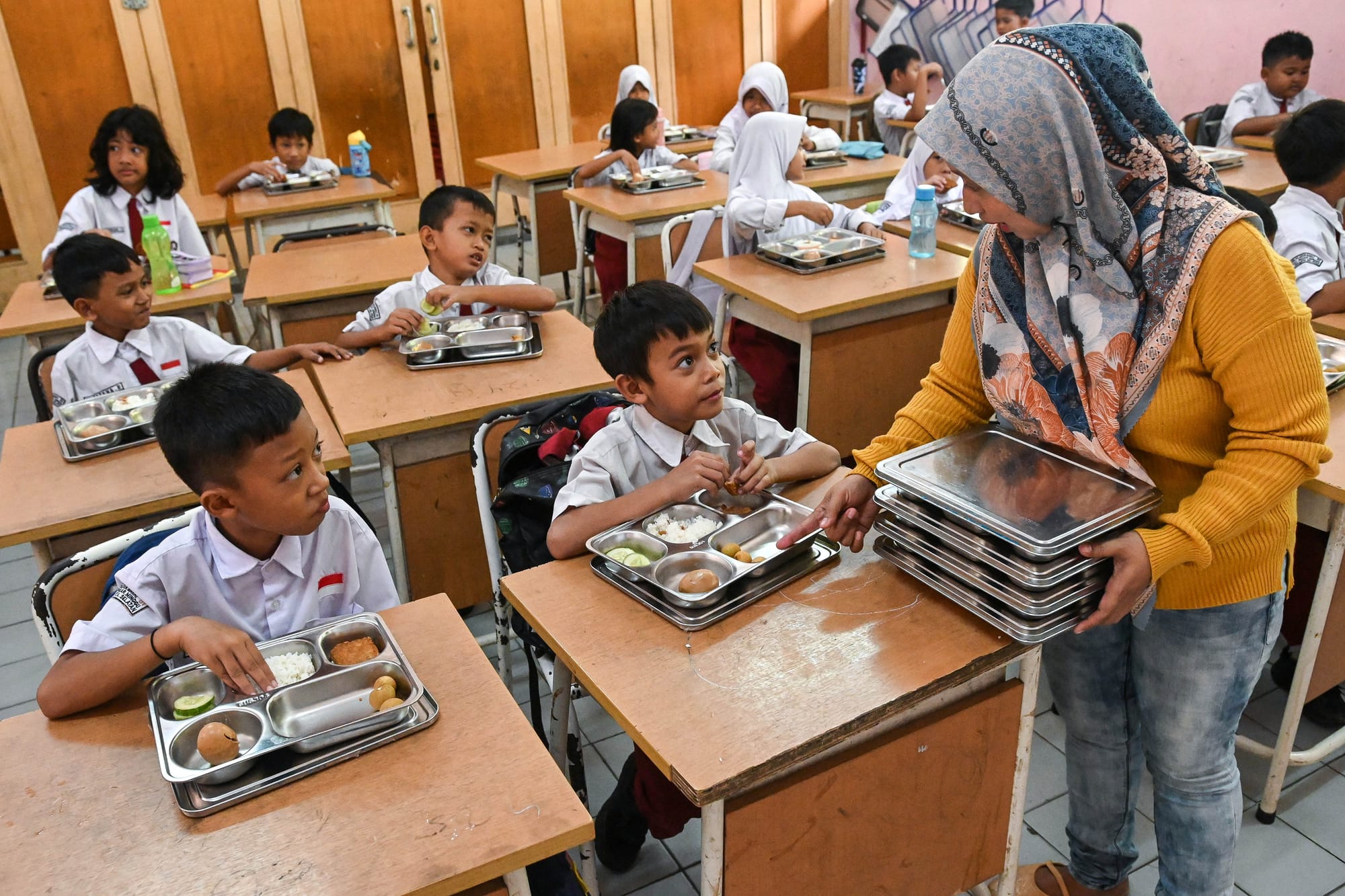
Minister of Health Budi Gunadi Sadikin said the government will continue to improve the implementation process of the free nutritious meal (MBG) program. After many cases of MBG poisoning at various schools, Budi revealed that the government now requires MBG kitchens or Nutritional Fulfillment Service Units (SPPG) to have 3 certificates.
"This will be the minimum standard for every SPPG," said Budi in a press conference at the Ministry of Health (Kemenkes) office, Thursday (2/10/2025).
The three certificates cover aspects of hygiene, food safety, and halal. As an MBG supervisor, the Ministry of Health will be responsible for hygiene certification or the Sanitation Hygiene Worthiness Certificate (SLHS).
"As of today, 100 SPPGs have received that certificate. We will review it every day," he said.
Together with the National Nutrition Agency (BGN), the Ministry of Health targets that all SPPGs will have obtained SLHS within one month.
The next certification that SPPGs must have is Hazard Analysis and Critical Control Points (HACCP). Budi said this certification is a standard in the food serving process and nutritional measurement. Budi said that the government is still preparing the mechanism.
Meanwhile, halal certification is entrusted to the Halal Product Guarantee Organizing Agency or BPJPH.
SUAR visited three pilot SPPGs in Jakarta to see the efforts of SPPGs in carrying out these instructions. SPPG Palmerah in West Jakarta is one of them.
This SPPG is a pilot SPPG because it has been established and operating since the beginning of the MBG program. SPPG Palmerah serves 20 delivery points, with details of 12 schools and 8 integrated health posts within a radius of 6 kilometers from the SPPG location. The number of food containers they produce and distribute every day reaches 3,559 portions of food.
Head of SPPG Palmerah, Saiful Arifin, confirmed the instructions from the government regarding certification. In fact, according to him, the SPPG had received this information since last week.
"At that time, we had an online coordination meeting with BGN. That's where we got the instructions," he said on Friday (03/10/2023).
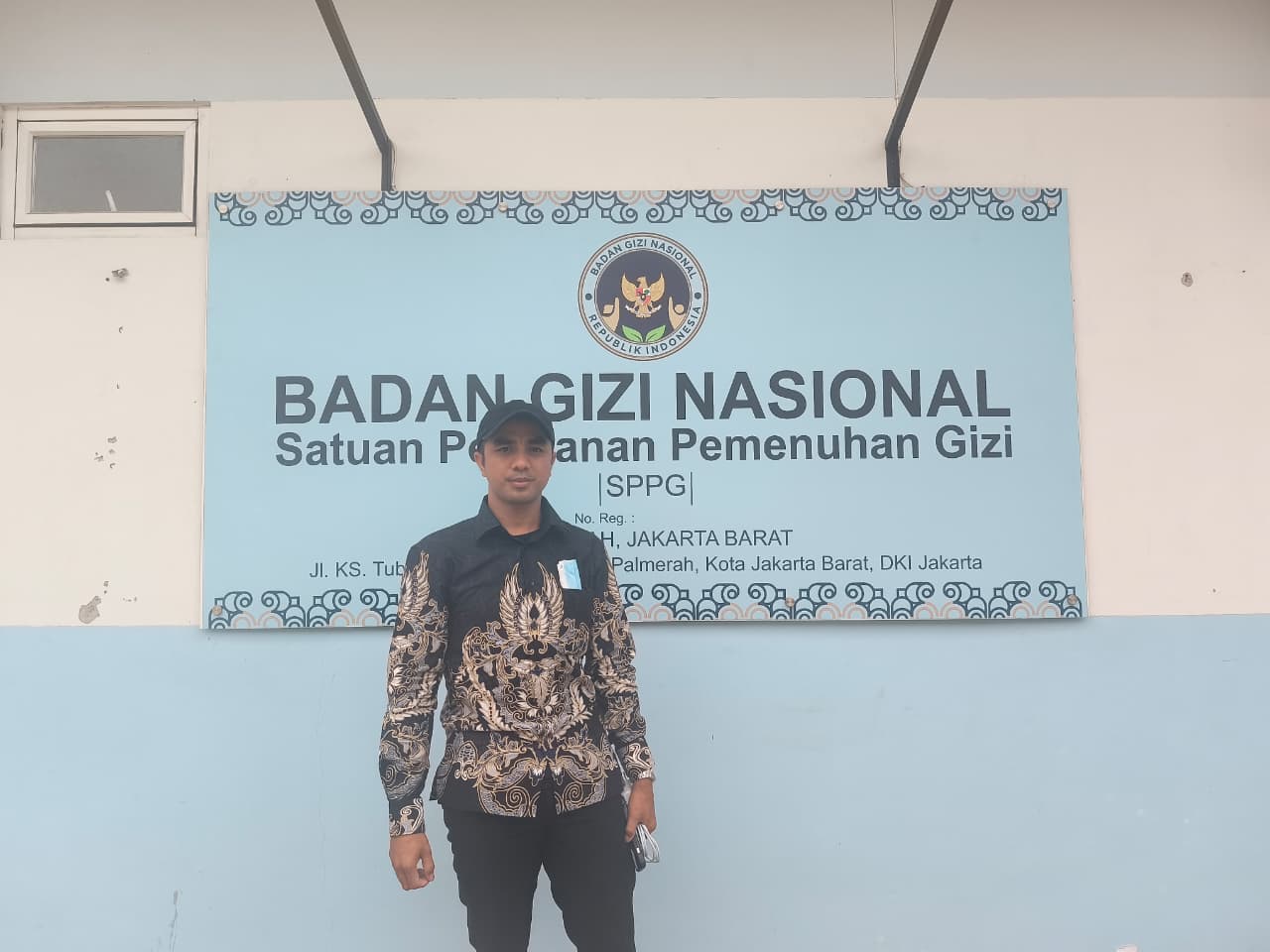
In the online meeting, Saiful said that the number of certifications that SPPGs must take care of is more than three. "There are a total of seven certifications," he said while showing notes on the number and names of certificates that SPPGs must take care of. These certifications include SLHS, HACCP, halal, NKV, ISO45001, ISO22000, and HSP.
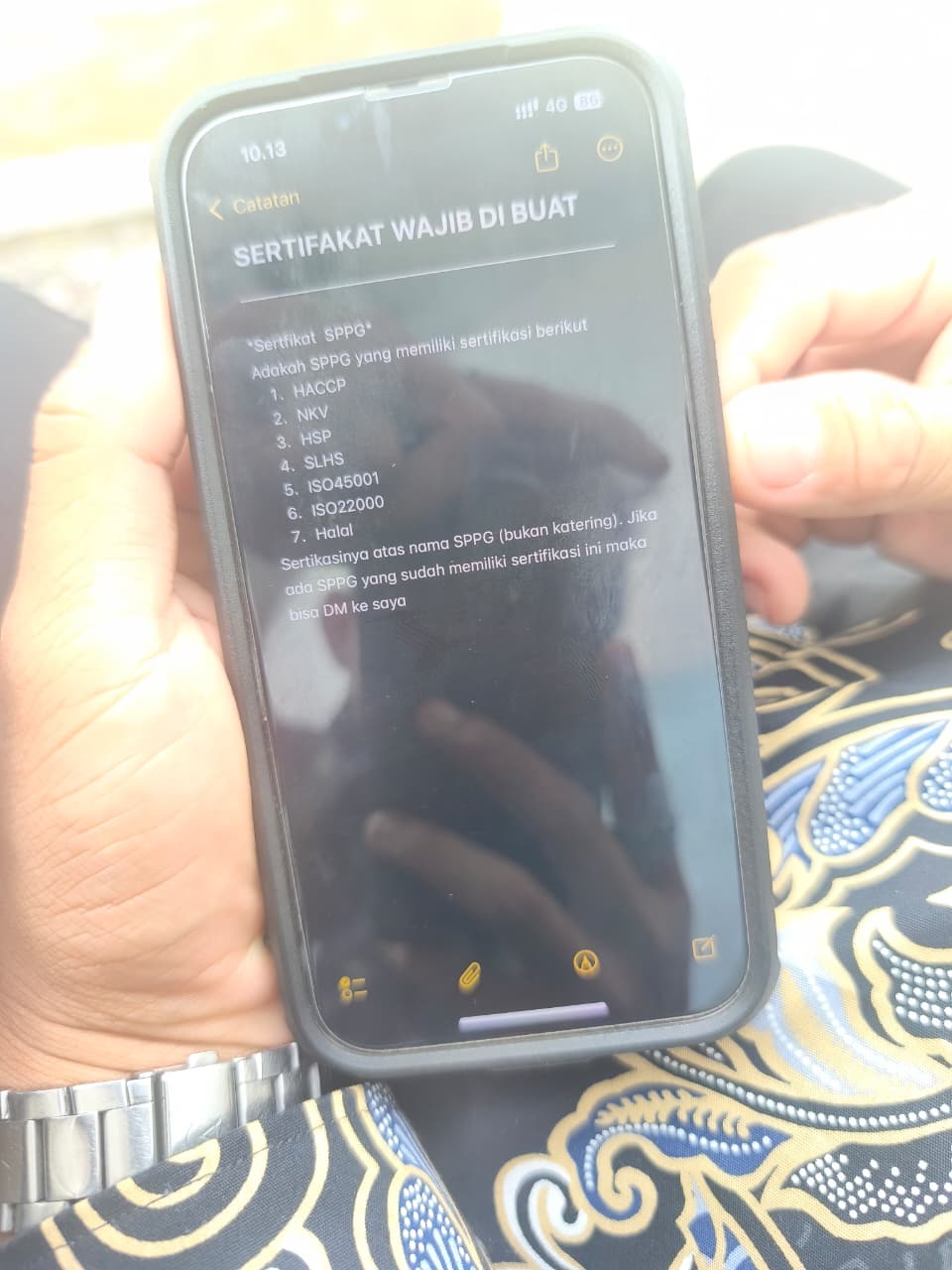
Currently, SPPG Palmerah has only obtained one certificate, namely SLHS. "That's done, just waiting to be published," he said. According to him, there are at least four assessment components that each SPPG must fulfill to obtain SLHS certification.
The first is employee health tests. Saiful said that all SPPG Palmerah employees have undergone health tests and have been declared healthy. "The basic health tests, such as tension, blood, cholesterol," he said. The health tests are carried out directly by the Health Office.
The second is a food handler certificate for SPPG employees. This certificate is obtained by employees after completing a competency test held by BGN. Saiful said that all employees in each SPPG must have this certificate. Because SPPG Palmerah is a Pilot SPPG, all of its employees have had this certificate from the start.
The third is a laboratory test. This test is carried out by Labkesda. Saiful said that the laboratory test includes checking the cleanliness of the water used in the cooking process to washing the food containers. Various raw materials to ready-to-eat food are also components that are assessed in the laboratory test. "There is a list of samples from Labkesda. We will send according to that list," he said.
Fourth is the Environmental Health Inspection or IKL. This component is an assessment of the suitability of the kitchen to run the MBG program. One of the things checked in the IKL, said Saiful, is the condition of the drainage channels. “It should not be stagnant water like the gutters on the side of the road,” he said. If it is stagnant, the SPPG is declared to have failed the IKL.
Saiful said that six other certificates for SPPG Palmerah are still in the process of being taken care of. Because the new instructions came a week earlier, Saiful admitted that he did not know exactly the mechanism and flow of the submission.
Read also:
 Gianie
The same thing also happened at the National Police SPPG in Pejaten, South Jakarta, which is a pilot SPPG. The SPPG, which serves 10 distribution points, has only pocketed one certificate, namely halal certification from BPJPH.
The Head of the National Police SPPG, Iqbal Salim, said that the National Police SPPG is currently undergoing a certification process to obtain the SLHS. Iqbal added that the National Police SPPG will immediately process other certifications in stages. “To ensure that the National Police SPPG Pejaten meets the operational standards set by the BGN,” said Iqbal.
In Koja, North Jakarta, the Koja SPPG, which is a pilot SPPG, was unwilling to provide information regarding this certification instruction. The Head of the Koja SPPG, Rena Apriliana Widorekno, was not at the SPPG on Friday (03/10/2025) afternoon.
“I don't have the authority on this. And I also don't know how many certificates we have received,” said Sitepu, Field Assistant of SPPG Koja. SPPG Koja serves 7 delivery points with a production of 3800 ompreng every day.
Better late than never
Executive Director of the Center of Reform on Economics (CORE) Mohammad Faisal assessed that this certification policy should have been carried out before the MBG program was running. The government must ensure that the food distributed meets nutritional standards and is safe. “So I think this is late,” he said.
Nevertheless, Faisal considers this certification step important as an effort to evaluate the program while ensuring the safety of MBG beneficiaries. According to him, the certification step must be carried out in stages and not in a hurry. This is important considering the increasing number of MBG poisoning victims.
BGN data shows that as of October 1, 2025, the number of MBG poisoning victims reached 6,517 people. A total of 1,307 victims were in Sumatra. 4207 victims were in Java and 1,003 victims were spread across the Eastern Indonesia region. Meanwhile, data collected by the Indonesian Education Monitoring Network (JPPI) revealed a much larger number of victims. As of September 30, 2025, JPPI recorded 9,286 victims spread across 22 provinces.
“The government should temporarily stop the operations of SPPGs that do not yet have certificates. Don't let it run but only have two certificates,” said Faisal.
The large number of MBG poisoning cases, according to Faisal, is due to the government's approach which only focuses on pursuing targets quickly. This has implications for neglecting safety and security aspects.
“This is a consequence of a populist program that is carried out in a hurry to achieve quantity targets. The target has a political motivation, because it is the President's number one program. In fact, because it is a flagship program, it should be more careful,” said Faisal.
Therefore, according to Faisal, the government must strictly monitor the certification process. The implementation must be carried out by involving all related elements, especially parents of students. The credibility of the certification institution must also be ensured so that it is not easily politically intervened.
“If necessary, involve an independent institution,” said Faisal.
Minister Budi said that the Ministry of Health together with BGN are designing an integrated reporting and monitoring system to oversee MBG. The system, said Budi, will be similar to reporting cases of corona virus disease or Covid-19 during the pandemic a few years ago. Later, he said, the report will be announced in real time and routinely. “For example, if there is a daily, weekly or monthly update like we did during Covid, we can do it,” said Budi Gunadi.
Budi added that BGN will play a role in carrying out routine internal supervision in the implementation of MBG. Meanwhile, the Ministry of Health and the Ministry of Home Affairs will carry out external supervision once a week.
Head of BGN Dadan Hindayana revealed that the government will continue the MBG program even though the number of poisonings continues to increase and there is a lot of criticism coming from the public. Currently, said Dadan, BGN will stop the operation of SPPGs that cause poisoning.
“I was ordered by the President to accelerate. I will continue to carry it out unless the President gives another order,” he said at a press conference at the Ministry of Health office.