
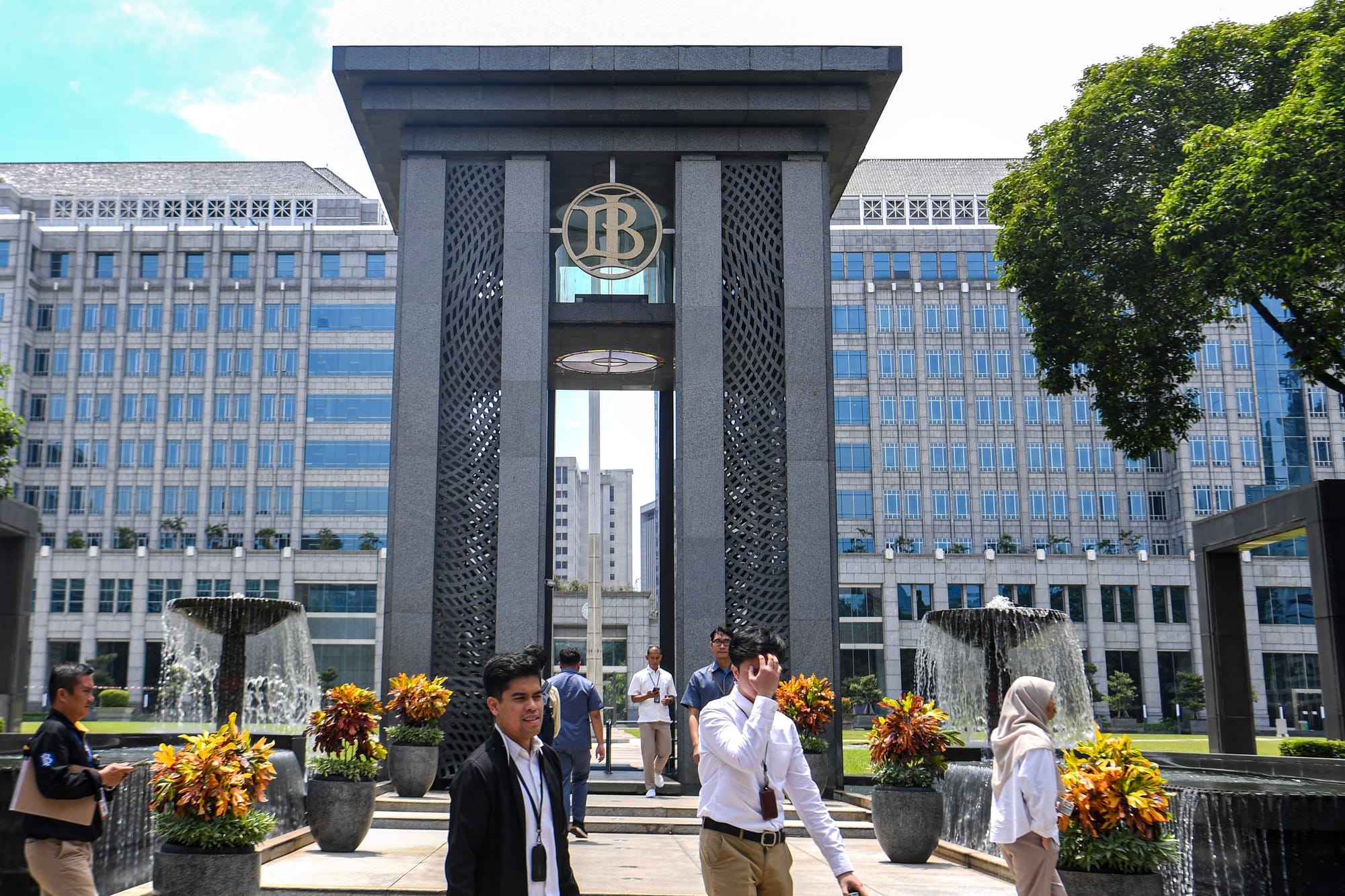
Throughout this year, Bank Indonesia (BI) has lowered the BI Rate by a total of 100 basis points. This reduction in the benchmark interest rate should drag down bank lending rates so that they can be lower. This is needed by the business world to get cheaper credit interest so that it can stimulate business expansion.
In early 2025, the BI Rate was at 6.00%, now it is at 5.00%. Throughout this year, BI has lowered the BI Rate four times, namely in January, May, July, and August 2025. Each reduction amounted to 25 basis points or 0.25%.
Finally, when lowering the BI Rate in August, BI Governor Perry Warjiyo said that the decision was due to the condition of inflation which was still under control according to the target. Namely, in the range of 1.5%-3.5%. In August 2025, inflation was at 2.31%.
Externally, the US central bank - the Federal Reserve (Fed) - has signaled that it will also implement a trend of lower interest rates.
Thus, BI still opens room for future interest rate cuts. "Going forward, Bank Indonesia will continue to watch the room for interest rate cuts," BI Governor Perry Warjiyo said at the press conference of the BI Board of Governors Meeting (RDG), August 20.
The impact of monetary policy began to appear in bank lending rates. BI data recorded that the basic lending rate (SBDK) in June 2025 was at 9.21%, down slightly from January 2025 which amounted to 9.23%. This figure illustrates a decline although not significant.
The Financial Services Authority (OJK) also reported a similar trend. In July 2025, the average rupiah lending rate fell by 36 basis points for investment loans and 20 basis points for working capital loans. The change marked an interest adjustment in the banking sector.
Here's how banks respond
BCA expressed its appreciation for BI's move to lower the benchmark interest rate. "In principle, BCA will be in line with BI's benchmark interest rate policy," said Hera F. Haryn, EVP Corporate Communication & Social Responsibility BCA.
Hera explained that the determination of BCA's interest rate policy takes into account a number of factors. These include future developments in the BI Rate, macroeconomic parameters, and banking sector liquidity conditions. In addition, the bank also looks at market conditions influenced by demand and supply.
According to Hera, BCA's lending rates have remained relatively unchanged. This is especially true in the small and medium business and retail segments. She said BCA's lending rates are among the most competitive.
BCA also conveyed its lending performance until the middle of this year. As of June 2025, total loan disbursements grew 12.9% on an annualized basis. The value reached Rp 959 trillion. "Higher than the average industry growth," he said.
In addition, Hera emphasized that BCA regularly reviews its lending policy. The review is conducted so that lending rates remain at a level that is acceptable to the market. The Djarum Group-owned bank also takes into account the purchasing power of the community in setting the policy.
He added that BCA is committed to lending to various segments and sectors in a prudent manner. The precautionary principle is part of the lending strategy. Disciplined risk management is also implemented to maintain the quality of financing.
The precautionary principle is part of the lending strategy. Disciplined risk management is also implemented to maintain the quality of financing.
"BCA will continue to strive to maintain a balance of growth in profitability, liquidity, and quality going forward," said Hera.
Bank Mandiri Corporate Secretary M. Ashidiq Iswara said, his party views Bank Indonesia's move to reduce the BI Rate by 25 basis points to 5.00% as an accommodative monetary policy and in line with the need to maintain stability amid the dynamics of the global and domestic economy.
This benchmark interest rate adjustment is expected to support the momentum of national economic growth while keeping inflation under control and a relatively stable exchange rate.
In line with this, Bank Mandiri will continue to maintain a healthy and selective intermediary role, especially in supporting productive sectors oriented towards strengthening the people's economy.
"We will adjust lending and deposit rates in a prudent manner by considering internal liquidity conditions, market dynamics, and the direction of the prevailing monetary policy," Ashidiq said.
Financial Services Authority (OJK) Banking Supervisory Executive Head Dian Ediana Rae said that the decline in the BI Rate has been followed by a decline in bank interest rates. Compared to the previous year, the average rupiah lending rate in July 2025 was recorded down 36 bps for investment loans and down 20 bps for working capital loans.
"Generally, a decrease in the BI Rate will be followed by a decrease in lending rates with a time lag of several periods. Therefore, lending rates are expected to continue to decline in response to the BI Rate cut in 2025," said Dian.
"The decline in the BI Rate will be followed by a decrease in lending rates with a time lag of several periods," said Dian Ediana Rae.
Coupled with the expectation of lower global interest rates in the fourth quarter of 2025, OJK sees that there is still room for further interest rate cuts.
However, the reduction in interest rates for each bank will depend on the strategy and cost structure of each bank, especially related to the cost of funds (CoF). Banks need to manage their funding strategy, particularly to increase the portion of low-cost funds, to create room for lending rate cuts.
OJK continues to urge banks to gradually adjust their interest rates, so that they remain in line with market conditions, healthy financial ratios and do not create unhealthy interest competition. Furthermore, banks are also asked to maintain transparency and consumer protection in conveying information related to banking products.
Stimulus for businesses
Senior Vice President of the Indonesian Banking Development Institute (LPPI) Trioksa Siahaan believes that even a small decrease in lending rates is meaningful for businesses because it reduces operational costs. He said the most affected sectors are property and automotive.
"These two sectors are sensitive to interest rates. With lower interest rates, there is hope for an increase in property and automotive sales," he said.
According to Trioksa, the impact of lower interest rates is different between large corporations and UMKM. Corporations rely on corporate finance and complex financial management, while UMKM are still simple, so their responses are not the same. He also explained that banks must maintain liquidity because around 90% of banking assets come from third-party funds, so the transmission of the BI Rate reduction to lending interest is slow.
Trioksa added that additional policies such as lowering the minimum reserve requirement (GWM) or placement of government funds in commercial banks can loosen liquidity. "If liquidity is looser, then banks have the opportunity to expand credit, but it also needs to be supported by a favorable economic and investment climate," he said.
Indonesian Employers Association (Apindo) Economic Policy Analyst Ajib Hamdani welcomed BI's decision to lower the benchmark interest rate. Cutting the benchmark interest rate will encourage more liquidity to rotate and people's purchasing power will be well maintained.
Cutting the benchmark interest rate will encourage more liquidity to circulate and people's purchasing power will be well maintained.
"Hopefully, the consumption sector will strengthen and become a momentum to maintain economic growth to reach 5% in the third quarter of 2025," said Ajib.