

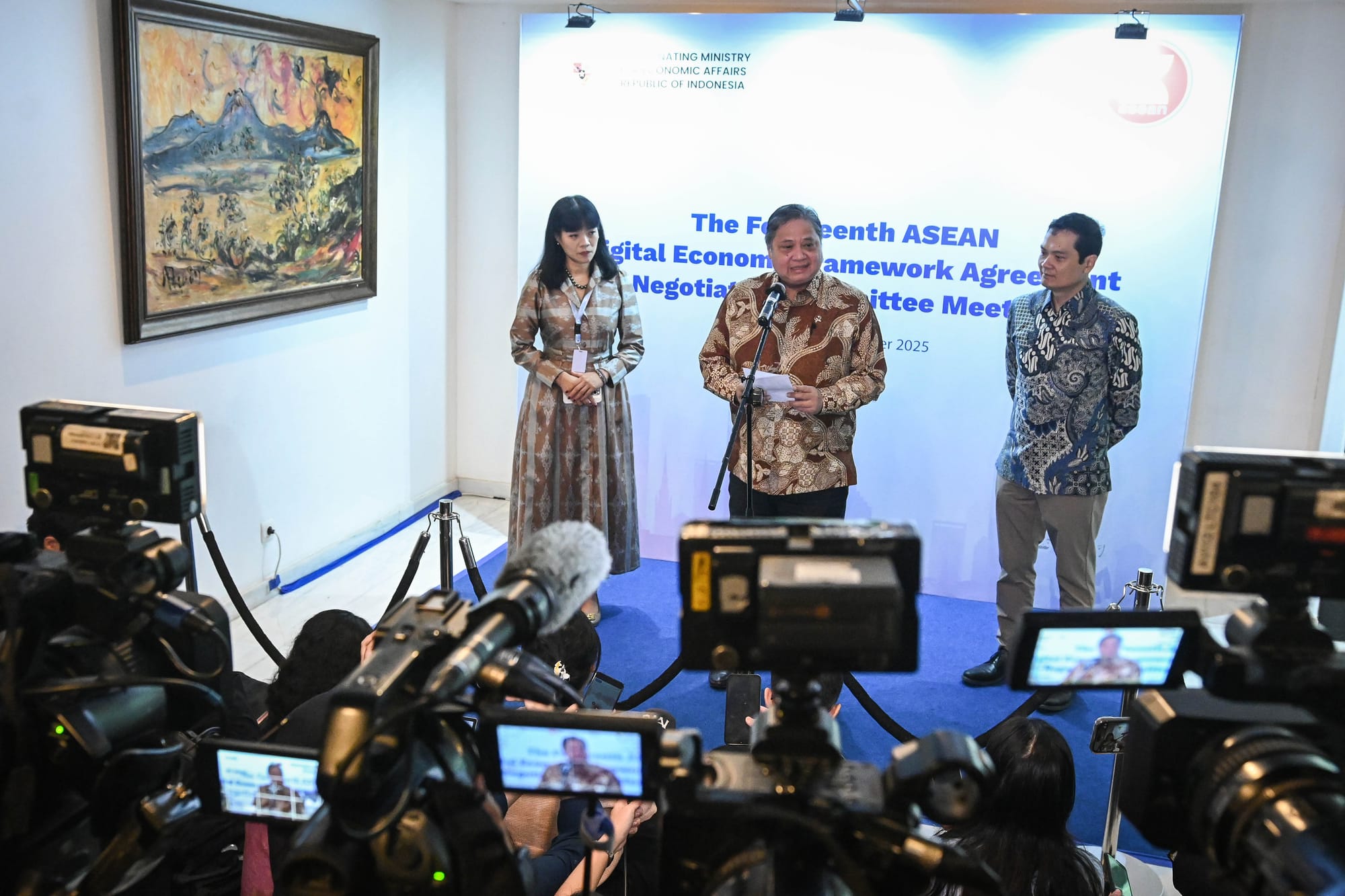
The Indonesian government and ASEAN countries are finalizing the ASEAN Digital Economic Framework Agreement (ASEAN-DEFA). This is expected to be an important milestone for the development of Indonesia's digital economy.
Coordinating Minister for the Economy Airlangga Hartarto said Indonesia is ready to lead the ASEAN digital market which by 2024 will reach a market value of USD 263 billion with a population of 680 million. Of this amount, Indonesia contributes with a market value of USD 90 billion, and is targeted to reach USD 360 billion by 2030.
"If we project in 2030, the value of the Southeast Asian digital market is USD 1 trillion, but with the implementation of DEFA, the amount can be USD 2 trillion, doubling," said Airlangga in front of the media crew.
In order to accelerate the achievement of this ambitious target, Airlangga stated that there are a number of challenges that must be faced by ASEAN member countries, ranging from differences in regulations between countries that need to be harmonized, to the limitations of UMKM to trade across national borders.
He added that the DEFA negotiating committee has agreed on five main articles that are important to adjust in finalizing the framework that will be signed and implemented next year. The five articles are financial services; import duties on electronic transmissions; nondiscriminatory treatment of digital products; undersea cables; and electronic payment flexibility.
"In the previous ASEAN Economic Minister meeting, it was targeted that the 14th round of negotiations in Jakarta would push the DEFA to reach 70% of achievable progress, so that it is expected to be implemented in 2026," he concluded.
Edi Prio Pambudi, Deputy for Coordination of International Economic Cooperation at the Coordinating Ministry for Economic Affairs, said the ASEAN-DFA will soon be completed and signed on October 26, 2025.
Build a regulatory framework
Edi added that with DEFA, an economic regulatory framework is expected to be built.
The DEFA is also expected to be a breakthrough for ASEAN in responding to global challenges, and the completion of the DEFA will mark the region's readiness to welcome the era of digital economic collaboration that is open to all parties.
This initiative is not just a document, but the foundation of ASEAN's future as an open and adaptive region to digital transformation.
"We need to realize together, currently the dynamics of artificial intelligence and data mobility are developing very quickly, ASEAN must be flexible and have the same spirit, this is very essential so that ASEAN can take advantage of the digital economic opportunities that are increasing globally, and the world is currently looking at ASEAN," he said.
Increasing the effort and flexibility of ASEAN Member States and sectoral bodies in the DEFA negotiations was agreed as one of the strategic recommendations to be submitted to ASEAN Economic Ministers, so that the DEFA can be substantially finalized this year as targeted.
 Benedictus Krisna Yogatama
In addition to DEFA, Indonesia also participates in the ASEAN Power Grid initiative, which is an important part of ASEAN's strategy to connect the grid between countries through the utilization of renewable energy.
Today, ASEAN faces major challenges despite its rapid economic growth. Therefore, cross-country collaboration is needed, in which Indonesia plays an active role in promoting inclusive and sustainable cooperation.
In the global context, Indonesia continues to strengthen ASEAN's position in international forums, including through the G20 Presidency in 2022 which successfully united the voices of developing countries and maintained the forum's relevance amid geopolitical tensions.
As the only ASEAN member of the G20 and an active participant in APEC, Indonesia, representing developing countries, continues to ensure that ASEAN priorities such as resilient supply chains, digital transformation, food and energy security, and inclusive growth remain high on the global agenda.
Edi also highlighted Indonesia's achievements in international trade. Indonesia has just finalized trade agreements with the European Union and Eurasia, and successfully reduced reciprocal tariffs with the United States (US). Currently, discussions with the US are still continuing for a number of strategic commodities.
Improve competitiveness
ASEAN Economic Community Sectoral Development Director Kachana Wanichkorn said the DEFA could improve competitiveness and connectivity, creating a regional digital economy that is more competitive, open, and adaptive to digital transformation.
"Facilitating easier and more efficient cross-border payments, as has been initiated through the use of QRIS between member countries," he said.
DEFA can also address various risks and challenges in the digital economy, including fraud, money laundering and terrorism financing through regional cooperation.
According to Dandy Rafitrandi, an economic researcher at CSIS, the Digital Economy Framework Agreement (DEFA) is not just a cross-border agreement, but also a collective mechanism to mitigate risks such as digital fraud, money laundering, and terrorism financing, which are increasingly complex as cross-border digital transactions develop.
He underlined the importance of building public trust in the digital payment ecosystem. According to him, financial literacy is still a big homework.
Dandy also highlighted the need for a bolder policy approach that favors small businesses.
"Instead of burdening them with administrative costs, the government should incentivize UMKM that adopt QR payments. Considering that 60 percent of our merchants are UMKM, the efficiency of digital transactions can have a direct impact on national economic growth," he said.