

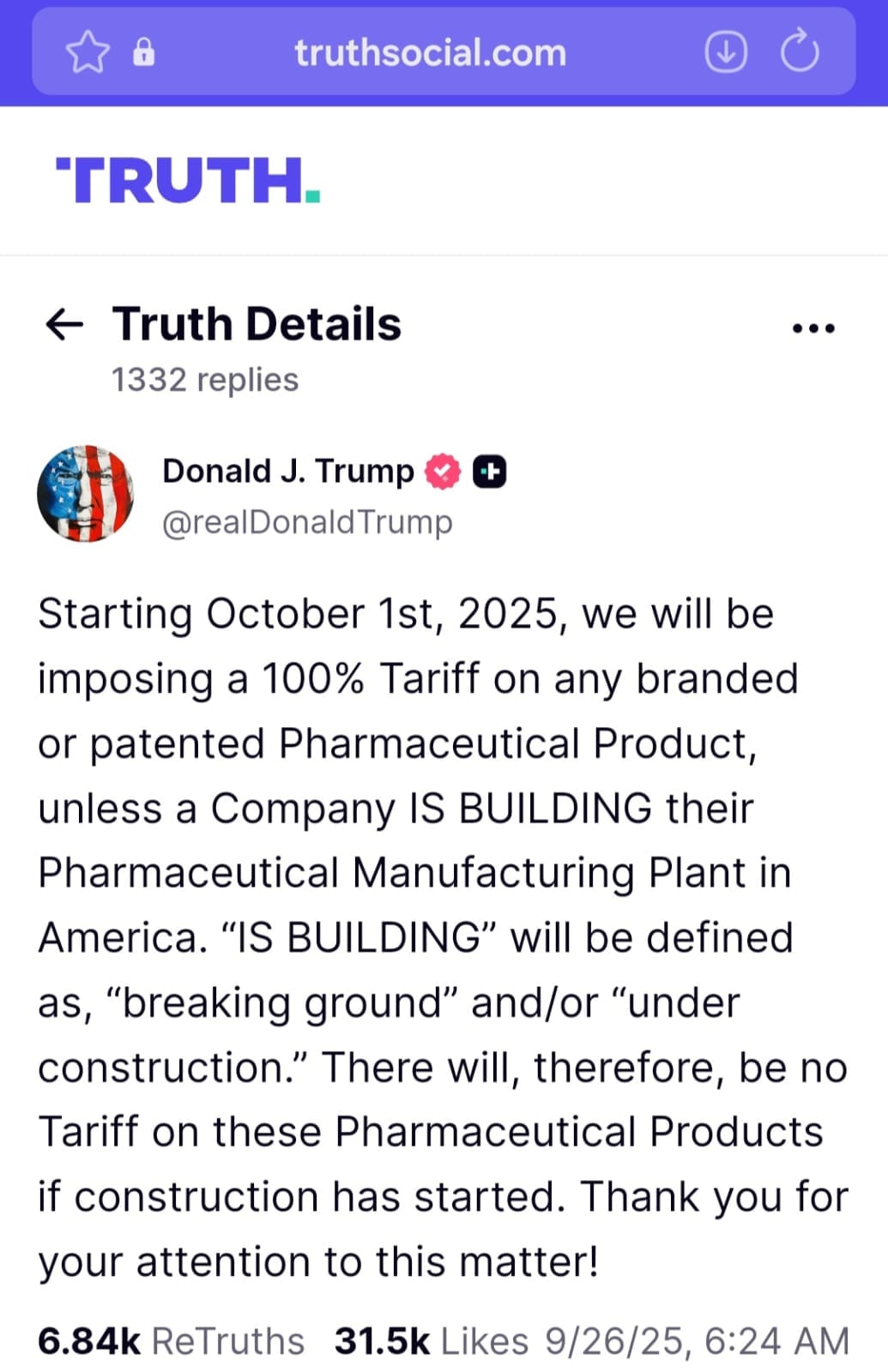
After imposing trade tariffs on dozens of countries in August, US President Donald Trump has set new import tariffs per product. Starting October 1, imports of pharmaceutical products to the US will be subject to a 100% tariff and household products and furniture to 50%.
The new tariff policy announced by President Donald Trump through his personal Truth Social account needs to be anticipated by related industry players.
"Starting October 1, 2025, we will impose a 100% tariff on any branded or patented pharmaceutical product, unless the company is building a pharmaceutical plant in America," Trump wrote on his Truth Social account on Thursday (25/9/2025).
In addition, the rates for kitchen cabinets and bathroom vanities have also increased by 50%. As for upholstered furniture, the rate is 30%.
Trump took this step because many products from other countries enter the United States on a large scale, while he wants an influx of investment to build factories in the US.
"We will impose a 50% tariff on all kitchen cabinets, bathroom vanities, and related products, starting October 1, 2025. In addition, we will impose a 30% tariff on upholstered furniture," Trump continued.
The United States will also impose a 25% tariff on all heavy trucks manufactured in other countries. According to Donald Trump, this is his attempt to protect US heavy truck manufacturers and national security.
Tariff impact
The imposition of additional tariffs certainly has the potential to negatively affect Indonesia's export performance to the United States in the near future, especially in the furniture sector.
So, Chairperson of the Indonesian Employers Association (Apindo) Shinta Kamdani regretted the US tariff escalation that continues to this day. She explained that additional tariffs on furniture products will put additional pressure on the Indonesian furniture industry, more than 50% of whose exports are destined for the United States.
"In fact, even now the national furniture sector has been affected by the decline in demand from the US since the introduction of reciprocal tariffs. So this additional tariff will certainly disrupt the sector's performance in the future," Shinta explained.
Apindo is also currently designing a strategy to deal with the new tariffs, including coordinating with the government to see how far Indonesia can get an exemption from the applicable tariff escalation rules.
In addition, businesses will also coordinate with buyers in the United States to create solutions to existing policies.
"We will also look into the extent to which options such as near-shoring or doing assembly or finishing in the US or nearby US markets can be an option for lower tariffs for Indonesian furniture products exported to the US," he continued.
Shinta also emphasized that the government needs to find a way out of the policy in bilateral negotiations. Thus, Indonesian exporters can continue to export their products to the US market with a definite tariff and not continue to increase.
"Government support in terms of economic diplomacy and stimulus for affected industries is much more needed in the short term to mitigate the negative effects of these tariffs on the national industry," he concluded.
In line with Shinta, Chairman of the Indonesian Furniture and Handicraft Industry Association (HIMKI) Abdul Sobur sees the additional tariff policy as not only a tough challenge for the Indonesian furniture industry that has the potential to shake up its position in the US market, but also a call for strategic transformation.
"We are promoting mitigation efforts such as market diversification and value-added product development. We also encourage active dialogue with the government so that there is strong trade diplomacy in order to get an exemption or postponement of this tariff," Abdul said.
HIMKI also continues to encourage businesses to improve the efficiency and innovation of their product designs to remain competitive.
Abdul explained that the United States is the largest export market for Indonesian furniture. Although, nominally, Indonesia's market share in the US furniture sector is relatively small, which is less than 5% for various categories of furniture products affected by tariffs.
He also mentioned that the decline in market share has occurred since 2022 due to fierce competition from Vietnam, Mexico, and also China, which have better cost and quality competitiveness. This condition has the potential to reduce export volumes, causing great pressure for business actors, especially labor-intensive micro, small and medium enterprisesUMKM) that have thin margins.
"This means that dependence on the US is still high but our position has been pushed, and this new tariff could worsen the condition," he explained.
A number of efforts have also been made by HIMKI after the news of the tariff increase, such as market diversification, product restructuring, and the use of e-commerce for business to business and business to consumer.
HIMKI will further endeavor to reduce dependence on the US by expanding exports to Europe, Australia, the Middle East, India, and also Africa. In addition, it will prepare products in semi knock-down or flat pack form to be assembled in countries that have trade agreements with the US such as Mexico to avoid high tariffs.
Furthermore, HIMKI sees this additional tariff as a fitting momentum to improve the quality and strengthen the branding of sustainable products and distinctive Indonesian designs that have unique value.
"If the transformation and diversification strategy goes well, Indonesia's competitiveness can recover and upgrade from the volume segment to the premium segment," he said.
Indonesia, according to Abdul, must be able to take advantage of this opportunity to accelerate industrial transition, optimize multilateral and bilateral cooperation, strengthen Indonesia's sustainable furniture industry ecosystem, and diversify export markets aggressively.
"Indonesia has the potential to not only survive protectionist tariffs, but also become a resilient, highly competitive and sustainable global player in the world furniture industry," he concluded.
Permata Bank Chief Economist Josua Pardede said that the policy will have an impact on price increases in the US market for goods subject to new tariffs.
"Policy design uncertainty and a short transition period risk delaying investment and new trade contracts, which in macro terms is likely to be growth suppressive," he added.
The new policy is said to increase the probability of countermeasures from other countries or policy adjustments, although some partners of the United States - such as the European Union and Japan - prefer the negotiation route first.
In the short term, the policy could potentially weaken new orders in the coming months, as buyers in the United States will either postpone purchases or look for alternative suppliers with lower tariffs.
"For branded drugs, Indonesia's exports to the US are relatively small, so the direct effect is very limited. For heavy trucks, Indonesia's exports to the US are also insignificant," said Josua.
The sectors most affected by the policy are wooden and upholstered furniture. Businesses such as those in Jepara, Cirebon, Sukoharjo, and Pasuruan could potentially face order delays, price pressures, and redesign requests.
"The biggest exposure is to upholstered products and wooden kitchen cabinets. Trade data shows the US imported more than US$60 million-US$70 million per year of wooden cabinets from Indonesia before the new tariffs, so these items are most sensitive to a 50% duty increase," he said.
Meanwhile, in the pharmaceutical sector, the direct impact on Indonesia is considered small. However, foreign drug companies are being forced to accelerate plant construction in the United States, which could shift raw material supply lines and manufacturing contracts, so pharmaceutical factories in Indonesia need to prepare for changes in suppliers and even quality standards.
"Heavy trucks, Indonesia's exports to the US for this category are negligible, so the direct impact is small. Downstream, some automotive component suppliers may be affected if global brands reorganize supply chains to US plants," he continued.
Strong cooperation is needed in Indonesia involving businesses and the government to address these policies and improve Indonesia's competitiveness. The Indonesian government has also designed a number of measures and coordinated with all relevant parties.
Prepare mitigation
Haryo Limanseto, Spokesperson for the Coordinating Ministry for Economic Affairs, said that his office has received information regarding the policy which will take effect soon. Further mitigation efforts are also being sought.
"The implementation of the new sectoral tariff policy will affect the products of all countries including Indonesia. However, the impact is being mitigated further. The government is currently still conducting intensive negotiations with the US government regarding reciprocal tariffs. Indonesia proposes further tariffs for products that are not naturally produced in the US," Haryo said.