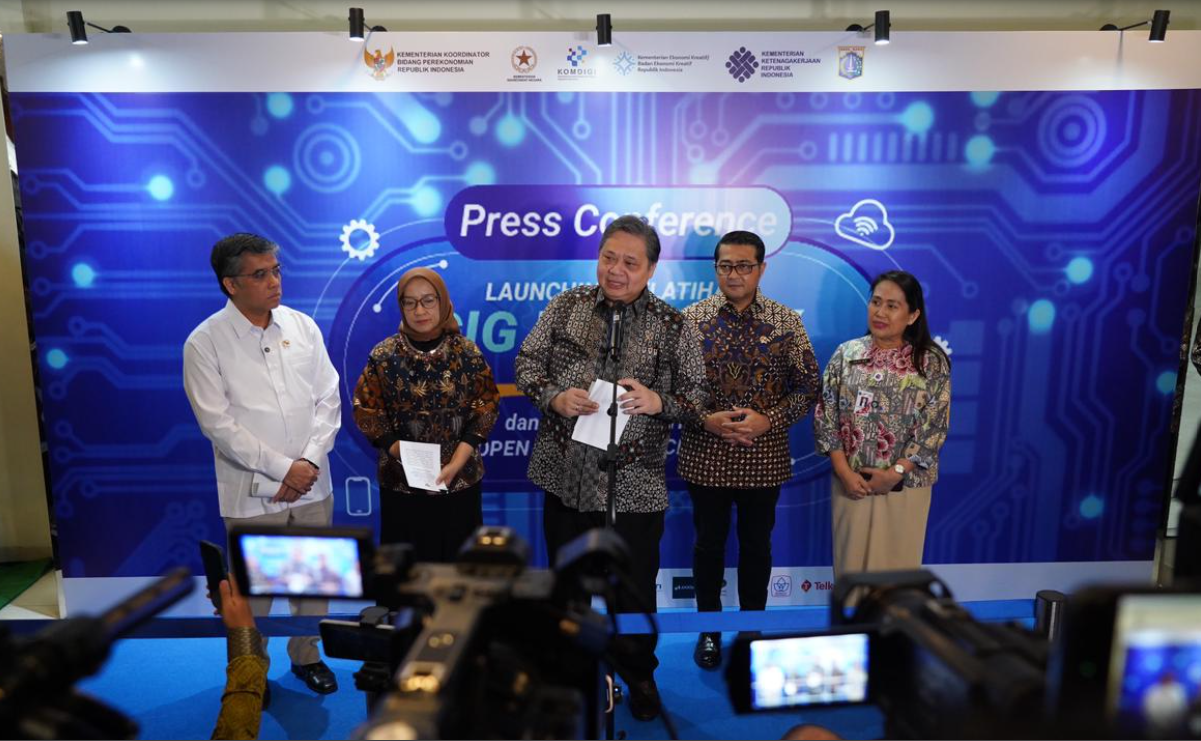


The meeting of the working committee of the Manpower Bill of Commission IX of the House of Representatives on Tuesday (23/9/2025) opened the opportunity to revise the Law on Manpower. What are the aspirations of laborers and employers?
Labor welfare and protection were discussed again after Commission IX of the House of Representatives held a working meeting with 22 labor unions in Jakarta last Tuesday. The agenda of the meeting was to capture the aspirations of workers in preparation for the third amendment to Law Number 13 of 2003 concerning Manpower. Therefore, labor protection regulations not only reflect the fulfillment of workers' welfare, but also the interests of the business world.
However, more than just accommodating the interests of the two parties, the transparency and accountability of the legislative process must still take into account the health of the business climate. Efforts to fulfill labor regulations do not reduce business competitiveness in the midst of fierce global competition.
The formulation of the new labor law is a follow-up to the Constitutional Court's decision that declared 21 norms in Law Number 6 of 2023 on Job Creation unconstitutional, and ordered the President and the House of Representatives to form a new labor law no later than two years after the verdict was issued on October 31, 2024.
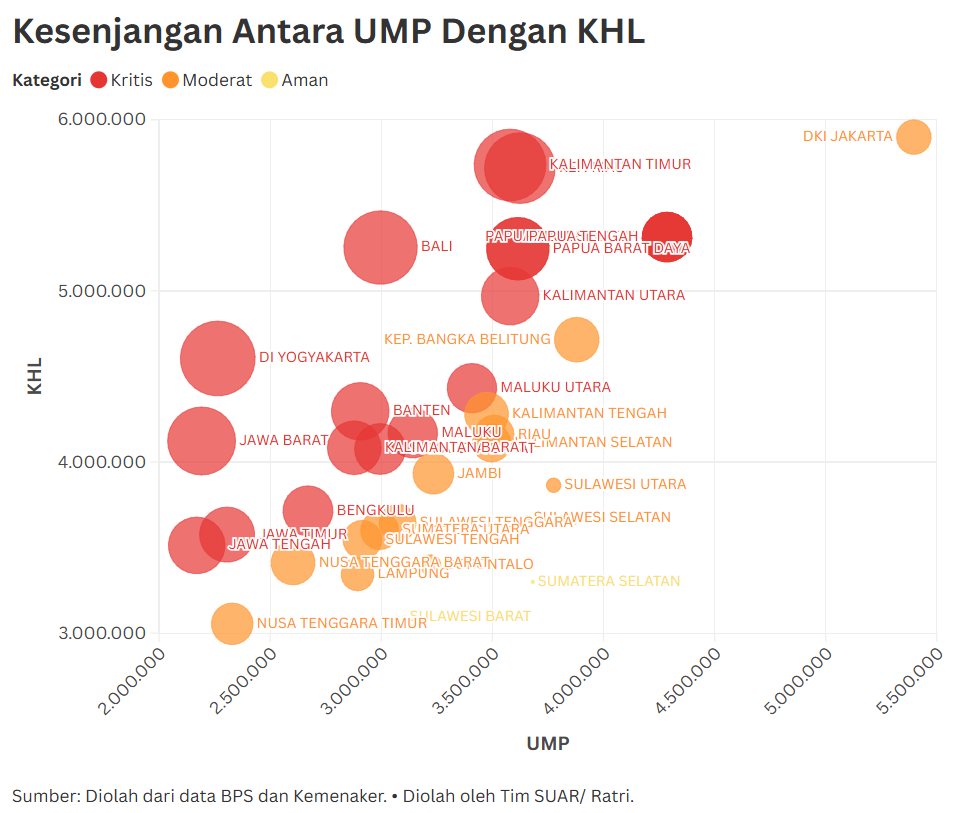
A number of agendas discussed at the working meeting included the calculation of a minimum wage based on decent living needs (KHL), which includes clothing, food, shelter, recreation, and old-age social security. Wage increases are not only based on the calculation of inflation and economic growth.
In addition, trade unions also voiced the establishment of sectoral minimum wages; automatic appointment of short-term contract employees to employees with indefinite term employment agreements (PKWTT) after two years of work; protection of vulnerable workers; and labor inspection.
President of the Confederation of Indonesian Trade Unions (KSPI) Said Iqbal stated that the need to form a new labor law is not only based on the Constitutional Court's order, but also following thelabor law reform that is currently taking place around the world. However, Iqbal did not deny that KSPI refused to attend yesterday's meeting.
"We refuse because there are so many unions invited, what do they want to hear? Only unions that have concepts and prepare ideas should come and be invited to the DPR, so that the discussion is sharper," Iqbal explained at a Labor Party press conference in Jakarta, Wednesday (24/9/2025).
Instead, KSPI has sent a letter to request a hearing with the DPR on Tuesday, September 30, 2025. Iqbal stated that the hearing will be held in conjunction with massive labor actions throughout Indonesia to voice the acceleration of the ratification of the new labor law.
"Minimum wages must have sectoral differences between industries because the weight of added value between the textile, automotive and mining industries is different. In addition, following the revision of Government Regulation Number 35 of 2021, we demand the abolition ofoutsourcing," he said.
Not only demanding, KSPI also invites workers to support fiscal policy changes launched by Finance Minister Purbaya Yudhi Sadewa, ranging from the rejection of tax amnesty to reforming the lower threshold of non-taxable income (PTKP) from Rp 4,500,000 to Rp 7,500,000 per month.
"If the PTKP limit rises, workers can have savings. From that savings, we can spend because purchasing power rises. As a result, household consumption rises, the economy grows, jobs open up, and there are no layoffs. That is simple logic, and Minister Purbaya has accepted it," concluded Iqbal.
Legislative votes
Deputy Chairperson of Commission IX of the House of Representatives Nihayatul Wafiroh emphasized the importance of protection aspects in the revision of labor-related laws. This is considering that the DPR has passed Law Number 18 of 2017 concerning the Protection of Indonesian Migrant Workers. Thus, not only migrant workers, workers in the country must also get the protection aspects regulated in the revision of the law.
"If later the results of this review turn out to be more than 80% changed, of course it will become a new law. I agree if the name becomes the Worker Protection and Welfare Act, because the word 'protection' is appropriate and we must continue to fight for it," said Nihayatul in a meeting of the Working Committee on the Manpower Bill of Commission IX of the House of Representatives with workers/labor organizations in Indonesia on Tuesday.
He also highlighted the importance of law enforcement, especially regarding the registration of workers in the BPJS Employment program. According to him, many companies do not register all their employees, so workers lose their protection rights.
In addition, Nihayatul emphasized the importance of protection for young workers in new sectors such as startups. Although not under the umbrella of a formal company, these workers still organize and advocate.
He also supports strengthening the rules regarding the wage system. According to him, these rules must be outlined in the law in order to have stronger legal certainty. "I agree that the wage system should be placed in the law, so that the legal umbrella is stronger and not easily changed," he added.
Furthermore, Nihayatul emphasized that the revision of this law must accommodate all workers, not just those in formal companies. She emphasized that the discussion in Commission IX was conducted in an open and inclusive manner.
Regulations should include
The business world welcomes labor law reform as an important momentum for Indonesia to rebuild its industry. The condition is that the regulations formed must also include the interests of the business world to obtain a healthy and competitive climate.
Vice Chairman of the Indonesian Chamber of Commerce and Industry (Kadin) Subchan Gatot hopes that the new labor law can meet the needs of the business world regarding the simplification of rules that are attractive to investment, so that entrepreneurs can create jobs and provide legal certainty.
According to Subchan, the minimum wage, which is a major labor issue every year, must be resolved by reaching an agreement in principle between the government, workers, and employers.
"It must be remembered, the Constitutional Court's decision mandating KHL as the basis for minimum wages does not cancel Government Regulation Number 51 of 2023 concerning Wages, so consistency needs to be maintained so that it is easier to communicate," Subchan said when contacted by SUAR, Wednesday (24/9).
Subchan recognizes that workers are now well aware and understand the business climate is not good.
"The wage formula must be able to answer the issue of wage disparity between regions, while still providing room for dialog in its later determination," he explained.
Sharing his views with Subchan, Chairman of the Manpower Division of the Indonesian Employers Association (Apindo) Bob Azam assessed that the main need of the business world in labor regulations remains the consistency of regulations that ensure businesses remain competitive.
"Not like now the Government Regulation on Wages changes 4 times in 10 years and the omnibus law on Job Creation is replaced after two years of enactment. If it's like this, how are investors interested in the investment climate in Indonesia?" Bob asked when contacted by SUAR, Wednesday (24/9/2025).
To achieve this consistency, rule makers are expected to not only accommodate the interests of all parties in the country, but also make proportional and measurable comparisons with labor regulations from other countries, while still considering the Indonesian context in their formulation.
"Look at labor laws across Southeast Asia, are there any that are as rigid as Indonesia's? They are more flexible and competitive, so investment is easy to enter and jobs are available. The best protection for workers and job seekers is to provide decent work for them," Bob concluded.
Stay political
Legislators' efforts in capturing aspirations in the process of formulating the new labor law, in addition to maintaining representation and balance of interests, must also pay attention to important aspects that determine the successful implementation of this law.
Padang Wicaksono, a lecturer in labor economics at the University of Indonesia's Faculty of Economics and Business (FEB UI), reminded the importance of the new labor law to include the obligation of companies to conduct Mandatory Company Labor Reports (WLKP) to the Ministry of Manpower every year.
"The aim is to encourage company compliance in conducting labor planning, guidance and development," Padang told SUAR, Wednesday (24/9/2025).
In addition to these implementation points, Professor of Labor Law at the Faculty of Law, Universitas Gadjah Mada Ari Hernawan reminded that however, law is a political product that will not be neutral or sterile from political struggles.
"The politics of Indonesian labor law still wants to create labor that is economically cheap and politically obedient. Labor policy is directed at job security, not job security," Ari said in Yogyakarta, Thursday (28/8/2025).
With this legal philosophy in mind, the implementation and enforcement of the law need to be examined as an essential element in labor relations. To be an effective regulation, all parties involved must understand the spirit, purpose, philosophy, achievement indicators, impact on workers and employers, as well as the determination of sanctions and the effectiveness of the performance of the institutions involved in it.
"Do not be hasty, because the result will be superficiality that does not bring together the interests of workers and employers in one formula," Ari concluded.